

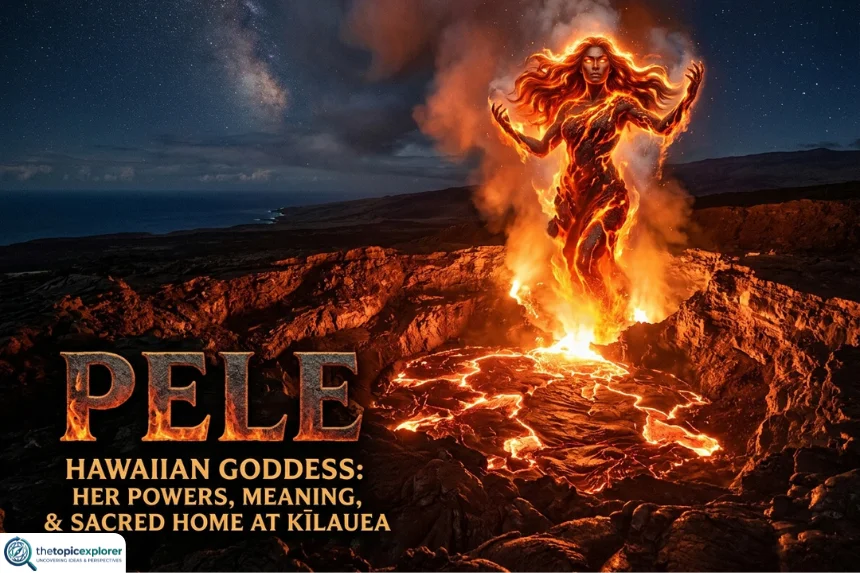

The Pele Hawaiian goddess commonly appears in English-language descriptions as the goddess of fire, lava, and volcanoes. However, that short definition does not fully express her place in Hawaiian culture. Pele, also called Pelehonuamea, is a Hawaiian akua associated with volcanic activity, the creation of new land, and the destruction or transformation of existing landscapes.
Hawaiian traditions place her home at Halemaʻumaʻu, a crater within Kaluapele, the summit caldera of Kīlauea on Hawaiʻi Island. Moreover, Pele is not merely a character from an old story. The National Park Service explains that many Hawaiians continue to regard her with respect, while some families in Puna and Kaʻū understand her as ʻohana or an ʻaumakua, a family Pele Hawaiian goddess or deified ancestor.
Quick answer: Pelehonuamea is the Hawaiian volcano deity associated with lava, volcanic fire, and the forces that create and reshape land. Although she is often called the Hawaiian goddess of fire, her role includes both creation and destruction. Hawaiian traditions identify Halemaʻumaʻu at Kīlauea as her home, and she remains culturally and spiritually significant for many Native Hawaiians today.
Pele Hawaiian Goddess Quick Facts
| Question | Evidence-based answer |
|---|---|
| Who is Pele? | A Hawaiian akua associated with volcanoes, lava, fire, and land formation |
| What is her full name? | Pelehonuamea |
| What does Pelehonuamea mean? | Commonly translated as “Pele of the red earth” |
| What else is she called? | Peleʻaihonua, “Pele the eater of the land,” and ka wahine ʻai honua, “the earth-eating woman” |
| Where does Pele live? | Halemaʻumaʻu at the summit of Kīlauea on Hawaiʻi Island |
| What are her main powers? | Volcanic fire, lava, eruption, creation of land, destruction, and transformation |
| Is Pele only destructive? | No. Lava destroys existing places but also cools and forms new land |
| Where did she come from? | Many traditions say she came from the distant ancestral homeland of Kahiki |
| Does Pele have one fixed genealogy? | No. Hawaiian sources preserve several genealogical traditions |
| Is Pele still honoured today? | Yes. She remains culturally and spiritually important for many Hawaiians |
| What are kino lau? | The multiple natural or bodily forms through which an akua may be present |
| Is lava one of Pele’s forms? | Yes. Hawaiian cultural sources identify lava and volcanic forces among her manifestations |
These facts draw primarily from the National Park Service, the University of Hawaiʻi’s Kahoʻiwai resource, and the U.S. Geological Survey. Together, those sources describe Pele as a volcano deity, a force of creation, and a presence deeply connected with the Hawaiian landscape.
Pele Hawaiian Goddess: Who Is She?
Pele is one of the most widely recognised akua in Hawaiian traditions. English-language sources often call her the goddess of fire or the goddess of volcanoes. Nevertheless, the National Park Service uses the broader description Hawaiian volcano deity and elemental force.
That wording matters because Pele does not simply stand Pele Hawaiian goddess outside a volcano and command it. Instead, Hawaiian cultural descriptions connect her directly with lava, eruptions, volcanic landscapes, and the movement of molten earth.
The National Park Service states that Pele is embodied by lava and the natural forces Pele Hawaiian goddess associated with volcanic activity. Similarly, the University of Hawaiʻi explains that Hawaiian thought does not always separate the akua Pele from the lava and volcanoes connected with her.
Therefore, Pele can be understood through several connected roles:
- A volcanic deity
- An elemental force
- A creator of land
- A destroyer and transformer of existing landscapes
- A figure within Hawaiian genealogies
- A central presence in moʻolelo, oli, mele, and hula
- A culturally significant member of the divine Hawaiian family
- An ancestral or familial presence for some Hawaiian families
Calling her the Pele Hawaiian goddess of fire may help new readers identify the subject. However, the full article should explain that her cultural meaning extends beyond fire alone.
What Does Akua Mean for the Pele Hawaiian Goddess?
The Hawaiian word akua is commonly translated into English as god, goddess, deity, or divine being. However, no single English word communicates every Hawaiian cultural meaning attached to it.
For a general U.S. audience, the article can introduce Pele as a Hawaiian goddess and then explain that Hawaiian institutional sources also call her an akua or elemental deity.
This wording avoids two problems.
First, it does not make the subject unnecessarily difficult for readers searching for “Pele Hawaiian goddess.” Second, it does not force Pele into a purely European model of a goddess who rules one separate department of nature.
A useful description is:
Pele is a Hawaiian akua whose presence and power are expressed through volcanoes, molten lava, fire, and the continuing creation of the Hawaiian landscape.
The University of Hawaiʻi identifies Pele as an akua wahine, or female deity. Meanwhile, the National Park Service describes her as an elemental force embodied by volcanic activity.
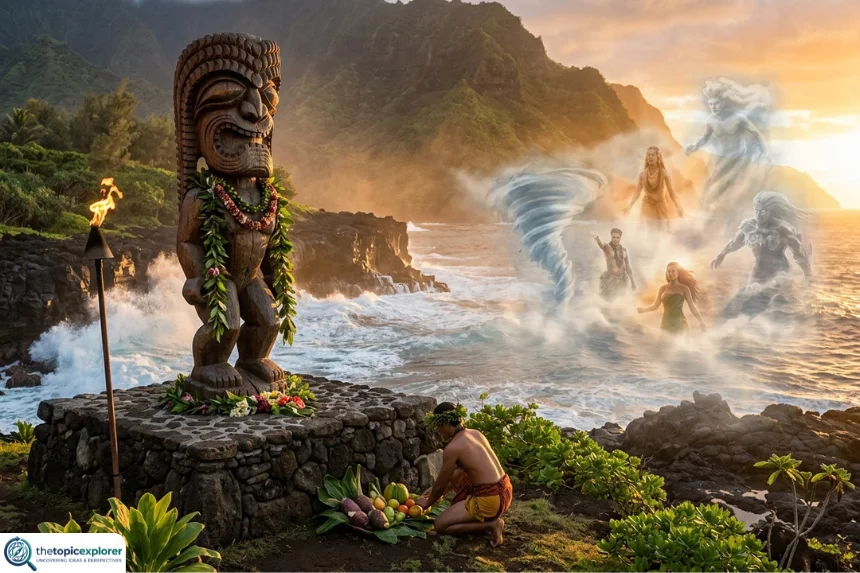
What Is the Pele Hawaiian Goddess Known For?
Pele is most strongly associated with:
- Volcanoes
- Molten lava
- Volcanic fire
- Eruptions
- Craters and volcanic pits
- Earthquakes and the movement of volcanic land
- The creation of new land
- The destruction of existing landscapes
- Renewal and environmental transformation
However, describing her as the goddess of “fire and Pele Hawaiian goddess volcanoes” should serve as an introduction rather than the complete answer.
Fire represents only one part of the volcanic process. Lava may burn and bury vegetation, roads, buildings, and earlier landforms. Nevertheless, Pele Hawaiian goddess after it cools, it becomes new rock and extends or reshapes the island.
Consequently, Pele represents an ongoing cycle:
- Molten material rises.
- Lava travels across the landscape.
- Existing land may be buried or transformed.
- The lava cools into solid rock.
- New land and future ecosystems gradually develop.
The National Park Service states that traditional Hawaiian chants describe Pele’s kuleana, or function and responsibility, as creating new land while destroying what previously existed.
Pele Hawaiian Goddess as Creator and Destroyer
Popular summaries often emphasise Pele’s temper, danger, and destructive power. However, such descriptions leave out her role as a creator.
A lava flow may destroy a forest or cover a human settlement. From that viewpoint, Pele represents danger, loss, and immense natural power.
At the same time, lava becomes the physical foundation of land. Every Hawaiian island owes its existence to volcanic processes. Therefore, destruction and creation cannot be separated easily in Pele’s story.
The National Park Service describes her as Pele Hawaiian goddess both destructive and creative. Likewise, its Haleakalā cultural resource explains that Pele may destroy everything in her path, yet she also creates land.
This dual role gives Pele deeper meaning than the stereotype of an “angry fire goddess.” She embodies:
- Change that cannot be stopped
- Destruction that makes future growth possible
- The power of land to renew itself
- The relationship between people and an active volcanic environment
- Respect for forces that humans cannot fully control
Therefore, Pele is neither purely benevolent Pele Hawaiian goddess nor purely destructive. Instead, she represents the complete volcanic process and its ability to transform the world.
Pele Hawaiian Goddess Name and Meaning
Pelehonuamea is one of Pele’s most important names. The National Park Service translates it as “Pele of the red earth.”
The name connects Pele with the colour, heat, and physical appearance of molten or newly formed volcanic ground.
Another name is Peleʻaihonua, translated by the National Park Service as “Pele the eater of the land.” This title describes lava moving across and covering the existing landscape.
The University of Hawaiʻi also records several descriptive titles:
| Hawaiian title | English explanation |
| Ka wahine ʻai honua | The earth-eating woman |
| Ka wahine o ka lua | The woman of the pit |
| Ka wahine malihini | The foreign or visiting woman |
| Ka wahine o ka ʻaʻahu keʻokeʻo | The woman of the white garment |
These names should not be treated merely as decorative nicknames. Instead, they preserve information about Pele’s power, appearance, movements, and relationship with particular places.
Does the Pele Hawaiian Goddess Have Other Names?
No. Hawaiian traditions use multiple Pele Hawaiian goddess names and titles for Pele.
Different names may highlight:
- Her connection to red volcanic earth
- Her ability to consume existing land
- Her home within a volcanic pit
- Her journey from another homeland
- Her appearance in different forms
- Her relationship with specific communities or landscapes
Therefore, the article should not claim that “Pele” is incorrect or that “Pelehonuamea” is the only acceptable name.
A clear approach is:
Pele is the commonly used name, while Pelehonuamea is an important fuller name meaning “Pele of the red earth.”
Where Does the Pele Hawaiian Goddess Live?
Hawaiian traditions identify Halemaʻumaʻu as Pele’s home.
Halemaʻumaʻu lies within Kaluapele, the summit caldera of Kīlauea volcano on Hawaiʻi Island. The U.S. Geological Survey describes it as the home of Pelehonuamea, the Hawaiian elemental force of creation appearing as red molten lava.
The National Park Service similarly states that Pele eventually reached Halemaʻumaʻu after travelling southeast through the Hawaiian Islands. From there, she is associated particularly with the districts of Puna and Kaʻū.
The relationship can be understood geographically:
| Place | Cultural importance |
| Hawaiʻi Island | The island where Pele eventually established her lasting home |
| Kīlauea | The volcano most closely associated with Pele |
| Kaluapele | Kīlauea’s summit caldera |
| Halemaʻumaʻu | The crater traditionally identified as Pele’s home |
| Puna and Kaʻū | Districts closely connected with Pele’s presence and traditions |
Consequently, referring vaguely to Pele as living “inside a Hawaiian volcano” loses important place-based meaning. Halemaʻumaʻu and Kīlauea should be named directly.
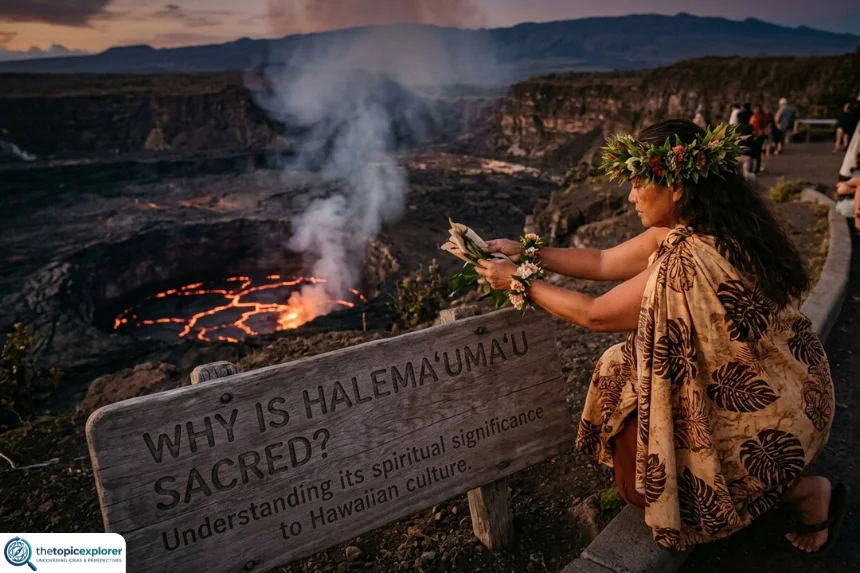
Why Is Halemaʻumaʻu Sacred to the Pele Hawaiian Goddess?
Halemaʻumaʻu is more than a geological feature in Hawaiian culture. It is a wahi connected with Pele’s presence, genealogy, moʻolelo, and continuing cultural practices.
The National Park Service describes Uēkahuna, the summit region overlooking Kaluapele, as a cherished location used for Native Hawaiian cultural practices honouring Pelehonuamea.
Moreover, the park’s educational material calls Kīlauea a wahi kapu o Pele, or sacred place of Pele. It describes Pele as a sacred living deity of Hawaiʻi’s volcanoes and places her home at Halemaʻumaʻu.
Therefore, visitors should not treat the summit solely as:
- A dramatic photo location
- A source of souvenirs
- A theme-park attraction
- A place for invented ceremonies
- A backdrop for disrespectful entertainment
Scientific observation and visitor access can coexist with cultural respect. However, the sacred importance of the landscape should remain visible in any accurate explanation.
Is Kīlauea the Same as the Pele Hawaiian Goddess?
Kīlauea is a physical volcano studied through geology, seismology, chemistry, and other sciences. Pele is an akua within Hawaiian cultural and spiritual traditions.
Nevertheless, Hawaiian cultural sources do not always divide the deity, lava, and volcano into completely separate categories.
The University of Hawaiʻi explains that, within Hawaiian thought, Pele cannot necessarily be separated from the lava and volcanic environment associated with her. Meanwhile, the National Park Service describes lava as a form through which Pele is embodied.
Therefore, the article should avoid two oversimplifications:
Pele is merely another name for the physical volcano.
and:
Pele is a distant human-shaped goddess who controls a volcano from outside it.
A more culturally informed explanation is:
Pele’s presence is expressed through volcanic fire, lava, landforms, and the natural forces active at Kīlauea.
Pele Hawaiian Goddess Powers and Kino Lau
Kino lau refers to the many forms or physical manifestations associated with an akua.
The University of Hawaiʻi records several forms connected with Pele, including fire, volcanic pits, an older woman, and ʻōhiʻa lehua. Its summary also states that Pele has several kino lau associated with volcanoes.
The National Park Service identifies molten Pele Hawaiian goddess lava and volcanic rock as important forms of Pele’s presence. Its Haleakalā resource explains that the volcanic rocks are understood within Hawaiian culture as physical forms of Pele and that lava is among her kino lau.
Consequently, Pele should not be represented only through one imagined human portrait.
Her forms and manifestations may include:
- Molten lava
- Volcanic fire
- Volcanic rock
- Craters and pits
- A woman
- An older woman
- ʻŌhiʻa lehua
- Other aspects of the volcanic landscape
However, different sources and family traditions Pele Hawaiian goddess may emphasise different forms. Therefore, the article should not present a short list as universally complete.
What Does the Pele Hawaiian Goddess Look Like?
There is no single authorised visual portrait of Pele.
Artists have represented her in many ways, including:
- A young woman surrounded by fire
- An older woman travelling through the landscape
- A woman whose hair becomes molten lava
- A figure dressed in red or white
- Lava itself without a human figure
Nevertheless, artistic images reflect interpretation. They should not be presented as photographs or historically verified portraits.
This distinction matters because online articles often use modern paintings as though they show Pele’s fixed appearance. In reality, her meaning extends beyond one human form.
A respectful image caption would say:
An artist’s interpretation of Pelehonuamea, the Hawaiian volcano deity.
It should not say:
This is what the goddess Pele looked like.
Is the Pele Hawaiian Goddess a Mythological Figure?
Pele appears within Hawaiian moʻolelo, a word commonly translated as stories, histories, legends, or narratives.
However, calling Pele “mythological” can create Pele Hawaiian goddess misunderstanding when readers use the word myth to mean something false or imaginary.
Hawaiian moʻolelo can communicate:
- Genealogy
- Cultural values
- Relationships with the land
- Environmental observations
- Responsibilities between family members
- Historical memory
- Spiritual knowledge
- Explanations of place names and landforms
Therefore, the strongest wording uses terms such as:
- Hawaiian tradition
- Hawaiian moʻolelo
- Oral tradition
- Cultural narratives
- Sacred stories
- Genealogical traditions
The National Park Service also warns that moʻolelo have been passed down by many Hawaiians over long periods. As a result, different versions may vary significantly.
Is the Pele Hawaiian Goddess Still Honoured Today?
Yes. Pele should not be discussed only as part of an extinct ancient religion.
The National Park Service states that many Pele Hawaiian goddess Hawaiians revere Pele and regard her with respect rather than simply fear. Furthermore, some families in Puna and Kaʻū consider her ʻohana or an ʻaumakua.
Her continuing significance appears through:
- Family traditions
- Oli and mele
- Hula
- Cultural education
- Hawaiian-language resources
- Place-based practices
- Respect shown at volcanic landscapes
- Interpretive programmes in national parks
- Contemporary discussions about volcanic activity
Therefore, avoid writing:
Ancient Hawaiians believed that Pele lived at Kīlauea.
Use:
Hawaiian traditions identify Halemaʻumaʻu as Pele’s home, and she remains culturally significant for many Hawaiians today.
The second version recognises continuity instead of treating Hawaiian cultural knowledge as something that disappeared.
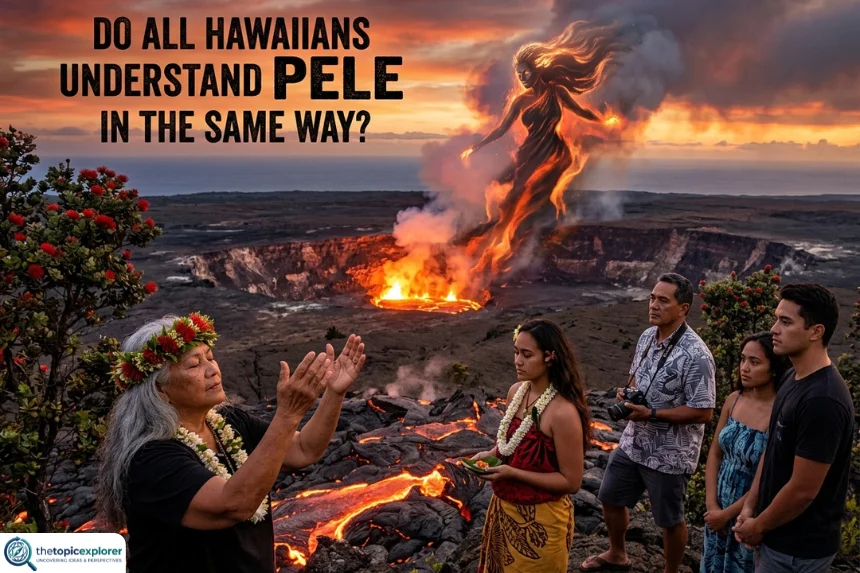
Do All Hawaiians View the Pele Hawaiian Goddess the Same Way?
No culture is completely uniform, and Hawaiian traditions about Pele are not limited to one fixed account.
The University of Hawaiʻi records several different genealogies for Pele. Some name Papa and Wākea as her parents. Others connect her with Haumea and Kūwahaʻilo, while another tradition names Kahinaliʻi and Kānehoalani.
Similarly, stories about her journey, family Pele Hawaiian goddess conflicts, relationships, and forms may differ according to:
- Family tradition
- Geographic region
- Hawaiian-language source
- Historical period
- Chanter or storyteller
- Published collection
- Cultural purpose
Therefore, the article should regularly use qualifying language such as:
- “In one widely told version…”
- “Some genealogies identify…”
- “According to this moʻolelo…”
- “Hawaiian traditions vary…”
- “One National Park Service account explains…”
This approach shows respect for the diversity of the source tradition.
How Does the Pele Hawaiian Goddess Relate to Volcanic Science?
Hawaiian cultural traditions and modern volcanic science use different forms of knowledge. However, they do not always need to be framed as opponents.
The U.S. Geological Survey reports that Pele Hawaiian goddess chants and oral traditions involving Pele and Hiʻiaka may preserve information about major periods of Kīlauea’s volcanic activity, including the long ʻAilāʻau eruption and the later formation of the summit caldera.
Moreover, USGS researchers have compared details in chants with mapped lava-flow paths. In some cases, the places and directions described in Hawaiian traditions align closely with geological evidence.
Therefore, the article should avoid saying:
Hawaiians invented Pele because they did not understand volcanoes.
A more accurate interpretation is:
Pele traditions carry cultural, genealogical, and environmental knowledge shaped by generations of living with active volcanoes.
Geology explains physical processes such as magma movement, eruptions, lava chemistry, and caldera formation. Meanwhile, moʻolelo communicate human relationships, responsibilities, memories, and meanings connected with those processes.
Why Respectful Language About the Pele Hawaiian Goddess Matters
Articles about Pele often repeat stereotypes:
- The angry volcano goddess
- The jealous fire woman
- The goddess who curses tourists
- A fictional explanation for eruptions
- A character created for visitor entertainment
Although some stories include anger, conflict, or punishment, those elements do not define Pele completely.
A stronger article recognises her as:
- Creator and destroyer
- Family member and ancestor
- Keeper of volcanic fire
- Traveller from Kahiki
- Presence within lava and volcanic land
- Subject of varied genealogies
- Central figure in Hawaiian cultural knowledge
Most importantly, the article should not Pele Hawaiian goddess claim to speak for every Native Hawaiian person. Instead, it should attribute explanations to specific Hawaiian, institutional, and scholarly sources.
What Does the Pele Hawaiian Goddess Represent?
Pele represents more than volcanic danger.
Her broader meanings include:
Creation
Lava cools and becomes new land. Therefore, Pele participates in the physical formation and expansion of Hawaiʻi.
Destruction
Eruptions can bury forests, roads, homes, and earlier landscapes. Consequently, her presence can involve real danger and loss.
Transformation
The land does not remain fixed. Pele represents change that reshapes both natural environments and human communities.
Responsibility
The concept of kuleana connects power with responsibility. Stories about Pele often explore how strength should be governed and respected.
Genealogy
Pele belongs to a divine family whose relationships connect ocean, fire, forests, rain, voyaging, and other parts of the Hawaiian environment.
Living culture
Pele remains meaningful through language, story, ceremony, family knowledge, and relationships with volcanic places.
The Most Accurate Pele Hawaiian Goddess Description
A concise but culturally informed description is:
Pelehonuamea is the Hawaiian akua of volcanoes and an elemental force embodied through lava, fire, and volcanic landscapes. She creates new land while transforming or destroying what existed before, and Hawaiian traditions identify Halemaʻumaʻu at Kīlauea as her home.
This sentence is more accurate than describing Pele only as an angry goddess of fire.
Pele Hawaiian Goddess Journey From Kahiki to Hawaiʻi
Many Hawaiian traditions say that Pele came from Kahiki, a distant ancestral homeland across the ocean. However, moʻolelo about her departure, travelling companions and conflicts do not appear in one universally fixed form.
In one version retold by the National Park Service, Pele’s parents recognised that she would become a woman of immense mana, or power. Because conflict developed between Pele and her older sister Nāmakaokahaʻi, the family instructed Pele to search Pele Hawaiian goddess for a new home where her volcanic fire could endure.
Pele did not travel alone. According to this account, members of her divine family accompanied her aboard a voyaging canoe called Honuaiakea. Moreover, she carried her youngest sister, Hiʻiakaikapoliopele, in the form of an egg during the journey.
The story combines:
- Voyaging knowledge
- Family responsibility
- Migration
- Fire and ocean
- The movement of volcanic activity
- The search for a permanent home
- Relationships among the Hawaiian Islands
Therefore, Pele’s journey should not be reduced to a simple adventure tale. It carries cultural, environmental and genealogical meaning.
Who Helped the Pele Hawaiian Goddess Reach Hawaiʻi?
Pele’s older brother Kamohoaliʻi plays an important role in several traditions.
The University of Hawaiʻi’s Kahoʻiwai resource describes Kamohoaliʻi as a renowned ancestral shark deity and the navigator who guided Pele and her ʻohana from Kahiki to Hawaiʻi. He can take both shark and human forms. Furthermore, a cliff at Kīlauea carries his name and is associated with the affection between Pele and her brother.
Kamohoaliʻi’s role adds another dimension to the Pele Hawaiian goddess journey. Pele possesses volcanic power, but reaching Hawaiʻi also requires navigation, ocean knowledge and family cooperation.
| Family member | Role in the journey |
|---|---|
| Pele | Leads the search for a place where her fire can remain |
| Kamohoaliʻi | Navigates Pele and her family from Kahiki |
| Hiʻiaka | Travels with Pele in the form of an egg in one tradition |
| Nāmakaokahaʻi | Pursues Pele and extinguishes the fires she attempts to establish |
| Other siblings | Support the family’s movement and appear in different versions of the moʻolelo |
Consequently, the migration story belongs to a wider divine family rather than to Pele alone.
How the Pele Hawaiian Goddess Found Her Permanent Home
One National Park Service version describes Pele travelling through the islands and repeatedly digging into the earth to establish her volcanic fire.
She first attempted to create a home on Kauaʻi. However, Nāmakaokahaʻi discovered the glow of the fire and forced Pele’s family to leave. Pele then Pele Hawaiian goddess continued through Oʻahu, Molokaʻi and Maui before finally reaching Hawaiʻi Island.
At each stage, water threatened or extinguished Pele’s fires. Therefore, she continued southeast until she found a volcanic environment capable of supporting her power.
After reaching Hawaiʻi Island, Pele travelled towards Kīlauea. She tested the ground with her digging stick, Pāoa, and received favourable signs. Consequently, she selected Halemaʻumaʻu as her permanent home.
The Island Sequence and Volcanic History
The journey moves broadly from the older northwestern islands towards the younger, volcanically active island of Hawaiʻi. The National Park Service notes that Pele’s migration mirrors the geological formation of the Hawaiian island chain.
Similarly, a U.S. Geological Survey publication observes that the progression in the traditional story corresponds with the relative geological ages of the islands.
However, the article should not claim that moʻolelo are simply coded geology textbooks. Instead, they preserve cultural memory, genealogy, place relationships and observations of the environment through a Hawaiian framework.
Why the Pele Hawaiian Goddess Journey Matters
The journey explains where Pele came from and how she reached Kīlauea. Nevertheless, it also explores several broader ideas.
Power Requires a Suitable Place
Pele cannot establish her fire everywhere. She must continue searching until she reaches a landscape where her power can remain.
Migration Changes Identity
Pele begins as a traveller from Kahiki. Eventually, however, she becomes Pele Hawaiian goddess inseparable from Kīlauea, Halemaʻumaʻu and the volcanic landscapes of Hawaiʻi Island.
Families Travel Together
Although conflict drives part of the story, family members also protect, teach, navigate and accompany one another.
Land and Story Are Connected
The moʻolelo names islands, craters, hills, cliffs and lava formations. Therefore, it places cultural memory directly within the landscape.
Most importantly, the journey shows why Pele cannot be understood Pele Hawaiian goddess solely as a distant supernatural figure. Her identity is rooted in particular places.
Pele Hawaiian Goddess and Nāmakaokahaʻi
Nāmakaokahaʻi is Pele’s older sister and an akua associated with the ocean. Their conflict is one of the most widely repeated parts of Pele’s story.
According to the University of Hawaiʻi, Nāmakaokahaʻi followed Pele as she searched for a home. Whenever Pele dug into the earth and attempted to establish a fire, her sister extinguished it. Eventually, the two met in a major confrontation at Haleakalā, where ocean and volcanic fire opposed one another.
A National Park Service version similarly describes Nāmakaokahaʻi pursuing Pele from island to island. In that telling, she destroys Pele’s physical body during a battle on Maui. Nevertheless, Pele continues in spiritual form and establishes herself on Hawaiʻi Island, beyond her sister’s ability to defeat her.
Their Conflict Is Not Simply “Two Jealous Sisters”
Commercial summaries often present the story as a family argument caused only by jealousy. However, that framing removes its environmental and cultural dimensions.
Pele and Nāmakaokahaʻi can also represent the interaction of:
- Lava and seawater
- Volcanic heat and ocean power
- Land formation and erosion
- Fire and flooding
- Sisters with competing responsibilities
- Natural forces that limit one another
When lava enters the ocean, fire and water visibly meet. Steam, hardened rock, collapsing shorelines and new coastal land may all result.
Therefore, the conflict can be understood as a relationship between powerful forces rather than a simple moral tale about one sister behaving badly.
Why Accounts of Pele and Nāmakaokahaʻi Differ
Sources preserve different locations and details surrounding their confrontation.
For example, the University of Hawaiʻi resource connects the destruction of Pele’s body with Kaʻiwiopele near Hāna. Meanwhile, the National Park Service version refers to broken volcanic formations in Kahikinui as the bones of Pele.
Similarly, one account describes Pele continuing towards Hawaiʻi Island after transcending her physical form, while another emphasises her spirit appearing through distant volcanic activity.
These differences do not necessarily mean that one account must be discarded. Hawaiian moʻolelo have passed through families, regions, chants, publications and generations. Consequently, place-based traditions may preserve distinct versions.
A culturally responsible article should say:
Different Hawaiian traditions describe Pele’s conflict with Nāmakaokahaʻi in different ways.
It should not claim:
Only one version is authentic, while every other version is incorrect.
Pele Hawaiian Goddess Family and Relationships
Pele’s family connects volcanic fire with other parts of the Hawaiian environment and cultural life.
| Relative | Cultural association | Relationship to Pele’s story |
| Nāmakaokahaʻi | Ocean | Pursues Pele and extinguishes her fires |
| Hiʻiakaikapoliopele | Healing, hula and renewed vegetation | Pele’s beloved younger sister and central figure in an epic journey |
| Kamohoaliʻi | Sharks, ocean voyaging and navigation | Guides Pele’s family from Kahiki |
| Lonomakua | Knowledge and the governing of fire | Teaches Pele how to create and maintain fire |
| Kapōʻulakīnaʻu | Supernatural power | Appears in family traditions and assists Pele in some accounts |
| Other Hiʻiaka sisters | Different responsibilities and natural forms | Accompany Pele and appear in major family conflicts |
The University of Hawaiʻi identifies Hiʻiaka, Nāmakaokahaʻi and Kapōʻulakīnaʻu among Pele’s sisters and Kamohoaliʻi and Lonomakua among her brothers or close divine relatives. However, genealogical relationships may vary across sources.
Therefore, a “Pele family tree” should be treated as a guide to one or more traditions—not as a fixed biological chart.
Pele and Lonomakua
The story of Pele and Lonomakua explains how Pele learned to govern fire.
According to the National Park Service, Lonomakua took the young Pele into a dark lava tube and taught her about the movements of the natural world. Their lessons included the sun, moon, ocean tides, clouds, winds, rain, freshwater, rock and soil. Only after receiving that wider environmental knowledge did Pele learn how to make fire.
Lonomakua created a spark by rubbing a hard pointed stick against softer wood. As the fire grew, Pele recognised that maintaining it would become her kuleana, or responsibility.
What This Moʻolelo Reveals About Pele
This story portrays Pele as more than a person born with uncontrolled destructive power.
Instead, she appears as:
- A student
- A receiver of inherited knowledge
- A careful observer of natural systems
- A person entrusted with responsibility
- A keeper rather than merely a user of fire
Furthermore, Lonomakua does not teach fire as an isolated element. He first explains water, weather, tides, rock and soil.
Therefore, the lesson suggests that governing fire requires an understanding of the entire environment around it.
Why Kuleana Is Central to Pele’s Power
The word kuleana can refer to responsibility, function, privilege and an area of authority.
In the Lonomakua story, fire is not simply a weapon or possession. Instead, it becomes a responsibility that Pele must maintain and govern.
This changes the interpretation of her power.
Pele’s volcanic force includes:
- The ability to create
- The ability to destroy
- The duty to sustain fire
- Knowledge inherited from elders
- Responsibility for how power affects the land
Consequently, the story challenges portrayals of Pele as reckless by nature. Some moʻolelo show anger and conflict, but others focus on training, knowledge and obligation.
Who Is Hiʻiakaikapoliopele?
Hiʻiakaikapoliopele, commonly called Hiʻiaka, is Pele’s youngest and most famous sister.
The University of Hawaiʻi records a tradition in which Hiʻiaka was born as an egg and carried close to Pele until she grew into a young woman. She is associated with healing and hula, while the palaʻā fern is identified as one of her kino lau.
Hiʻiaka’s name is often understood through her close connection with Pele. However, she has her own powers, relationships and responsibilities.
She is particularly associated with:
- Healing
- Hula
- Restoring life
- Vegetation
- Ferns and forest growth
- Loyalty
- Long-distance travel
- Overcoming dangerous beings
- Protecting companions
Therefore, she should not be described only as “Pele’s helper.”
Pele Hawaiian Goddess and Hiʻiaka Story
One of the most extensive Hawaiian narrative cycles concerns Pele, Hiʻiaka and Lohiʻau, a chief associated with Kauaʻi.
According to the National Park Service summary, Pele longed for Lohiʻau and asked one of her sisters to bring him from Kauaʻi to Kīlauea. The other sisters refused, but Hiʻiaka accepted the difficult task. Before leaving, she asked Pele to protect her treasured ʻōhiʻa groves and her beloved companion Hōpoe.
After a long journey, Hiʻiaka reached Kauaʻi and learned that Lohiʻau had died. Nevertheless, she used her abilities to retrieve his spirit and restore him to life. She then began the journey back to Hawaiʻi Island with him.
Pele’s Suspicion
The journey took longer than Pele expected. Consequently, she began to suspect that Hiʻiaka had betrayed her.
In anger, Pele burned Hiʻiaka’s cherished ʻōhiʻa groves and covered Hōpoe with lava. When Hiʻiaka returned and learned what had happened, the relationship between the sisters broke down.
Pele then killed Lohiʻau after seeing him embrace Hiʻiaka at Kīlauea. In response, Hiʻiaka attempted to reach the groundwater beneath the crater and extinguish Pele’s volcanic fire. However, she stopped before completing the act, and the sisters eventually reconciled in the National Park Service version.
Themes in the Pele and Hiʻiaka Story
The story contains many themes, including:
Loyalty and Broken Promises
Hiʻiaka accepts a difficult journey for Pele. Meanwhile, Pele promises to protect what her sister values. The conflict begins when trust collapses.
Healing and Destruction
Hiʻiaka restores Lohiʻau to life. In contrast, Pele destroys forests and takes life through volcanic fire.
Love and Jealousy
Romantic attachment creates tension, but the story also explores love between sisters, companions and communities.
Forest and Lava
Hiʻiaka is strongly connected with vegetation and renewed growth. Pele represents the volcanic forces that cover existing forests.
Restraint
Although Hiʻiaka reaches the point where she could release water and extinguish Pele’s fire, she does not complete the destruction.
Consequently, the story is not simply about which sister wins. It considers how anger can threaten family, land and responsibilities shared across generations.
Did the Pele and Hiʻiaka Story Preserve Volcanic History?
Researchers have examined whether the Pele–Hiʻiaka narrative preserves memories of major eruptions and changes at Kīlauea.
The U.S. Geological Survey reports that parts of the oral tradition may relate to the approximately 60-year-long ʻAilāʻau eruption during the 15th century and the later development of Kīlauea’s caldera. Geological studies support the central sequence preserved in the traditions, although researchers do not treat every narrative element as a literal scientific measurement.
Furthermore, USGS research has compared place names and directions in Hawaiian chants with mapped lava flows. In some cases, the movements described in the chants closely follow geological evidence on the landscape.
Therefore, the moʻolelo can carry:
- Cultural meaning
- Genealogical knowledge
- Memories of eruptions
- Place-based observations
- Environmental change
- Community responses to volcanic activity
This evidence also challenges the idea that oral traditions are valuable only as entertainment.
Hiʻiaka and the Return of Vegetation
Hiʻiaka’s healing role extends beyond people.
A U.S. Geological Survey discussion explains that Native Hawaiian traditions associate Hiʻiaka with the re-greening of landscapes after eruptions and storms. New plants eventually colonise areas covered by volcanic deposits, beginning the long process of ecological recovery.
This relationship creates a meaningful contrast:
| Pele | Hiʻiaka |
| Lava and volcanic fire | Healing and vegetation |
| Burial of existing landscapes | Re-growth on transformed land |
| Creation of new rock | Return of plant communities |
| Rapid environmental change | Gradual ecological recovery |
However, these forces should not be treated as permanent enemies. They belong to the same landscape cycle.
Pele creates new volcanic ground. Later, plant life returns, and Hiʻiaka’s restorative associations become visible.
Pele and Kamapuaʻa
Kamapuaʻa, whose name is often translated as “hog-child,” is a powerful shape-shifting figure associated with pigs, rain, forests and vegetation.
In one National Park Service account, Kamapuaʻa travels to Kīlauea and begins chanting to Pele. The two exchange insults, and their disagreement grows into a major battle.
Pele calls upon volcanic fire, gas and molten rock. Meanwhile, Kamapuaʻa receives help through heavy rain, which fills the volcanic pit and suppresses the flames. He also takes forms connected with forests and ferns, including the ʻamaʻu fern.
Neither side gains a permanent victory in this NPS version. Instead, the struggle continues as fire, rain and vegetation push against one another.
What Does the Pele and Kamapuaʻa Conflict Represent?
The conflict connects opposing but interdependent environmental forces:
| Pele | Kamapuaʻa |
| Volcanic heat | Rain and moisture |
| Lava fields | Forests and ferns |
| Dry volcanic ground | Wet environments |
| Fire-driven transformation | Plant growth and water |
| Crater and eruption | Hog and vegetation forms |
Therefore, their story should not be presented only as a strange romance or personal quarrel.
It can also communicate the interaction between:
- Wet and dry regions
- Rainfall and volcanic heat
- Forests and lava flows
- Destruction and regrowth
- Competing natural domains
- Power balanced by another power
The moʻolelo does not make the Hawaiian environment simple. Instead, it presents land, water, fire, plants and weather as related forces with their own responsibilities and tensions.
Was Kamapuaʻa Pele’s Husband?
Some modern summaries describe Kamapuaʻa as Pele’s husband or lover. However, the traditions surrounding them are more complicated.
Their relationship may involve attraction, ridicule, conflict, negotiation and environmental opposition. Different versions may also end differently.
Therefore, avoid the oversimplified statement:
Kamapuaʻa was Pele’s husband.
Use instead:
Kamapuaʻa is a powerful figure whose complex relationship with Pele includes courtship, insults and conflict in different Hawaiian traditions.
This wording recognises the relationship without forcing all versions into one fixed category.
Why Pele’s Stories Contain Conflict
Pele’s moʻolelo include repeated conflicts with siblings, companions and other powerful beings.
However, those conflicts perform several cultural functions.
They explore:
- The limits of individual power
- The consequences of broken promises
- The need for responsibility
- Relationships between environmental forces
- Family loyalty and rivalry
- How landscapes change
- Why particular places carry names and histories
- The possibility of reconciliation
Consequently, Pele’s anger should not become her only defining personality trait.
A complete article must also show:
- Pele as a traveller
- Pele as a sister
- Pele as a student
- Pele as a keeper of fire
- Pele as a creator of land
- Pele as a figure with kuleana
- Pele as part of a broader environmental family
Common Oversimplifications About Pele’s Moʻolelo
“Pele Left Home Because She Was Bad”
Some traditions involve conflict that leads to her departure. However, the journey also concerns destiny, migration, family protection and finding a landscape suitable for her fire.
“Nāmakaokahaʻi Was Simply Jealous”
Jealousy appears in some retellings. Nevertheless, the sisters also embody the meeting of ocean and volcanic forces.
“Hiʻiaka Was Only Pele’s Servant”
Hiʻiaka possesses her own healing powers, hula traditions, relationships and heroic journey.
“Lonomakua Gave Pele Unlimited Power”
Lonomakua teaches environmental knowledge before fire. Furthermore, Pele recognises fire as a responsibility.
“Kamapuaʻa Was Only Pele’s Romantic Partner”
Their traditions also communicate relationships among rain, vegetation, pigs, volcanic fire and contrasting ecological regions.
“Every Version Tells the Same Story”
The National Park Service and University of Hawaiʻi both note or demonstrate that moʻolelo and genealogies vary.
What Pele’s Family Stories Teach
Together, these moʻolelo show that Pele’s power does not exist in isolation.
Nāmakaokahaʻi limits fire through ocean water. Kamohoaliʻi makes migration possible through navigation. Lonomakua provides knowledge and responsibility. Hiʻiaka restores life and vegetation. Kamapuaʻa confronts volcanic heat through rain and forest forms.
Therefore, Pele’s family and rivals connect her with a complete living environment.
The stories show that:
- Power must operate within relationships.
- No natural force controls every place.
- Creation may involve destruction.
- Recovery follows environmental change.
- Knowledge passes between generations.
- Family conflict can damage people and land.
- Reconciliation and restraint remain possible.
- Hawaiian place-based narratives preserve cultural and environmental memory.
Pele Hawaiian Goddess Symbols and Sacred Associations
The Pele Hawaiian goddess is associated with symbols that reflect volcanic activity, land creation, family relationships and Native Hawaiian cultural practices.
However, these objects should not be treated as decorative fantasy accessories. Instead, many carry meanings preserved through Hawaiian moʻolelo, oli, hula and relationships with particular places.
Major associations include:
| Symbol or natural form | Cultural connection |
|---|---|
| Molten lava | Pele’s volcanic power and one of her physical manifestations |
| Red earth | Reflected in the name Pelehonuamea |
| Halemaʻumaʻu | Pele’s traditional home at Kīlauea |
| Pāoa | The digging stick used while searching for a permanent home |
| ʻŌhelo berries | A plant traditionally regarded as sacred to Pele |
| ʻŌhiʻa lehua | Connected with Pele, Hiʻiaka and volcanic forests |
| Fire | Pele’s energy, responsibility and transformative force |
| Pele’s hair | Fine strands of volcanic glass produced during eruptions |
| Pele’s tears | Small droplets of volcanic glass formed by lava fountains |
| Red and white garments | Connected with titles and human forms attributed to Pele |
These symbols do not all come from one single version of Pele’s traditions. Therefore, articles should explain their sources rather than presenting a universal list.
Why Are ʻŌhelo Berries Associated With Pele?
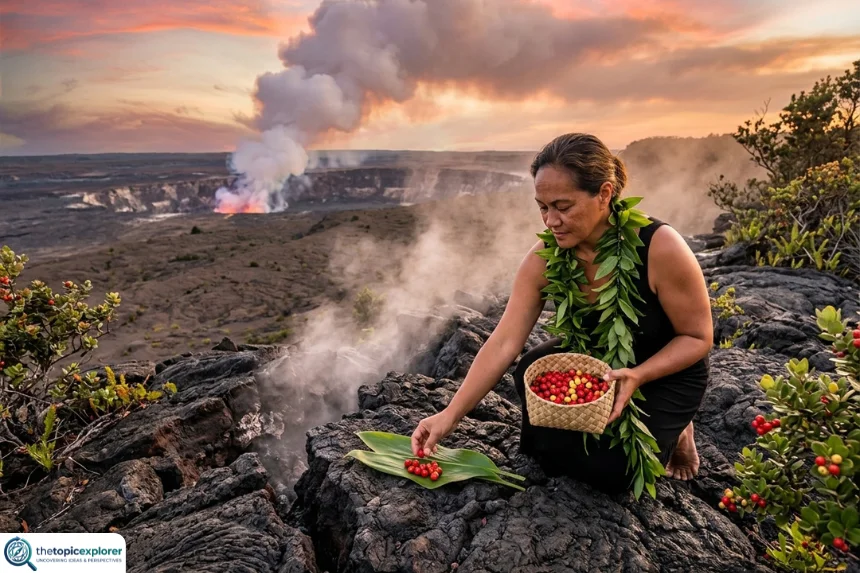
The ʻōhelo is a Native Hawaiian shrub that grows in volcanic environments. It can colonise relatively young lava flows and is strongly associated with Pele.
The National Park Service explains that, in Native Hawaiian custom, people traditionally offered some ʻōhelo berries to Pele before eating the fruit themselves. Historical accounts also record travellers being warned not to consume berries near Kīlauea without first recognising Pele.
Consequently, the ʻōhelo berry represents more than food. It reflects:
- Respect for Pele
- Recognition of her volcanic domain
- Reciprocity between people and the land
- The responsibility to give before taking
- Plant life returning to lava-covered ground
Nevertheless, a modern visitor should not copy a sacred practice merely after reading a travel article. Cultural traditions should be approached through Native Hawaiian practitioners and reliable educational sources rather than improvised ceremonies.
What Are Ho‘okupu?
Ho‘okupu are gifts or offerings presented with purpose, respect and cultural understanding.
National Park Service educational material identifies traditional offerings connected with Pele, including ʻāmaʻu fern, bananas, red fish, ʻōhiʻa lehua blossoms and red ʻōhelo berries. The same resource warns that people sometimes leave inappropriate items at Halemaʻumaʻu because they do not understand traditional practice.
Therefore, an article should not encourage tourists to leave:
- Alcohol bottles
- Plastic lei
- Coins
- Candles
- Packaged food
- Written notes
- Synthetic objects
- Items copied from fictional films or online posts
Leaving an object does not automatically make it a respectful offering. Moreover, foreign materials may damage a protected environment or create waste.
The safest visitor guidance is simple:
Do not invent a ceremony or leave objects at Kīlauea. Follow National Park Service rules and learn from recognised Native Hawaiian cultural educators.
Why Is the ʻŌhiʻa Lehua Important?
The ʻōhiʻa lehua is one of Hawaiʻi’s most culturally and ecologically important native plants. It commonly grows in volcanic landscapes and appears throughout Hawaiian moʻolelo, oli and chants.
Stories connect the tree and its blossoms with Pele, Hiʻiaka, love, jealousy and transformation. However, the National Park Service notes that the popular story about Pele changing the lovers ʻŌhiʻa and Lehua may be a relatively modern narrative. Therefore, it should not automatically be presented as an ancient account accepted in every tradition.
The plant also carries ecological meaning. After an eruption, ʻōhiʻa can grow on volcanic terrain and contribute to the gradual return of forest life.
As a result, it connects several themes already present in Pele’s moʻolelo:
- Lava and forest
- Destruction and regrowth
- Love and separation
- Pele and Hiʻiaka
- Volcanic change and ecological recovery
What Is Pele’s Hair?
Pele’s hair is the name given to very thin strands of volcanic glass created during certain eruptions.
The strands form when droplets or pieces of molten lava stretch into fine filaments and cool rapidly. They may appear golden or brown and can travel considerable distances on the wind.
Despite the poetic name, Pele’s hair is not human hair. It is a natural volcanic product whose appearance resembles fine strands.
Is Pele’s Hair Safe to Touch?
No. Visitors should avoid touching it.
The U.S. Geological Survey warns that the glass strands can irritate skin and eyes, create tiny splinters and affect respiratory systems. Wind may also carry them far beyond an active vent.
Therefore:
- Do not collect Pele’s hair.
- Do not rub it between your fingers.
- Keep it away from the eyes and mouth.
- Follow official volcanic-hazard guidance.
- Avoid areas closed by park or emergency authorities.
The name carries cultural meaning, but the material also represents a genuine physical hazard.
What Are Pele’s Tears?
Pele’s tears are small, rounded or teardrop-shaped pieces of volcanic glass created when molten lava droplets cool in the air.
They may form during lava fountains alongside Pele’s hair. The U.S. Geological Survey has documented both materials in tephra collected from Kīlauea eruptions.
Pele’s tears should not be removed as souvenirs. They are volcanic resources, and sharp or glassy material can cause injury.
Pele Hawaiian Goddess in Oli, Mele and Hula
Pele’s presence extends far beyond written stories.
Hawaiian cultural knowledge about Pele has been expressed through:
- Oli: chants
- Mele: songs or poetic compositions
- Hula: movement that communicates words, places and histories
- Moʻolelo: narratives, histories and traditions
- Mele inoa: name chants honouring a person or akua
National Park Service educational material preserves a chant honouring Pele that describes her hissing, bursting, rising, descending and moving across the land. Another NPS resource explains that chants and hula create vivid artistic descriptions of volcanic activity and the landscape formed by Pele.
Therefore, hula connected with Pele should not be described simply as entertainment. It can preserve:
- Place names
- Genealogy
- Volcanic observations
- Movement of lava
- Family relationships
- Praise and respect
- Cultural responsibilities
- Historical memory
Bishop Museum collections also preserve extensive Hawaiian-language materials involving Pele, Hiʻiaka, chants and songs.
Can Anyone Perform a Pele Chant or Hula?
A published chant may be visible online, but visibility does not remove cultural context.
Some compositions belong to particular traditions, teachers, families or performance lineages. Moreover, correct pronunciation, movement and interpretation may require extensive instruction.
Therefore, readers should avoid:
- Copying a chant for a commercial advertisement
- Performing sacred material as a joke
- Rewriting Hawaiian words without understanding them
- Using hula gestures as generic “island” decoration
- Claiming authority after reading one translation
- Removing a composition from its place and genealogy
A respectful article may describe the importance of oli and hula. However, it should not turn sacred or culturally specific practices into step-by-step tourist activities.
Is Pele Worshipped Today?
Pele remains culturally and spiritually significant for many Native Hawaiians. However, individual beliefs and practices differ.
The National Park Service explains that many Hawaiians continue to revere Pele. Some families in Puna and Kaʻū understand her as ʻohana or as an ʻaumakua connected with family ancestry.
Therefore, the phrase “ancient Hawaiians believed in Pele” is incomplete because it places every relationship with her in the distant past.
Better wording includes:
Pele has been honoured through generations of Hawaiian tradition and remains important to many people today.
Nevertheless, the article should not claim that all Native Hawaiians follow identical spiritual practices. Hawaiian communities, families and individuals may understand Pele differently.
Is Pele Feared or Loved?
Pele may inspire fear, love, respect, admiration and a sense of familial connection.
Volcanic eruptions can destroy homes, roads, forests and familiar landscapes. Consequently, people living near an active volcano may recognise the danger associated with Pele’s presence.
However, lava also creates land. Moreover, some families view Pele as a relative or ancestral guardian rather than an enemy. The National Park Service specifically notes that she is respected rather than simply feared.
Therefore, the answer is not limited to one emotion.
| Response to Pele | Why it may appear |
| Respect | Her power exceeds human control |
| Fear | Eruptions can threaten lives and communities |
| Love | Some people understand her as family or ancestor |
| Gratitude | Lava creates the land itself |
| Awe | Volcanic events reveal extraordinary natural force |
| Responsibility | People must behave carefully within her domain |
Reducing Pele to a frightening or angry goddess removes these more complex relationships.
What Is “Pele’s Curse”?
“Pele’s curse” is a popular visitor story claiming that anyone who removes lava rock or sand from Hawaiʻi will experience misfortune until the material is returned.
However, the curse narrative should not become the main reason for respecting volcanic landscapes. Fear of bad luck turns a culturally meaningful issue into tourist entertainment.
A stronger explanation focuses on three points.
1. Volcanic material has cultural meaning
Many Native Hawaiians understand lava as a kino lau, or physical manifestation, of Pele. Removing or damaging it may therefore be deeply disrespectful.
2. Natural resources belong in the landscape
Removing rocks, plants, glass or cinders changes protected places and encourages other visitors to do the same.
3. Removing resources from national parks is prohibited
The National Park Service states that federal regulations prohibit possessing, destroying, removing, digging or disturbing natural and cultural resources inside national parks.
Therefore, visitors should leave lava rocks where they are because doing so respects Hawaiian culture, protects the environment and follows park rules—not merely because they fear a supernatural punishment.
Should People Return Lava Rocks They Already Took?
People should not mail unsolicited rocks directly to random Hawaiian cultural sites, crater edges or communities.
Instead, they should contact the agency responsible for the place from which the material was removed. For example, someone who took an object from a national park should contact that park for current guidance.
Moreover, returning a rock does not reverse environmental disturbance automatically. The best practice is to avoid removing it in the first place.
The article should not provide a ritual for “removing the curse.” Such instructions would turn a cultural and environmental issue into a commercial superstition.
How Should Visitors Respect Pele and Kīlauea?
Respectful behaviour does not require a visitor to adopt beliefs they do not hold. However, everyone can behave responsibly within a culturally important and hazardous landscape.
Visitors should:
- Remain on open trails and designated viewing areas.
- Obey all closures and ranger instructions.
- Leave lava, rocks, plants and glass in place.
- Avoid poking or disturbing fresh lava.
- Do not create unofficial shrines or leave litter.
- Do not imitate ceremonies found on social media.
- Keep a respectful distance from cultural practitioners.
- Use correct Hawaiian place names where possible.
- Learn from Native Hawaiian and institutional sources.
- Treat active volcanic hazards seriously.
The National Park Service explains that disturbing lava is both culturally disrespectful and prohibited in protected park areas. Additionally, current volcanic material may include sharp glass, ash and other hazards.
Can Visitors See Pele?
Some modern encounter stories describe Pele appearing as an older woman, a young woman or a figure dressed in white.
However, such accounts belong to personal experience, family tradition or contemporary folklore. They cannot be independently verified as ordinary historical events.
Therefore, an accurate article may say:
Hawaiian traditions describe Pele appearing in different human and natural forms.
It should not say:
Every mysterious woman seen near Kīlauea is Pele.
Likewise, stock photographs of women wearing red dresses should not be labelled as factual images of the deity.
Why Is Pele Sometimes Shown With Long Red Hair?
Modern artists often portray Pele with flowing red, orange or black hair resembling lava and smoke.
This image communicates volcanic energy clearly to general audiences. Nevertheless, it is an artistic convention rather than one universally authorised traditional portrait.
The appearance may also draw inspiration from the volcanic glass called Pele’s hair. However, the geological material received that name because of its strand-like form; it does not prove that every Hawaiian tradition describes Pele with the same hairstyle.
Therefore, captions should use:
An artistic interpretation of Pele.
Avoid:
An accurate portrait of the Hawaiian goddess Pele.
Should Writers Use “Madame Pele” or “Tūtū Pele”?
The expression Madame Pele appears frequently in older visitor accounts and English-language travel writing. However, it reflects outside or later patterns of address rather than a Hawaiian-language title.
Tūtū Pele may be used respectfully in some communities and families. Nevertheless, a writer should not assume that it is preferred universally.
For a general informational article, the safest primary forms are:
- Pele
- Pelehonuamea
- Hawaiian volcano deity
- Hawaiian akua associated with volcanic activity
Additional titles should appear only with explanation and attribution.
Is Pele the Creator of All the Hawaiian Islands?
Pele is closely associated with volcanic land formation. However, the statement that she personally created every island may oversimplify varied Hawaiian creation and genealogical traditions.
The journey of Pele moves through the islands and broadly mirrors their geological sequence. Nevertheless, wider Hawaiian traditions also contain accounts involving Papa, Wākea, Haumea, Kāne and other akua.
Therefore, use:
Pele is strongly associated with the creation and reshaping of volcanic land.
Avoid:
Pele is the only creator of every Hawaiian island.
The first statement recognises her central volcanic role without erasing other Hawaiian traditions.
Does Science Disprove Pele?
No. Science and Hawaiian cultural tradition answer different kinds of questions.
Volcanology studies magma, lava chemistry, earthquakes, gases, eruption patterns and land formation. Meanwhile, Pele moʻolelo communicate relationships, responsibilities, genealogy, place-based knowledge and memories of environmental change.
U.S. Geological Survey research has found that traditions concerning Pele and Hiʻiaka may preserve information that corresponds with centuries of volcanic activity at Kīlauea.
Therefore, the article should not create a false choice:
- Either volcano science is true, or Pele traditions matter.
- Either Pele is honoured, or geological explanations are accepted.
Both knowledge systems can contribute to understanding the landscape, although they use different methods and purposes.
Common Myths About the Pele Hawaiian Goddess
| Common claim | More accurate explanation |
| Pele is only a fire goddess | She is associated with volcanoes, lava, land creation, destruction and transformation |
| Pele is an extinct ancient belief | She remains culturally and spiritually significant for many Hawaiians |
| Every eruption means Pele is angry | Eruptions should not automatically be assigned one human emotion |
| All Pele stories are identical | Genealogies and moʻolelo differ across families, places and sources |
| Pele is purely destructive | Lava destroys existing land but also creates new ground |
| Tourists should leave offerings | Visitors should not improvise sacred practices or leave inappropriate objects |
| Taking rocks matters only because of a curse | Removing resources is culturally disrespectful, environmentally harmful and prohibited in national parks |
| Pele’s hair is safe volcanic thread | It is fragile volcanic glass that can irritate or injure |
| Pele has one fixed human appearance | She appears through multiple human and natural forms in different traditions |
| Science proves Pele stories meaningless | Research shows that oral traditions may preserve significant volcanic and place-based knowledge |
Pele Hawaiian Goddess FAQs
What symbols represent Pele?
Lava, volcanic fire, red earth, Halemaʻumaʻu, Pāoa, ʻōhelo berries, ʻōhiʻa lehua and forms of volcanic glass are among the strongest associations.
Why are ʻōhelo berries sacred to Pele?
The berries grow in volcanic environments and traditionally formed part of customs recognising Pele before people consumed them.
What is Pele’s hair made from?
Pele’s hair consists of fine strands of volcanic glass formed when molten lava stretches and cools rapidly.
Can Pele’s hair hurt people?
Yes. Its fine glass strands may irritate the skin and eyes, enter the respiratory system or create splinters.
What are Pele’s tears?
They are small pieces of volcanic glass formed from airborne lava droplets during some eruptions.
Do Hawaiians still honour Pele?
Yes, Pele remains culturally and spiritually important to many Native Hawaiians. However, beliefs and practices differ among families and individuals.
Is it illegal to take lava rocks?
Removing natural resources from U.S. national parks is prohibited under federal regulations. Visitors should also leave rocks in place outside parks unless the landowner or managing authority explicitly permits collection.
Is Pele’s curse real?
The curse is a popular tourist narrative. Regardless of personal belief, people should not remove rocks because the practice can be culturally disrespectful, environmentally damaging and illegal in protected areas.
Should tourists leave offerings for Pele?
Tourists should not invent ceremonies or leave inappropriate objects. Traditional ho‘okupu belong within cultural knowledge and practice, not casual imitation.
What flower is associated with Pele?
The ʻōhiʻa lehua is strongly connected with Pele, Hiʻiaka and volcanic landscapes. However, stories explaining that relationship vary.
What colour represents Pele?
Red, orange, black and white frequently appear in names, volcanic imagery and artistic representations. Nevertheless, there is no single universal colour code.
Can Pele appear as a human?
Hawaiian traditions describe Pele in human and natural forms. Personal encounter stories may portray her as a young or older woman, although such accounts cannot be verified as ordinary historical facts.
Why is Halemaʻumaʻu important?
Hawaiian traditions identify Halemaʻumaʻu at Kīlauea as Pele’s home and a place of deep cultural significance.
Is Pele the same as lava?
Hawaiian cultural sources identify lava as one of Pele’s forms or manifestations. However, reducing her entire identity to a geological substance would overlook her genealogy, moʻolelo and cultural relationships.
Why is Pele important in hula?
Chants and hula preserve names, movement, places, relationships and observations connected with Pele and volcanic activity.
Is Pele part of Hawaiian mythology?
She appears in Hawaiian moʻolelo and traditions. However, “mythology” should not be used to suggest that Native Hawaiian cultural knowledge is simply false or irrelevant.
Conclusion: Why the Pele Hawaiian Goddess Still Matters
The Pele Hawaiian goddess is not simply a dramatic figure associated with fire. Pelehonuamea represents volcanic power, the creation and destruction of land, responsibility, genealogy and the continuing relationship between Native Hawaiian communities and volcanic places.
Her presence appears through lava, Halemaʻumaʻu, chants, hula, plants and named forms such as Pele’s hair. Moreover, ʻōhelo berries and ʻōhiʻa lehua demonstrate how Pele traditions connect volcanic land with plant life, cultural practices and renewal.
Visitors do not need to copy ceremonies to show respect. Instead, they can follow closures, leave rocks and plants untouched, avoid inappropriate offerings and learn from Native Hawaiian and authoritative institutional sources.
Ultimately, Pele remains meaningful because her moʻolelo describe more than an eruption. They communicate how power, family, land, destruction and renewal remain connected across generations.
READ MORE ABOUT: Buddhist Riddles
