


The main difference in first degree murder vs second degree murder is usually an added element such as premeditation, deliberation, a specified method, or a death during a listed felony. In many U.S. jurisdictions, second-degree murder covers other murders, including some intentional killings without premeditation and some killings caused by extreme recklessness. However, that is only a general rule. Federal law and each state define homicide offenses differently.
Legal information notice: This article provides a general U.S. overview, not legal advice. It does not predict the correct charge, defense, verdict, or sentence in any case. Anyone affected by an investigation or criminal charge should promptly consult a licensed criminal-defense lawyer in the jurisdiction handling the matter.
Sources checked for currency: July 30, 2026
First Degree Murder vs Second Degree Murder at a Glance
The following table summarizes the most common U.S. distinction. Still, the controlling statute—not this chart—determines the elements in a real case.
| Legal issue | First-degree murder, generally | Second-degree murder, generally |
|---|---|---|
| Basic category | The jurisdiction’s most aggravated degree of murder | Murder that does not satisfy the first-degree requirements |
| Intent | Often an intent to kill, although some felony-murder laws do not require it | May involve intent to kill, intent to cause serious injury, or extreme disregard for life |
| Premeditation | Commonly required for the ordinary intentional-killing route | Commonly absent |
| Other routes | Listed felonies, methods, victims, or special circumstances may qualify | Some jurisdictions include depraved-indifference conduct or felony murder |
| Relative severity | Usually punished more severely | Usually punished less severely than the first degree but remains an extremely serious felony |
| Universal rule? | No | No |
Therefore, “planned versus unplanned” is a helpful starting point, but it is not a complete legal test. For example, a statute may classify a killing during robbery as first-degree murder without proof that the defendant planned a death. Conversely, New York generally places an intentional killing in the second degree unless the prosecution proves the special circumstances required for the first degree.
Why Jurisdiction Changes the Answer
Most homicides fall under state law. Federal murder law applies only when the federal government has jurisdiction, such as in certain federal places or when another federal statute reaches the conduct. As a result, the current text of 18 U.S.C. §1111 does not define every murder prosecuted in the United States.
Moreover, states do not share one classification system. California and Minnesota use first- and second-degree labels. Pennsylvania uses three degrees. Meanwhile, Texas Penal Code Chapter 19 uses “murder” and “capital murder” instead of the two labels in the keyword.
Country also matters. Canada has its own statutory degrees, while England and Wales currently use a different homicide structure. Therefore, a Canadian, Australian, or English page should not be used to interpret a U.S. criminal charge.
What Is First-Degree Murder?
First-degree murder usually means the most aggravated category of murder in a jurisdiction that uses degrees. The familiar form is a willful, deliberate, and premeditated killing. In plain language, the defendant formed an intent to kill and reflected on that decision before acting.
However, statutes frequently create additional routes. Under federal law, for instance, murder by poison or lying in wait may qualify. A murder committed during specified felonies can also fall in the first degree. Similarly, California Penal Code §189 lists premeditated killings, particular methods, and deaths during enumerated felonies.

Common Elements of First-Degree Murder
Although the wording varies, prosecutors commonly must prove:
- the defendant caused the victim’s death;
- the killing was unlawful;
- the defendant had the mental state required for murder; and
- an additional first-degree fact existed, such as premeditation, a listed felony, a specified method, or a protected-victim circumstance.
The government must prove every required element beyond a reasonable doubt. Nevertheless, the precise elements come from the applicable code and the judge’s instructions.
Does Premeditation Require Long-Term Planning?
No universal minimum period applies. Premeditation requires thought before the act, but the necessary amount and quality of reflection depend on local law. For example, Minnesota defines it as considering, planning, preparing for, or deciding to commit the act before its commission.
Still, merely forming an intent at the instant of an unconsidered impulse may not establish deliberation under a particular instruction. Courts often tell juries to examine the quality of the reflection rather than count minutes. Thus, “premeditated” does not necessarily mean that a person planned the killing for days.
What Is Second-Degree Murder?
Second-degree murder generally covers murder that lacks the added facts required for first-degree murder. It can involve a deliberate intent to kill formed without legally sufficient premeditation. Additionally, some statutes include an intent to cause serious bodily harm, extreme recklessness, or certain felony-murder situations.
Under federal law, “any other murder” that does not fall within the first-degree categories in §1111 is second-degree. The Ninth Circuit’s federal jury instruction states that the government must prove an unlawful killing with malice aforethought within federal jurisdiction. It explains malice as killing deliberately and intentionally or recklessly with extreme disregard for human life.

Common Elements of Second-Degree Murder
A typical prosecution must establish an unlawful killing, causation, and the jurisdiction’s required form of malice. However, the available routes differ. One statute may require an intent to kill, while another may also recognize implied malice or depraved indifference.
Importantly, second-degree murder does not mean “an accidental death.” An unintended death can still qualify when the law treats the defendant’s conscious, extreme risk-taking as murder. Yet ordinary carelessness usually does not reach that level.
Intentional but Unpremeditated Killing
This is the classic second-degree example. The prosecution alleges that the defendant intended to kill but did not deliberate or premeditate as the first-degree rule requires. Minnesota states the distinction directly: Minnesota Statutes §609.19 includes causing death with intent to effect death but without premeditation.
Extreme Recklessness or “Depraved Heart”
Some jurisdictions treat conduct showing extreme indifference to human life as murder even without a purpose to kill a particular person. A common hypothetical is knowingly firing into an occupied room without targeting anyone. However, the prosecution must prove the mental state specified by local law; a tragic result alone does not establish it.
First- vs. Second-Degree Murder: The Core Legal Difference
In the ordinary comparison, first-degree murder contains an aggravating element that second-degree murder does not. Most often, that extra element is premeditation and deliberation. Still, a statute may substitute a listed felony, method, victim, or special circumstance.
Intent, Malice, and State of Mind
Criminal law uses mental-state concepts to distinguish purposeful conduct, knowing conduct, recklessness, and negligence. “Malice aforethought” is a traditional murder term, but it does not always mean personal hatred or a long-standing grudge. Depending on the jurisdiction, it can cover an intent to kill, an intent to cause grave injury, or extreme disregard for life. Readers who need conceptual background can review general background on mens rea, but the governing statute and cases supply the legal test.
Premeditation and Deliberation
Premeditation generally concerns deciding beforehand; deliberation concerns weighing the decision. Evidence of both can elevate an intentional murder to the first degree where the statute uses that framework. In contrast, a sudden intent to kill may support second-degree murder if the other elements exist. Yet these words must be read through the relevant jury instructions, not their everyday dictionary definitions.
How Prosecutors Prove State of Mind
No one can directly see another person’s thoughts. Therefore, prosecutors often rely on circumstantial evidence, including:
- statements before or after the death;
- steps taken to obtain a weapon or lure the victim;
- threats, research, surveillance, or concealment;
- the sequence and manner of the acts;
- the relationship between the parties; and
- conduct after the event.
Motive can help explain conduct, but motive is not automatically a formal element. Moreover, one fact may support competing interpretations. The defense may argue that the evidence shows impulse, panic, accident, self-defense, or a lesser mental state. Ultimately, the factfinder evaluates the evidence under the judge’s instructions.
How Felony Murder Changes Degree Classification
Felony murder can impose murder liability when a death occurs during a qualifying felony, even if the prosecution cannot prove a premeditated plan to kill. However, the underlying felonies, causation rules, participant liability, defenses, and degree vary significantly.
Federal §1111 places deaths during listed offenses such as robbery, burglary, kidnapping, and arson in the first degree. California also places killings during specified felonies in the first degree, although its statute limits liability for certain participants who were not the actual killer.
In contrast, Pennsylvania’s Chapter 25 labels a homicide committed while the defendant acts as a principal or accomplice in the perpetration of a felony as second-degree murder. New York also includes a form of felony murder within its second-degree statute. Consequently, the statement “felony murder is always first-degree” is false.
Sentencing for First- and Second-Degree Murder
First-degree murder usually carries the harsher authorized punishment. Nevertheless, there is no national sentence that applies to every conviction.
Under federal §1111, first-degree murder first degree murder vs second degree murder carries death or life imprisonment, while second-degree murder carries any term of years or life. Those words describe statutory authorization; they do not make a death sentence automatic. Separate constitutional and procedural rules govern capital eligibility.
California provides another illustration. Its code generally sets 25 years to life for first-degree murder and 15 years to life for second-degree murder, subject to exceptions and enhancements. Other states use different minimums, maximums, parole rules, and sentencing systems. Therefore, only the current law governing the offense can answer a sentencing question.
How State Laws Classify Murder
This table shows why one nationwide formula is unsafe:
| Jurisdiction | Illustrative structure |
|---|---|
| Federal | Premeditated murder and listed felony murders are first-degree; other murder is second-degree |
| California | Listed methods, premeditated killings, and listed felony murders are first-degree; other murder is second-degree |
| Minnesota | Intentional killing without premeditation and specified felony murder can be second-degree |
| Pennsylvania | Intentional killing is first-degree; felony murder is second-degree; other murder is third-degree |
| New York | Intentional killing, depraved-indifference killing, and listed felony murder are generally second-degree; first-degree requires additional statutory circumstances |
| Texas | The code uses murder and capital murder rather than first- and second-degree labels |
For the full New York categories, consult New York Penal Law Article 125. These examples are illustrative, not a fifty-state survey, and legislatures can amend them.
Murder Degrees vs. Manslaughter
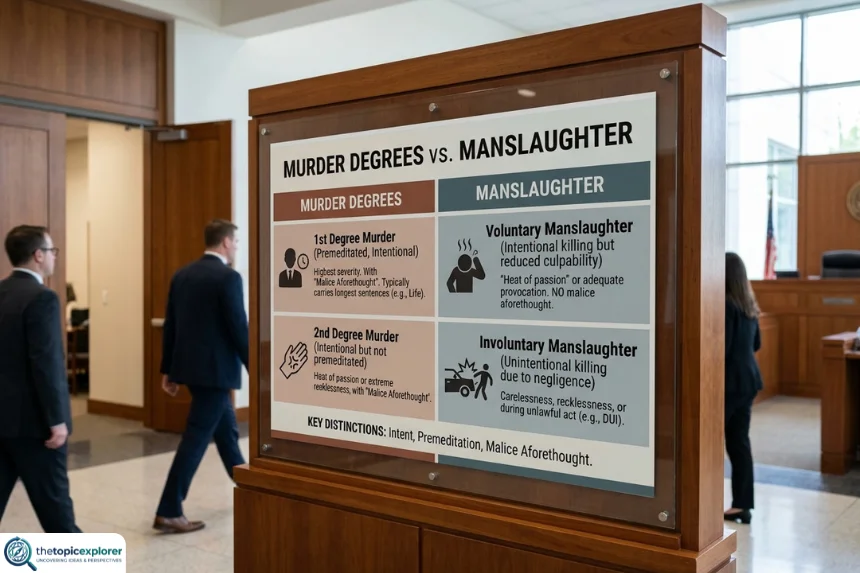
Manslaughter is not simply another name for second-degree murder. It generally involves a lower level of culpability or a circumstance that mitigates what otherwise might be murder. Depending on the jurisdiction, voluntary manslaughter may involve an intentional killing in legally adequate heat of passion or under extreme emotional disturbance. Involuntary manslaughter may involve unlawful killing through recklessness or gross negligence.
The boundary can be difficult. Extreme, conscious disregard for life may support murder, while a lower level of recklessness may support manslaughter. Likewise, legally adequate provocation may reduce an intentional killing. Because each statute draws its own line, “unplanned” alone does not decide between second-degree murder and manslaughter.
Common Misconceptions About First- and Second-Degree Murder
- “Second-degree means accidental.” It can describe an intentional killing or extremely reckless conduct.
- “First-degree requires weeks of planning.” The law may require prior reflection without setting a long minimum period.
- “Every felony-related death is first-degree.” Pennsylvania provides a clear second-degree counterexample.
- “Every state uses two degrees.” Texas and other states use different labels.
- “First-degree automatically means execution.” Capital punishment is not automatic, and many cases are legally ineligible for it.
- “A first-degree charge proves premeditation.” A charge is an allegation. The prosecution still must prove every element beyond a reasonable doubt.
- “Manslaughter is third-degree murder.” Only a few jurisdictions use a third-degree category, and manslaughter remains a distinct offense.
Hypothetical Examples
These simplified examples illustrate concepts; they do not predict an actual charge.
Planned intentional killing: A person researches a victim’s schedule, buys a weapon, waits at a chosen location, and intentionally kills the victim. Those facts may support premeditation and first-degree murder under a statute using the common framework.
Sudden intentional killing: During an unexpected confrontation, a person forms an intent to kill and immediately acts, without legally sufficient reflection. If no mitigation or justification applies, the facts may support second-degree murder in some jurisdictions.
Extreme-risk conduct: A person knowingly directs lethal force into a crowded space without targeting a specific individual, causing a death. A jurisdiction may treat the conduct as depraved-indifference or implied-malice murder. However, the statutory wording and evidence control each example.
Charges, Defenses, and Lesser Verdicts
The degree listed at arrest or indictment is not necessarily the final outcome. Prosecutors may amend charges, parties may litigate which instructions the evidence supports, and a jury may consider a lesser-included offense when the law permits.
Potential issues include identity, causation, intent, premeditation, the felony-murder requirements, self-defense, defense of others, accident, and legally recognized mitigation. However, a defense that exists in one jurisdiction may work differently or not exist in another. Moreover, procedural deadlines and evidence-preservation concerns can arise quickly. A person facing a real investigation should obtain local legal counsel rather than apply online hypotheticals to the case.
FAQs About First Degree Murder vs Second Degree Murder
Is first-degree murder always premeditated?
Not always. Premeditated intentional killing is the classic route, but statutes can classify murder as first-degree because of a listed felony, method, victim, or circumstance. Federal law, for example, includes specified felony murders in the first degree. The applicable statute supplies the complete list.
Does second-degree murder mean the killing was accidental?
No. Second-degree murder often includes an intentional but unpremeditated killing. It may also cover conduct that creates an extreme risk of death and shows profound disregard for human life. By contrast, a genuine accident without the required criminal mental state is not murder merely because someone died.
Can second-degree murder be intentional?
Yes. In many jurisdictions, an intent to kill combined with insufficient proof of premeditation is a standard second-degree theory. Minnesota states this route expressly. Still, other states define and label intentional homicide differently.
Can first-degree murder apply without an intent to kill?
Sometimes. A felony-murder statute may classify a death during a listed felony as first-degree without requiring a premeditated intent to kill. However, statutes may restrict liability for a participant who neither killed nor intended a killing. The answer therefore depends on the jurisdiction and the defendant’s alleged role.
How long must someone plan a killing for it to be premeditated?
There is no nationwide minimum. The question usually concerns whether the person reflected and decided before acting, not whether a particular number of minutes or days passed. A court’s jury instruction explains the controlling standard.
Which is punished more severely: first- or second-degree murder?
First-degree murder generally carries the more severe authorized punishment. However, both can lead to life imprisonment, and the actual range varies by jurisdiction, enhancements, age, criminal history, and other rules. A general comparison cannot determine a sentence in a specific case.
Can first-degree murder be reduced to second-degree murder?
It can be, depending on the law, evidence, negotiations, and procedural posture. For example, insufficient proof of premeditation might prevent a first-degree conviction while still allowing a second-degree verdict. Nevertheless, no reduction is automatic or guaranteed.
Is second-degree murder the same as manslaughter?
No. Second-degree murder generally requires malice, intent, or a more extreme form of recklessness than manslaughter. Voluntary manslaughter can involve legally adequate provocation or another mitigating condition, while involuntary manslaughter often involves a lower culpable mental state. Definitions vary.
Do all states use first- and second-degree murder?
No. Texas uses murder and capital murder. Pennsylvania uses three degrees. Other states use terms such as aggravated murder, intentional homicide, or murder without numbered degrees. Therefore, readers should look first at the jurisdiction named in the case.
Do first- and second-degree murder mean the same thing outside the United States?
No. Canada has a national statutory classification, while England and Wales and Australian jurisdictions use different structures. Similar words do not guarantee matching elements or penalties. A U.S. explanation should never be substituted for the controlling law of another country.
Conclusion: Comparing First- and Second-Degree Murder Correctly
The general first degree murder vs second degree murder distinction turns on an added first-degree feature—often premeditation, deliberation, or a circumstance listed by statute. Meanwhile, second-degree murder may cover intentional but unpremeditated killing, extreme disregard for life, or felony murder, depending on local law.
Therefore, the safest answer always begins with jurisdiction. The relevant code, court decisions, jury instructions, evidence, and defenses determine the charge and punishment. Anyone dealing with an actual case should speak with a qualified criminal-defense lawyer where the matter is pending.
LEARN MORE ABOUT: Waimea Big Island
