



Buddhist riddles commonly refer to Zen kōans—short questions, dialogues, stories, or statements used to challenge habitual ways of understanding experience. Although a kōan may resemble a brain teaser, practitioners do not approach it merely to discover a clever hidden answer.
Instead, kōans developed as part of Buddhist literature, meditation, teacher-student training, and spiritual inquiry. They invite practitioners to examine their assumptions, remain attentive in uncertainty, and respond from direct experience rather than relying entirely on abstract reasoning.
Quick answer: Buddhist riddles are usually called Zen kōans. A kōan may sound contradictory, illogical, or impossible, but it is not simply a puzzle with one secret solution. In traditional practice, it can help reveal fixed assumptions about the self, language, knowledge, and reality.
The phrase “Buddhist riddles” is useful for searchers, but it requires clarification. Buddhism contains many schools and practices, while formal kōan traditions developed particularly within Chinese Chan and related forms of Zen Buddhism. Stanford’s overview describes these “public cases” as records of encounters between Chan teachers and students that eventually became a major literary form and training curriculum.
Buddhist Riddles and Zen Kōans at a Glance
| Question | Best-supported answer |
|---|---|
| What are Buddhist riddles commonly called? | Zen kōans |
| What form can a kōan take? | A question, dialogue, story, statement, action, or recorded encounter |
| Where did kōan traditions develop? | Primarily in medieval Chinese Chan Buddhism |
| What does kōan mean? | It comes from the Chinese term gong’an, usually translated as “public case” |
| Are kōans ordinary riddles? | No; they form part of Buddhist teaching, literature, and practice |
| Do kōans have answers? | They may require responses, but not simple trivia-style solutions |
| Are kōans used by all Buddhists? | No |
| Are they used in meditation? | Often, although methods differ between schools and teachers |
| Can beginners read kōans? | Yes, but historical and religious context helps prevent misunderstandings |
| Is every strange Buddhist quote a kōan? | No; traditional cases usually have a recognised textual or teaching context |
What Are Buddhist Riddles?
The term Buddhist riddles usually describes kōans because their wording often creates uncertainty. A kōan may challenge the reader with an apparently impossible question, an unexpected reply, or a situation that does not fit normal categories.
Traditional kōans may appear as:
- Questions presented by a teacher
- Dialogues between teachers and students
- Stories about encounters in a monastery
- Short statements selected from longer records
- Unexpected actions or gestures
- Cases accompanied by poetry and commentary
- Phrases used as objects of sustained inquiry
However, kōans are not random collections of strange sentences. They emerged within religious communities and became part of a large body of Zen literature. By the middle of China’s Song dynasty, recorded “public cases” had become a core element of Chan training and literary culture.
Therefore, readers should distinguish between three different categories:
- Traditional kōans: Cases preserved within recognised Chan or Zen literature.
- Kōan-inspired questions: Modern contemplative prompts influenced by Zen practice.
- Ordinary riddles: Word puzzles designed to conceal a particular answer.
All three may encourage reflection. Nevertheless, they do not have the same history, religious role, or method of use.

Are Buddhist Riddles the Same as Ordinary Riddles?
No. Kōans may resemble riddles, but their purposes and methods differ considerably.
An ordinary riddle usually contains clues leading toward a specific solution. Once the solver identifies the intended answer, the puzzle has largely completed its purpose.
A typical riddle follows this pattern:
- The wording hides an object, idea, or word.
- The solver studies the clues.
- Logical interpretation reveals the answer.
- The correct solution resolves the puzzle.
A kōan does not necessarily work that way. Instead, it may challenge the assumptions that make the original question appear straightforward.
For example, a practitioner may try to resolve a kōan by:
- Finding a symbolic interpretation
- Reading another person’s answer
- Searching for a philosophical definition
- Making a deliberately strange gesture
- Remaining silent because silence seems “Zen”
- Repeating words associated with emptiness or nonduality
However, none of these strategies automatically demonstrates understanding. In formal practice, teachers may expect an original response rather than a memorised phrase or predetermined philosophical explanation. Stanford’s discussion of the famous “Mu” case explains that ordinary affirmation, denial, both, neither, and borrowed textual answers can all miss the purpose of the inquiry.
Key differences between a riddle and kōan
| Feature | Ordinary riddle | Traditional kōan |
|---|---|---|
| Primary goal | Discover the hidden answer | Deepen inquiry and transform understanding |
| Method | Clues and logical deduction | Meditation, attention, dialogue, and direct engagement |
| Completion | Usually ends when solved | May produce further questions or testing |
| Correct response | Often one intended phrase | Depends on the case, teacher, lineage, and understanding |
| Historical setting | Entertainment, education, or wordplay | Buddhist literature and religious training |
| Role of explanation | Usually explains the solution | An explanation may remain incomplete |
| Relationship with daily life | Often limited to the puzzle | Insight should influence conduct and perception |
Consequently, calling a kōan an “unsolvable riddle” is also incomplete. Traditional teachers may require a response, while major kōan collections contain extensive comments, verses, instructions, and evaluations.
The issue is not that thought becomes forbidden. Rather, conceptual analysis alone may be insufficient.
What Does the Word Kōan Mean?
The Japanese word kōan comes from the Chinese term gong’an. Scholars commonly translate the term as “public case.”
Originally, the expression had legal or administrative associations. A public case could function as an authoritative record or precedent rather than as a private opinion.
Chan communities eventually used the term for recorded encounters involving Buddhist teachers and students. These cases preserved questions, replies, actions, challenges, and moments that later practitioners could examine.
Therefore, the phrase “public case” suggests several important qualities:
- The case belongs to a wider community.
- Previous generations preserved and studied it.
- It can test a person’s understanding.
- It is not merely a private fantasy.
- Teachers and commentators may evaluate responses to it.
- The case may remain meaningful in different times and settings.
Stanford identifies gong’an in Chinese and kōan in Japanese as “public cases” that allegedly recorded teacher-student encounters. These records eventually became the leading Chan literary form.
Oxford University Press likewise describes kōans as enigmatic spiritual formulas used for religious training. Its scholarly collection emphasises that the history of kōan literature and practice is far more diverse than common Western stereotypes suggest.
Where Did Buddhist Riddles and Kōans Originate?
Kōan traditions developed within Chinese Chan Buddhism, particularly through stories and encounter dialogues associated with prominent teachers and their students.
Chan itself emerged in China through a complex historical development. Later tradition presented it as a direct transmission from the Buddha through generations of teachers, eventually reaching the Indian monk Bodhidharma and then China.
However, modern scholars treat several elements of the traditional lineage story as later constructions rather than straightforward historical records. Stanford notes that Chan’s established account of its own origins contains features now viewed as inventions of tradition.
This distinction does not make Chan teachings meaningless. Instead, it helps readers separate:
- Religious tradition
- Institutional history
- Later literary development
- Modern historical scholarship
From encounter stories to formal collections
Stories about Chan masters circulated among monks, educated readers, and Buddhist communities. Over time, editors collected, reshaped, and commented on these encounters.
As a result, kōan literature developed several layers:
- An original or supposed teacher-student encounter
- A later written version of the case
- Editorial comments
- Poetic verses
- Additional explanations
- “Capping phrases” or short comments
- Instructions for later practitioners
Therefore, traditional kōan collections are not simply lists of unexplained questions. They are sophisticated literary works shaped across generations.
For example, the Book of Serenity contains 100 older cases with verse comments and extensive prose commentary. The official Soto Zen glossary explains that the collection took its present form in 1223 and contains several layers of instruction, commentary, verse, and interlinear remarks.
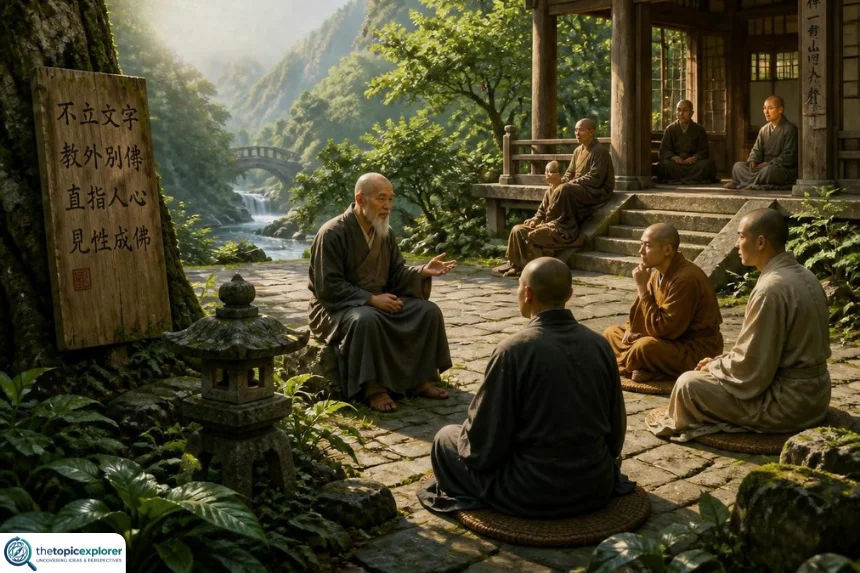
How Did Kōan Practice Develop?
Recorded encounters initially preserved the words and actions associated with respected Chan teachers. However, later communities increasingly used selected cases as organised training materials.
By the Song dynasty, two influential currents of Zen practice had developed in China:
- Silent Illumination Zen
- Watching-Kōan or Kōan-Introspection Zen
The official Soto Zen teaching resource identifies these as two currents that developed in twelfth-century Song China.
In Watching-Kōan practice, a practitioner might concentrate intensely on a central phrase or critical point from a case. Rather than analysing every historical detail, the practitioner would carry the inquiry into sitting meditation and daily life.
Meanwhile, other traditions used kōans through:
- Public teaching
- Private interviews
- Dharma talks
- Scriptural commentary
- Poetry
- Monastic debate
- Written reflection
- Ritual and lineage education
Consequently, there has never been only one universal way to use a kōan.
Are Kōans Used by All Buddhists?
No. Buddhism includes many traditions, communities, scriptures, meditation systems, rituals, and philosophical schools.
Formal kōan practice is associated especially with Chan and the East Asian traditions that developed from it. Therefore, it would be inaccurate to imply that Tibetan, Theravāda, Pure Land, Nichiren, or every other Buddhist community uses the same kōan methods.
Even within Zen, approaches differ.
Some communities use structured sequences of kōans in close teacher-student training. Others study kōans through sermons, reading, commentary, or reflection without treating them as a ladder of formal tests.
Furthermore, the relationship between kōans and meditation varies according to:
- The school
- The teaching lineage
- The individual teacher
- The student’s level of training
- The historical period
- The monastic or lay setting
For that reason, an article about Buddhist riddles should avoid statements such as:
- “All Buddhists solve kōans.”
- “Every Zen school follows the same curriculum.”
- “Soto Zen completely rejects kōans.”
- “Rinzai Zen is only about riddles.”
- “Kōans replace Buddhist ethics and scripture.”
Each claim oversimplifies a diverse religious history.
What Is the Purpose of Buddhist Riddles?
The purpose of a kōan is not merely to create confusion. Instead, it may expose limitations in the practitioner’s habitual way of seeing a situation.
People often divide experience into fixed categories, including:
- Yes and no
- Self and other
- Sacred and ordinary
- Success and failure
- Existence and nonexistence
- Enlightened and unenlightened
- Question and answer
- Knowing and not knowing
A kōan may make these categories difficult to maintain. However, the intended response is not necessarily to choose the opposite answer or announce that “everything is one.”
Depending on the tradition, working with a kōan may encourage a practitioner to:
- Sustain attention
- Observe automatic reactions
- Recognise rigid assumptions
- Remain present during uncertainty
- Integrate body and mind
- Respond appropriately to circumstances
- Connect insight with everyday conduct
- Avoid attachment to spiritual concepts
- Deepen compassion and ethical awareness
Stanford’s account presents Chan practice as an embodied discipline concerned with attentive and responsive conduct rather than knowledge acquired solely through concepts.
Therefore, the deeper question is not always, “What does this kōan symbolise?” It may be, “How are you meeting this situation right now?”
Why Do Buddhist Kōans Sound Illogical?
Many famous cases appear illogical because they do not follow the expectations built into ordinary questions.
A student may request:
- A definition of Buddha
- An explanation of enlightenment
- A description of the true self
- A statement about ultimate reality
- Confirmation of a religious doctrine
Instead of providing a conventional definition, the teacher may respond with an ordinary object, another question, a gesture, or an apparently unrelated statement.
Several explanations may help readers understand this style.
The question may contain a false assumption
A student may ask whether something either possesses or does not possess a spiritual quality. However, the teacher may challenge the idea that the subject can be understood as an object with a detachable property.
Abstract answers can become substitutes for experience
A technically correct Buddhist definition may still function as borrowed knowledge. Therefore, a teacher may redirect the student toward the immediate situation.
Language can divide what experience does not divide
Words are useful. Nevertheless, they can encourage people to treat fluid relationships as independent and permanent objects.
The teacher may test responsiveness
A response that worked in one encounter may fail when copied in another. Therefore, imitation is not the same as understanding.
Kōan literature uses drama and compression
Many cases are brief, edited, and highly stylised. They may contain humour, wordplay, cultural references, and literary conventions unfamiliar to modern readers.
As a result, not every difficult sentence should be interpreted as a rejection of logic. Historical context and translation also matter.
Do Buddhist Riddles Have Answers?
Kōans may require responses, but they generally do not have simple answers that function like the solutions printed at the back of a puzzle book.
A formal response may involve:
- Spoken words
- A gesture
- Silence
- A quotation
- A demonstration
- A response to a follow-up question
- An explanation of how the case applies in daily life
However, performing something unusual does not automatically make the response authentic. A student who copies a famous gesture may only demonstrate familiarity with kōan stories.
Stanford’s examination of the “Mu” kōan explains that the practitioner is expected to produce an original response that does not remain trapped within ordinary alternatives such as yes, no, both, or neither. Furthermore, the inquiry involves the whole person rather than intellectual reasoning alone.
Therefore, online pages promising “the correct answers to every Buddhist riddle” should be treated cautiously.
A commentary may still be valuable. Traditional collections contain large amounts of commentary. Nevertheless, commentary should support engagement with the case rather than replace it.
Is Kōan Practice Anti-Intellectual?
No. Zen traditions often warn against attachment to words and concepts. However, they also produced extensive philosophical discussions, biographies, poems, encounter records, ritual texts, and commentarial literature.
Stanford notes that Chan’s claim of transmission beyond words did not necessarily reject textual transmission. Chan teachers referred frequently to Buddhist scriptures even while warning students against treating words as the final reality they describe.
Accordingly, kōan practice does not require a person to become irrational or abandon critical thinking.
Instead, it may question whether conceptual knowledge alone can resolve every human problem.
For example, a person may understand the definition of compassion but still respond harshly during conflict. Likewise, someone may memorise teachings about impermanence while continuing to resist every unwanted change.
Therefore, kōan practice often asks whether understanding has become embodied in conduct.
What Is the Relationship Between Kōans and Meditation?
Kōans may be used during meditation, although not every Zen practitioner meditates on them in the same way.
A practitioner might:
- Receive a case or central phrase.
- Read or hear the case carefully.
- Sit in an attentive posture.
- Return repeatedly to the central inquiry.
- Notice attempts to escape into rehearsed explanations.
- Carry the question into ordinary activities.
- Present an understanding to a teacher.
- Respond to additional questions.
- Continue practising after an apparent breakthrough.
Nevertheless, beginners should not assume that kōan practice consists of aggressively forcing the mind to become blank.
Official Soto Zen instructions place meditation within a disciplined physical setting involving posture, breathing, preparation, clothing, and attentive sitting. They also provide chair-based guidance for people who cannot comfortably use traditional floor postures.
Thus, kōan practice belongs within a broader framework of Buddhist discipline rather than acting as a shortcut to a dramatic spiritual experience.
Why Teacher Guidance Can Matter
Anyone can read a kōan. However, formal practice often includes a relationship with a qualified teacher because the practitioner may:
- Mistake cleverness for insight
- Copy traditional responses
- Become attached to one interpretation
- Force unusual mental experiences
- Ignore the case’s historical context
- Use spiritual language to avoid personal difficulties
- Treat frustration as proof of failure
- Separate meditation from ethical conduct
A teacher may question a student’s response, redirect the inquiry, assign another case, or help connect an insight with daily behaviour.
Nevertheless, teacher authority should not remove healthy judgment. Buddhist communities, like other institutions, can contain unequal power relationships. Therefore, students should look for qualified, ethical, transparent teachers and communities with appropriate safeguards.
Common Misconceptions About Buddhist Riddles
Every strange Zen sentence is a kōan
A traditional kōan usually comes from a recognised case, collection, encounter record, or teaching context.
Modern contemplative questions may still be valuable. However, writers should label them as modern prompts rather than ancient Buddhist teachings.
Kōans are designed to stop all thought
Kōans may interrupt habitual conceptual thinking. Nevertheless, Zen traditions do not require permanent thoughtlessness.
Thoughts can arise while a practitioner remains attentive.
Kōans are meaningless nonsense
Their language may appear strange outside its cultural and historical context. However, traditional cases developed within Buddhist communities and address recognisable religious concerns.
Every kōan has a secret sentence as its answer
Teacher manuals and accepted responses have existed in some settings. Even so, memorising a phrase does not necessarily show that the practitioner understands or embodies the case.
All Buddhists use kōans
Kōan practice belongs especially to Chan- and Zen-related traditions. It does not represent every form of Buddhism.
Zen rejects all books and scriptures
Chan criticised dependence on texts, but Chan and Zen communities also produced and studied large bodies of literature. Their warnings concern attachment to words as final truth, not necessarily the complete rejection of reading.
Any spontaneous action counts as a Zen response
Random shouting, silence, laughter, or strange behaviour does not automatically express insight. Context, understanding, appropriateness, and ethical conduct still matter.
How Should Beginners Approach Buddhist Riddles?
Beginners can explore kōans without pretending to complete formal Zen training.
A responsible starting method is:
- Select one traditional case from a reliable collection.
- Learn its basic historical context.
- Read it slowly more than once.
- Notice the answer you immediately expect.
- Observe which words or assumptions create tension.
- Sit quietly without forcing a solution.
- Return to the question after ordinary daily activities.
- Read reputable commentary without treating it as the final answer.
- Avoid copying another person’s performance.
- Seek qualified guidance before beginning an intensive formal practice.
Most importantly, beginners should remain patient. Confusion does not necessarily mean failure. However, dramatic confusion is not automatically spiritual progress either.
The value of the case lies partly in how honestly and attentively a person engages with it.
The Essential Meaning of Buddhist Riddles
Ultimately, Buddhist riddles are not simply puzzles about Buddhism. They are better understood as traditional Zen cases that challenge practitioners to examine how they think, perceive, speak, and respond.
Their value does not depend on appearing mysterious. Instead, a kōan can reveal how quickly the mind reaches for fixed identities, rehearsed explanations, and rigid oppositions.
Therefore, the central purpose is not to defeat logic with nonsense. It is to discover where conceptual knowledge helps, where it becomes limiting, and how insight might appear through ordinary life.
The next section can examine famous traditional kōans individually while separating their historical wording from modern interpretations and avoiding false one-line “solutions.”
15 Famous Buddhist Riddles and Zen Kōans
The following Buddhist riddles come mainly from traditional Chan and Zen literature. However, English wording varies because translators make different choices when rendering classical Chinese and Japanese texts.
The reflections below are not fixed solutions. Instead, they explain the central tension of each case while leaving room for contemplation, commentary, and teacher-guided practice.
1. Does a Dog Have Buddha-Nature?
A monk asked the Chan master Zhaozhou whether a dog has Buddha-nature. Zhaozhou answered:
“Mu.”
This case appears first in The Gateless Gate and remains one of the most famous kōans in Zen practice.
“Mu” is often translated as:
- No
- Not
- Without
- Nothing
- Un
However, the case cannot be completed by selecting the best dictionary definition.
The monk’s question appears to invite a yes-or-no answer. Traditional Mahayana teachings often state that sentient beings possess Buddha-nature. Nevertheless, Zhaozhou’s response disrupts the expected doctrinal answer.
What does the Mu kōan explore?
The case may expose:
- Attachment to yes-or-no thinking
- Dependence on memorized doctrine
- The distinction between an idea and direct experience
- The urge to turn Buddha-nature into a possession
- The assumption that reality must fit the question’s categories
A reader may conclude that “Mu means emptiness” or “Mu means neither yes nor no.” Yet those explanations can become another set of concepts.
Contemplative direction: Before deciding what Mu means, examine the mind that demands a final verbal answer.
2. What Is the Sound of One Hand?
This famous kōan is associated with the Japanese Rinzai teacher Hakuin Ekaku.
Two hands come together and create a familiar clapping sound. The kōan then asks:
What is the sound of one hand?
Modern culture often shortens the question into an amusing paradox. However, formal kōan practice does not treat it as a joke or ordinary sound puzzle.
What does the one-hand kōan explore?
The question may challenge the practitioner’s assumptions about:
- Sound and silence
- Cause and effect
- Listener and sound
- One and two
- Presence and absence
- The boundary between observer and experience
A person may respond by snapping fingers, moving one hand through the air, remaining silent, or giving a philosophical explanation. Nevertheless, copying one of these responses does not necessarily show understanding.
Contemplative direction: Listen before naming what you hear.
3. What Was Your Original Face Before Your Parents Were Born?
This question appears in The Gateless Gate.
It does not ask for an ancestor, childhood photograph, soul, or previous life. Instead, it challenges the identity built from biography, appearance, memory, social roles, and personal history.
A person normally answers “Who are you?” by mentioning:
- A name
- A nationality
- A profession
- A family
- A personality
- A belief
- A memory
- A physical body
The kōan asks what remains before those descriptions appear.
What does the original-face kōan explore?
It may investigate:
- The constructed sense of self
- Identity before labels
- The relationship between awareness and biography
- Attachment to personal narratives
- The difference between direct experience and self-description
The case does not necessarily claim that a hidden permanent self exists behind the ordinary personality. Instead, it invites the practitioner to look before producing another definition.
Contemplative direction: Who are you before the answer forms?
4. Wash Your Bowl
A monk approached Zhaozhou and said that he had recently entered the monastery. Then, he asked for instruction.
Zhaozhou asked whether he had eaten his meal. The monk replied that he had. Zhaozhou then said:
“Wash your bowl.”
The monk reportedly experienced insight.
At first, this case appears too ordinary to qualify as a profound spiritual teaching. However, that ordinariness gives the kōan its force.
What does “Wash Your Bowl” suggest?
The monk may have expected:
- A secret teaching
- A philosophical explanation
- A special meditation technique
- A dramatic statement about enlightenment
- Recognition from a famous teacher
Instead, Zhaozhou directed him toward the unfinished task immediately before him.
The case does not mean that enlightenment equals dishwashing in a simplistic symbolic sense. Rather, it may expose the tendency to search elsewhere while neglecting present responsibilities.
Contemplative direction: What remains undone while you search for a more impressive answer?
5. The Oak Tree in the Courtyard
A monk asked Zhaozhou:
“Why did Bodhidharma come from the West?”
Within Zen literature, this question asks about the essential meaning of Bodhidharma’s journey from India to China and, more broadly, the purpose of Zen transmission.
Zhaozhou replied:
“The oak tree in the courtyard.”
The response seems unrelated. Therefore, readers often assume that the tree must represent a hidden spiritual concept.
However, decoding the tree as a symbol may repeat the same habit the kōan challenges.
What does the oak-tree kōan explore?
The response may redirect attention from abstract religious history toward immediate reality.
The monk asks about:
- The essence of Zen
- The meaning of transmission
- The purpose of Bodhidharma’s teaching
- Ultimate truth
Zhaozhou points toward what stands directly in front of them.
Contemplative direction: Can you meet what is present before turning it into an explanation?
6. Ordinary Mind Is the Way
Zhaozhou asked his teacher Nanquan:
“What is the Way?”
Nanquan replied:
“Ordinary mind is the Way.”
Zhaozhou then asked whether he should direct himself toward it. Nanquan explained that deliberately aiming toward it would move him away from it.
This creates a difficulty. If ordinary mind is the Way, should a person try to become more ordinary? Yet the attempt to manufacture naturalness already makes it artificial.
What does “Ordinary Mind Is the Way” explore?
The case may challenge:
- The search for a special spiritual condition
- The effort to manufacture enlightenment
- The rejection of ordinary life
- The division between practice and daily activity
- Attachment to appearing calm, wise, or “Zen”
However, “ordinary mind” does not necessarily mean following every impulse without reflection. Buddhist practice still includes discipline, compassion, and ethical conduct.
Contemplative direction: What happens when you stop trying to perform spirituality?
7. Is the Flag Moving or the Wind Moving?
Two monks watched a flag moving in the wind.
One monk said:
“The flag is moving.”
The other replied:
“The wind is moving.”
According to the traditional story, the teacher Huineng told them that neither the flag nor the wind was moving. Instead, their minds were moving.
This case can easily be misunderstood as a claim that physical objects do not move. However, the kōan is not primarily a scientific theory about wind.
What does the flag kōan explore?
The case may examine:
- Perception and interpretation
- The observer’s participation in experience
- The difference between an event and a judgment
- Attachment to being correct
- The mind’s creation of competing explanations
The two monks become absorbed in deciding which external object deserves the word “moving.” Meanwhile, the teacher draws attention to the mental activity driving the argument.
Contemplative direction: Where does an event end and your interpretation begin?
8. Three Pounds of Flax
A monk asked the teacher Dongshan:
“What is Buddha?”
Dongshan replied:
“Three pounds of flax.”
The answer appears unrelated to the religious question. Therefore, readers may search for a symbolic relationship between flax and Buddhahood.
Perhaps the teacher was weighing flax. Perhaps the phrase carried a cultural association. Alternatively, the response may refuse to separate Buddha from the ordinary reality of that moment.
What does the flax kōan explore?
It may challenge the assumption that Buddha must be:
- An abstract definition
- A distant divine figure
- A mystical feeling
- A special object
- An answer separate from daily life
Nevertheless, saying “everything is Buddha” can become another borrowed formula.
Contemplative direction: What changes when the sacred is not separated from the ordinary?
9. Bring Me Your Mind, and I Will Pacify It
Huike approached Bodhidharma and asked him to calm his troubled mind.
Bodhidharma replied:
“Bring me your mind, and I will pacify it.”
Huike searched for the mind but could not find it. Bodhidharma then told him that the mind had been pacified.
The story does not deny anxiety, grief, confusion, or psychological distress. Instead, it asks what the troubled mind is when examined directly.
What does the mind-pacification kōan explore?
The case may investigate:
- Whether the mind is a fixed object
- The changing nature of thoughts and feelings
- The difference between experience and ownership
- The search for a permanent controller
- The relationship between attention and distress
A person may say, “The mind does not exist.” However, that statement can become another concept detached from lived experience.
Contemplative direction: Can you locate the mind apart from the thoughts, feelings, and sensations arising now?
10. A Person Hanging From a Tree
A person hangs from a tree branch by the teeth. The hands cannot grasp the branch, while the feet cannot touch the ground.
Someone standing below asks an important question about the deepest meaning of Zen.
If the person answers, the mouth opens and the person falls. However, if the person remains silent, the question goes unanswered.
What does the tree-hanging kōan explore?
The case creates a situation in which normal options appear inadequate.
It may examine:
- Speech and silence
- Life and death
- Responsibility
- The need to respond
- Situations that cannot be solved by calculation
- The difference between a living response and a rehearsed answer
The reader may try to escape the case by inventing a clever physical solution. Nevertheless, such problem-solving can avoid the existential pressure of the question.
Contemplative direction: How do you respond when neither speaking nor silence seems sufficient?
11. The Buffalo Passing Through a Window
A buffalo passes through a window.
Its head, horns, and four legs pass through successfully. However, its tail remains stuck.
Why does the small tail fail to pass when the larger parts have already gone through?
The physical absurdity encourages the reader to search for hidden symbolism. Yet the case may also reflect the experience of believing that almost every obstacle has been overcome while one final attachment remains.
What does the buffalo kōan explore?
It may point toward:
- Subtle attachment
- Spiritual pride
- The desire to measure progress
- A final habit that resists change
- The belief that awakening occurs in a predictable sequence
Sometimes the apparent “small part” carries the strongest attachment.
Contemplative direction: What remains when you believe the main difficulty has already disappeared?
12. A Person of Great Strength Does Not Lift a Leg
A traditional case asks why a person of great strength does not lift a leg.
At first, the question sounds contradictory. If the person possesses great strength, why not demonstrate it?
The case may challenge the assumption that every quality must be displayed, proved, measured, or recognized by others.
What does this kōan explore?
It may investigate:
- Strength without performance
- Action and non-action
- Confidence without display
- The urge to prove spiritual attainment
- Whether ability depends on public recognition
A person who constantly announces strength may still depend heavily on other people’s approval.
Contemplative direction: When does proving a quality interfere with expressing it?
13. Who Is Hearing This Sound?
A person hears a bell, bird, voice, passing vehicle, or another sound. The inquiry then becomes:
“Who is hearing?”
The immediate answer may be:
- My ears
- My brain
- My mind
- My consciousness
- Me
However, the kōan does not necessarily end with a physiological or philosophical explanation.
What does the hearing kōan explore?
It may examine:
- The separation between hearer and sound
- Awareness and sensory experience
- The creation of the word “I”
- Whether hearing requires a fixed internal observer
- The point at which experience becomes personal ownership
This question may sound simple. Nevertheless, direct examination can make the boundaries between listener, listening, and sound less obvious.
Contemplative direction: Can you find a separate hearer apart from hearing?
14. Who Is Repeating the Buddha’s Name?
In some Chan, Seon, and related practices, a practitioner may repeat the name of a Buddha and then investigate:
“Who is reciting?”
This type of concentrated inquiry is often associated with a critical phrase or huatou.
The goal is not to reply with a personal name. Likewise, the expected answer is not simply “the mind,” “the self,” or “consciousness.”
What does this question explore?
It may direct attention toward:
- The sense of agency
- The apparent speaker behind speech
- Awareness before personal identification
- The difference between an action and an assumed actor
- The instant in which “I am doing this” appears
The practitioner returns to the question without rushing to settle it conceptually.
Contemplative direction: Before the answer “I” appears, what is already present?
15. If You Meet the Buddha, What Should You Do?
Zen literature sometimes uses shocking language about “killing the Buddha” when one meets the Buddha.
This language should not be interpreted as literal violence, hostility toward Buddhism, or disrespect for the historical Buddha. Instead, it warns practitioners against becoming attached to an image, concept, vision, teacher, or spiritual ideal.
A person may imagine the Buddha as:
- A perfect authority
- An external savior
- A fixed religious image
- A special meditative vision
- An identity the practitioner wants to imitate
- A concept that cannot be questioned
The warning suggests that even a sacred image can become an obstacle when it replaces direct practice.
What does this teaching explore?
It may challenge:
- Attachment to religious concepts
- Dependence on authority
- Spiritual idealization
- The desire to possess enlightenment
- Fear of questioning inherited images
However, the case does not reject teachers, rituals, scriptures, or devotion. Rather, it warns against turning them into rigid substitutes for understanding.
Contemplative direction: Can a spiritual ideal become another form of attachment?
Why Famous Buddhist Riddles Have Different Wordings
Readers may notice that the same kōan appears differently across books and websites.
Several reasons explain these variations.
Translation choices differ
Classical Chinese words may carry several possible meanings. Therefore, translators must decide whether to favor literal wording, readability, historical context, or traditional Zen interpretation.
The same case may appear in several collections
Editors sometimes preserved related versions of an encounter. Consequently, the wording, names, setting, or order of events may differ.
Oral transmission influenced the stories
Before a case reached its surviving written form, teachers and communities may have repeated, expanded, shortened, or reshaped it.
Later commentaries changed how people read the case
A famous verse or teacher’s explanation may become closely associated with a kōan even when it was not part of the earliest known version.
English spelling systems vary
The same Chinese teacher may appear under different names.
For example:
| Common form | Alternative form |
|---|---|
| Zhaozhou | Chao-chou or Jōshū |
| Nanquan | Nan-ch’üan or Nansen |
| Huineng | Hui-neng or Eno |
| Wumen | Wu-men or Mumon |
| Linji | Lin-chi or Rinzai |
| Chan | Ch’an |
| Kōan | Koan |
Therefore, slightly different spellings do not always indicate different people or cases.
What Do Buddhist Riddles Mean?
There is no single message shared by every kōan.
Some cases examine:
- Buddha-nature
- Identity
- Attachment
- Awareness
- Ordinary activity
- Language
- Nonduality
- Compassion
- Death
- Impermanence
- Teacher-student relationships
- The limits of doctrinal answers
Nevertheless, readers often make one of two mistakes.
First, they may conclude that every kōan means “everything is one.” Second, they may decide that kōans have no meaning at all.
Both conclusions oversimplify the literature.
A kōan can contain historical, philosophical, religious, dramatic, poetic, and practical dimensions simultaneously. Therefore, one case may support several levels of interpretation without becoming an arbitrary puzzle.
Why One-Line Kōan Answers Can Be Misleading
Searchers frequently ask for “Buddhist riddles with answers.” However, a short answer may create the illusion of understanding.
For example, someone may write:
- Mu means emptiness.
- One hand means silence.
- The original face means the true self.
- Washing the bowl means mindfulness.
- The oak tree means living in the present.
- Three pounds of flax means everything is Buddha.
These statements may identify one possible theme. Nevertheless, none should be treated as a complete solution.
One-line answers remove the case’s tension
A kōan often works by creating uncertainty. A final slogan may close the question before the reader has examined it.
The same formula cannot solve every case
Statements about emptiness, nonduality, mindfulness, or present-moment awareness may sound Buddhist. However, repeating them mechanically does not respond to the specific details of each kōan.
Traditional training includes follow-up questions
A teacher may challenge a student to apply the same insight in several situations. Therefore, one accepted response does not necessarily complete the case.
Understanding should influence conduct
A person may speak impressively about nonduality yet behave selfishly, dishonestly, or cruelly.
Consequently, Buddhist insight should not be separated from compassion and ethical responsibility.
How Should Readers Interpret a Zen Kōan?
A balanced interpretation can include several layers.
Historical layer
Ask:
- Which collection preserves the case?
- Who are the figures involved?
- When was the text compiled?
- Are there alternative versions?
- Does the case use wordplay or cultural references?
Literary layer
Consider:
- Why is the story so brief?
- Where does the tension appear?
- What does the reader expect?
- How does the response disrupt that expectation?
- Is humor involved?
Philosophical layer
Examine whether the case raises questions about:
- Selfhood
- Emptiness
- Buddha-nature
- Language
- Nonduality
- Knowledge
- Perception
- Time
Practical layer
Ask how the case relates to:
- Work
- Relationships
- Conflict
- Responsibility
- Attention
- Fear
- Pride
- Daily routines
Meditative layer
Notice what happens when the case remains present without an immediate solution.
Does the mind:
- Become impatient?
- Search for approval?
- Repeat religious phrases?
- Try to avoid uncertainty?
- Create a dramatic answer?
- Become attached to silence?
The reader’s reaction may become part of the inquiry.
Traditional Kōans vs Modern Buddhist Riddles
Many websites publish newly written “Zen riddles.” These questions may still support reflection. However, writers should not present them as ancient cases unless a reliable historical source confirms that status.
| Traditional kōan | Modern contemplative question |
|---|---|
| Preserved in recognised Zen literature | Created by a modern author or teacher |
| Connected with historical figures or collections | Usually lacks an ancient textual source |
| May be used in formal training | Usually intended for personal reflection |
| Often includes commentary traditions | Meaning depends mainly on the modern writer |
| Should be translated carefully | Can be written directly in modern English |
A responsible article may include both categories. Nevertheless, it should label them clearly.
Modern Kōan-Inspired Questions for Reflection
The following prompts are modern and should not be described as ancient Buddhist teachings.
Where does a thought go when it ends?
Watch one thought arise and disappear. Then, look for the place from which it came or to which it went.
Can you stand outside the present moment?
Memory concerns the past, while imagination concerns the future. However, both activities occur now.
Is silence the absence of sound?
Sit quietly and listen. What initially seems silent may contain breath, distant movement, bodily sensations, and subtle environmental sounds.
Where is the boundary between you and your breath?
Air enters the body, changes, and leaves. At which exact point does it become “your” breath?
What remains when you stop defending your identity?
Notice the effort involved in maintaining a fixed image of who you are.
Can awareness see itself?
Objects, thoughts, and sensations appear within awareness. However, can awareness become an object in the same way?
What is missing from this moment?
Observe whether the answer describes present reality or compares it with an imagined alternative.
Where does “now” begin?
Every identified beginning already belongs to a later moment of recognition.
These questions may encourage attention. However, they should not replace formal kōan training or be presented as canonical Buddhist texts.
How Long Should Someone Contemplate a Kōan?
There is no universal time limit.
A practitioner may remain with one case for:
- A single meditation period
- Several days
- Many months
- Several years
- Different periods throughout life
However, longer practice does not automatically mean deeper understanding.
The quality of inquiry matters more than creating an impressive timeline. Moreover, formal training should remain connected with rest, ethical behaviour, emotional stability, community, and responsible teacher guidance.
A beginner may initially spend ten or fifteen quiet minutes with a case. Nevertheless, the person should avoid forcing intense concentration merely to produce an unusual mental state.
Can Reading Commentary Help?
Yes. Traditional kōan collections contain extensive commentaries, poems, introductions, judgments, and explanatory notes.
Therefore, the idea that commentary always “ruins” a kōan is historically inaccurate.
Commentary can help readers understand:
- Historical references
- Translation difficulties
- Teacher lineages
- Buddhist terminology
- Literary wordplay
- Alternative versions
- Cultural assumptions
- The role of the case in a collection
However, commentary becomes limiting when readers memorize one interpretation and stop engaging with the case.
The most useful approach combines study with reflection.
What If a Buddhist Riddle Causes Frustration?
Frustration is common because a kōan resists the normal desire for quick completion.
A reader may feel:
- Confused
- Irritated
- Bored
- Embarrassed
- Competitive
- Intellectually inadequate
- Determined to find the official answer
These reactions do not necessarily indicate failure. Instead, they may reveal how strongly the mind wants control and certainty.
However, distress should not be romanticized. Intense anxiety, sleep disruption, dissociation, or emotional instability should not be treated as signs of spiritual progress.
A person experiencing significant distress should pause the practice, return to ordinary grounding activities, and seek appropriate professional or qualified spiritual support.
Can Buddhist Riddles Improve Everyday Life?
Kōans are not productivity tricks. Nevertheless, their methods of inquiry may influence ordinary situations.
They may help a person notice:
- The need to win every argument
- Automatic judgments
- Fixed ideas about other people
- The urge to avoid uncertainty
- Attachment to a self-image
- The search for recognition
- Separation between spiritual ideals and daily conduct
For example, “Wash your bowl” may remind someone to complete a simple responsibility instead of endlessly planning a more meaningful life.
Likewise, “Ordinary mind is the Way” may challenge the belief that wisdom must always feel extraordinary.
Nevertheless, these practical applications should not reduce kōans to motivational slogans. Their Buddhist context includes ethical discipline, wisdom, compassion, community, and sustained practice.
The Deeper Value of Famous Buddhist Riddles
Famous Buddhist riddles remain powerful because they resist passive reading.
A reader cannot fully engage with “Who is hearing?” merely by learning its historical date. Likewise, understanding the translation of “Mu” does not automatically settle the question it raises.
These kōans repeatedly direct attention toward the relationship between:
- The person and the question
- Experience and explanation
- The ordinary and sacred
- Language and reality
- Knowledge and conduct
- Insight and compassion
Therefore, their value does not come from being strange. It comes from making familiar assumptions visible.
The next section can complete the article with major kōan collections, practical study guidance, common questions, conclusion, SEO metadata, authentic external links, and the final Yoast audit.
Major Collections of Buddhist Riddles and Zen Kōans
Traditional Buddhist riddles did not survive as isolated sayings alone. Instead, editors gathered encounters, questions, responses, poems, and commentaries into major kōan collections.
These works often contain several literary layers. For Buddhist riddles example, a collection may include the main case, an editor’s introduction, a judgment, a verse, and later explanatory notes. Consequently, reading only the central dialogue may leave out much of the original literary context.
Academic research published by Oxford University Press emphasises that kōan literature and practice are more historically varied than the popular image of mysterious riddles with secret answers.
The Gateless Gate
The Gateless Gate is also known by its Chinese title, Wumenguan, and its Japanese title, Mumonkan.
The collection is traditionally associated with the Chinese Chan teacher Wumen Huikai. It includes several cases discussed earlier in this article, including:
- Zhaozhou’s dog
- The original face
- Washing the bowl
- The oak tree in the courtyard
- The flag and the wind
- A person hanging from a tree
The title presents an intentional tension. A gate appears to block entry, yet the gate is described as gateless. Therefore, the reader may immediately ask what prevents passage when no physical barrier exists.
The Gateless Gate remains widely read because many of its cases are brief and memorable. Nevertheless, the collection also includes Wumen’s comments and verses. Readers who study only shortened online versions may miss those additional layers.
The Blue Cliff Record
The Blue Cliff Record is a major collection of one hundred cases accompanied by introductions, comments, and poems.
Compared with a basic list of Zen questions, it is a dense literary work. Its cases include historical references, wordplay, allusions, and exchanges connected with earlier Chan teachers.
Consequently, beginners may find the collection difficult without notes or commentary.
An official Soto Zen publication describes The Blue Cliff Record as an especially important text in the Linji or Rinzai tradition. The same source also explains that the collection contains one hundred kōans.
However, the collection should not be reduced to a Rinzai training manual alone. Scholars also study it as literature, history, Buddhist commentary, and evidence of how Chan communities shaped earlier encounter stories.
The Book of Serenity
The Book of Serenity is also known as the Book of Equanimity or Congronglu.
It contains one hundred cases associated with Hongzhi Zhengjue’s verses and later commentary by Wansong Xingxiu. An official Soto Zen publication explains that Hongzhi collected one hundred cases and composed verses for them. Wansong later added instructions, commentaries, and additional remarks to create the collection known as The Book of Serenity.
The collection holds particular importance in discussions of Caodong and Soto approaches to Zen literature. Nevertheless, several cases also appear in other collections.
Comparing different versions can show how editors changed the wording, structure, and emphasis of a case. Therefore, variations do not always mean that one translation is wrong. They may reflect different textual traditions.
Entangling Vines
Entangling Vines translates the Japanese collection known as the Shūmon Kattōshū.
Unlike the best-known Chinese collections, this work was compiled in Japan. Wisdom Publications describes it as a major Japanese kōan collection containing many cases used within contemporary Rinzai curricula.
Its title suggests that Zen cases can entangle a practitioner rather than offer instant freedom. The more aggressively someone tries to escape uncertainty through a clever formula, the more tightly the assumptions behind the question may hold them.
Therefore, the “vines” are not necessarily the kōans themselves. They may also represent attachment to concepts, explanations, spiritual achievements, or the desire to appear enlightened.
Other Kōan and Encounter-Literature Sources
Traditional Zen literature extends beyond the four collections above.
Readers may also encounter cases within:
- Recorded sayings of individual teachers
- Transmission-of-the-lamp histories
- Monastic teaching records
- Dharma talks
- Biographical collections
- Dōgen’s writings
- Korean Seon texts
- Vietnamese Thiền literature
- Modern compilations created by specific Zen lineages
However, not every teaching story functions as a formal kōan. Likewise, not every case receives the same interpretation or practical use across different communities.
For this reason, readers should check where a case comes from before calling it an ancient Buddhist riddle.
How Rinzai and Soto Zen Use Kōans Differently
Popular summaries sometimes claim that Rinzai Zen uses kōans while Soto Zen does not. However, that statement is too simple.
Rinzai practice is strongly associated with concentrated investigation of a case or critical phrase during meditation. In some lineages, students work through an organised curriculum and present their understanding during private meetings with a teacher.
Meanwhile, Soto Zen commonly emphasises shikantaza, or “just sitting.” Nevertheless, Soto teachers have also studied, quoted, interpreted, and taught kōan literature.
An official Soto Zen discussion explains that Rinzai practitioners may focus on and “become one with” the central point of a teacher-assigned kōan. By contrast, Soto practitioners may study kōans in a manner similar to studying sutras or other Buddhist texts.
Another official Soto Zen resource explains that Dōgen valued kōans but did not use them merely as instruments for obtaining a separate enlightenment experience. Instead, he often treated them as expressions of Buddhist reality and practice.
Therefore, the difference involves method and interpretation rather than a simple choice between using and rejecting kōans.
How to Choose a Reliable Kōan Translation
Translations can change how a reader understands a case. Therefore, source quality matters.
A reliable edition should ideally provide:
- The collection’s original title
- The names of the teachers involved
- Alternative spellings
- Historical notes
- Explanations of wordplay
- References to related versions
- Information about the translator
- Distinctions between the main case and later commentary
Compare more than one translation
One translator may choose literal wording, while another may prioritise readability.
For example, a word may be rendered differently according to whether the translator focuses on:
- Dictionary meaning
- Buddhist doctrine
- Monastic usage
- Chinese grammar
- Japanese Zen tradition
- The case’s function in meditation
Therefore, different translations can reveal possibilities that one version hides.
Check whether a quotation is complete
Many online pages shorten traditional encounters.
A shortened version may remove:
- The student’s follow-up question
- The teacher’s final reply
- The editor’s warning
- A verse
- An important cultural reference
- A second version that changes the apparent meaning
Consequently, readers should avoid building a definite interpretation from a social-media quotation alone.
Separate translation from interpretation
A translator renders the wording into another language. A commentator explains what the text may mean.
However, many books combine both roles. Therefore, readers should notice when a sentence belongs to the original case and when it comes from a modern teacher or editor.
How to Study Buddhist Riddles Respectfully
Kōans have entered popular culture, business writing, psychology, and self-help. Nevertheless, they remain part of living Buddhist traditions.
A respectful approach should acknowledge their Chan and Zen context.
Name the source when possible
Instead of writing:
“An ancient Buddhist riddle says…”
Use a more specific introduction:
“A case preserved in The Gateless Gate asks…”
This wording helps readers distinguish documented tradition from a modern quotation.
Avoid inventing ancient origins
A contemporary meditation question may be useful. However, it should not be called a 2,000-year-old Buddhist kōan without evidence.
Instead, label it:
- A modern contemplative prompt
- A kōan-inspired question
- A reflection influenced by Zen
- A contemporary meditation exercise
Do not treat Asian religious terms as decoration
Words such as Zen, kōan, Buddha-nature, emptiness, and enlightenment have complex histories.
Therefore, they should not become vague labels for anything mysterious, peaceful, irrational, or minimalist.
Preserve ethical context
Zen practice does not consist only of dramatic insights.
It also belongs within broader Buddhist concerns involving:
- Compassion
- Ethical conduct
- Non-harming
- Attention
- Community
- Responsibility
- Wisdom
- Awareness of suffering
Consequently, a response to a kōan should not be considered profound merely because it appears shocking or unconventional.
A Beginner’s Seven-Day Kōan Reflection Plan
The following plan offers a gentle introduction. It does not replace formal teacher-guided training.
Day 1: Read the complete case
Choose one traditional kōan and read it slowly.
Then, identify:
- The people involved
- The question
- The response
- The point that creates uncertainty
Do not search for a final answer immediately.
Day 2: Notice your first assumptions
Write down your automatic interpretation.
For example, ask:
- What answer did I expect?
- Which word seems strange?
- Am I trying to turn the case into a symbol?
- Do I want the case to confirm something I already believe?
Day 3: Sit quietly with one phrase
Choose the shortest central phrase.
Examples include:
- “Mu”
- “Who is hearing?”
- “Wash your bowl”
- “What is your original face?”
Sit quietly for five to ten minutes. Whenever analysis wanders far from the phrase, gently return.
Day 4: Carry the question into an ordinary task
Remember the case while:
- Washing dishes
- Walking
- Waiting in line
- Listening to someone
- Cleaning a room
- Eating a meal
Notice whether the question changes when it enters daily activity.
Day 5: Read a reliable commentary
Study historical or religious context from an academic source, recognised publisher, or established Zen institution.
However, do not assume that the commentary closes the case permanently.
Day 6: Examine conduct
Ask whether the reflection changes how you act.
For example:
- Are you listening more carefully?
- Are you less determined to win an argument?
- Are you completing an avoided responsibility?
- Are you becoming more patient?
- Are you using spiritual language to avoid an uncomfortable issue?
Day 7: Write a temporary response
Describe what the case currently reveals.
Use the word “temporary” because the same kōan may appear differently after further experience.
Then, revisit the case later rather than declaring it permanently solved.
When Should Someone Pause Kōan Practice?
Contemplative practice should not become a reason to ignore physical or psychological well-being.
A person should consider pausing intensive practice when it contributes to:
- Severe anxiety
- Persistent insomnia
- Dissociation
- Panic
- Inability to complete daily responsibilities
- Obsessive searching for a breakthrough
- Fear of discussing difficulties
- Pressure from an unethical teacher or community
Confusion can be part of learning. However, serious distress should not be romanticised as proof that enlightenment is near.
Therefore, someone experiencing significant symptoms should seek suitable support from a qualified healthcare professional and, where appropriate, a responsible and experienced meditation teacher.
Can Buddhist Riddles Be Used in Schools or Discussion Groups?
Yes, provided that the facilitator gives appropriate context.
Kōans can support discussions about:
- Language
- Assumptions
- Identity
- Perception
- Ambiguity
- Religious literature
- Cultural translation
- The difference between explanation and experience
However, teachers should not present one interpretation as the official Buddhist answer.
A balanced activity may ask students to:
- Read a complete case.
- Identify the expected answer.
- Explain how the teacher disrupts that expectation.
- Compare two translations.
- Research the historical collection.
- Discuss how cultural context changes interpretation.
- Separate textual evidence from personal reflection.
This approach respects the religious source while encouraging critical thinking.
Are Buddhist Riddles Suitable for Children?
Some cases can support age-appropriate discussions. Nevertheless, not every traditional kōan suits young readers.
Certain collections contain:
- Violence
- Threats
- Death
- Harsh teacher-student encounters
- Cultural references that require substantial explanation
Therefore, adults should choose carefully.
Suitable beginner questions may include:
- Who is hearing the bell?
- Is silence completely silent?
- Where does a thought go?
- Can you find the beginning of now?
- What do you overlook while searching for something special?
Adults should label newly created questions as modern reflections rather than ancient Buddhist texts.
Frequently Asked Questions About Buddhist Riddles
What are Buddhist riddles called?
They are commonly called kōans, particularly when they come from Chan or Zen traditions.
However, not every Buddhist story, paradox, or difficult quotation is a formal kōan.
Is a kōan a riddle?
A kōan can resemble a riddle because it creates uncertainty and invites a response.
Nevertheless, an ordinary riddle generally hides a specific verbal solution. A kōan may instead challenge the assumptions behind the question and form part of meditation, teaching, commentary, or teacher-student training.
What is the most famous Buddhist riddle?
The best-known examples include:
- “Does a dog have Buddha-nature?”
- “What is the sound of one hand?”
- “What was your original face before your parents were born?”
- “Who is hearing?”
The dog case, often called the Mu kōan, remains especially important in Zen literature and practice.
What does “Mu” mean?
In ordinary translation, “Mu” may mean “no,” “not,” or “without.”
However, formal practice does not necessarily treat it as a simple negative reply. The case challenges the practitioner’s dependence on a yes-or-no framework.
What is the answer to the sound of one hand?
There is no universally useful one-sentence answer that replaces engagement with the kōan.
A copied gesture, silence, or philosophical explanation may show familiarity with Zen culture without showing deeper understanding.
Do Zen kōans have correct answers?
Formal lineages may recognise or reject particular responses. Nevertheless, the process is not identical to answering a trivia question.
The teacher may use follow-up questions to determine whether a response comes from understanding, imitation, conceptual analysis, or performance.
Can I solve a kōan by reading its meaning online?
Online commentary can provide history and interpretation. However, learning another person’s explanation is not the same as directly examining the case.
Traditional kōan collections themselves contain commentary. Therefore, reading is not forbidden, but it should deepen inquiry rather than close it prematurely.
Are kōans supposed to be meaningless?
No. Kōans emerged within specific Buddhist communities, teachings, texts, and historical situations.
Their language may appear irrational when readers lack the relevant cultural context. Nevertheless, difficulty does not mean meaninglessness.
Are Buddhist riddles designed to stop thinking?
Not exactly.
They may challenge attachment to conceptual analysis. However, Zen traditions also created extensive philosophical, poetic, historical, and commentarial literature.
The aim is not permanent thoughtlessness. Instead, practitioners examine where concepts help and where rigid attachment to them limits understanding.
Did the historical Buddha teach kōans?
The classical Chinese kōan collections developed many centuries after the historical Buddha.
Therefore, they should not be presented as direct transcripts of teachings given in ancient India. They arose within the later development of Chinese Chan and related East Asian traditions.
Do all Buddhists use kōans?
No. Formal kōan practice is especially associated with Chan, Zen, Seon, and related traditions.
Other Buddhist schools use different scriptures, rituals, meditation techniques, philosophical systems, and teaching stories.
Does Soto Zen reject kōans?
No. Soto Zen teachers have studied and commented on kōan literature.
However, Soto approaches may differ from formal Rinzai curricula that use a kōan as a concentrated object of meditation and teacher-guided testing. Official Soto Zen resources explicitly distinguish these methods.
Can non-Buddhists contemplate kōans?
Yes. People can read and reflect on kōans without formally becoming Buddhist.
However, readers should acknowledge their religious and cultural background instead of presenting them as anonymous self-help puzzles.
Can kōans improve mindfulness?
A kōan may strengthen attention and reveal automatic mental habits.
Nevertheless, formal kōan practice is not identical to every modern mindfulness programme. The goals, methods, texts, and teacher relationships may differ.
Can I create my own Buddhist riddle?
You can create a contemplative question. However, it should be described as kōan-inspired or modern rather than as an ancient Buddhist kōan.
Clear labelling protects historical accuracy.
Which kōan collection should a beginner read first?
Many beginners start with selected cases from The Gateless Gate because the central encounters are relatively brief.
However, a well-annotated translation matters more than choosing the shortest book. Historical notes can prevent readers from mistaking cultural references for deliberate nonsense.
Is The Blue Cliff Record suitable for beginners?
Beginners can read it, but the collection is complex.
Its cases include layered commentary, poetry, historical references, and literary allusions. Therefore, an annotated edition or teacher-led discussion can help.
What is the difference between The Blue Cliff Record and The Book of Serenity?
Both contain one hundred cases, and some stories appear in both collections.
However, their editorial structures, commentaries, verses, and traditional associations differ. Official Soto Zen material connects The Blue Cliff Record closely with Linji or Rinzai study and The Book of Serenity with Caodong or Soto interpretation.
Should I use only one kōan at a time?
A beginner may benefit from staying with one short case long enough to notice automatic reactions.
Nevertheless, literary or academic study may involve comparing several cases and translations. Formal practitioners should follow the method of their teacher or community.
Conclusion
Buddhist riddles are best understood as Zen kōans rather than ordinary puzzles with hidden solutions.
They developed through Chinese Chan literature and later became important in Japanese Zen, Korean Seon, Vietnamese Thiền, and modern Buddhist communities. Although methods differ, traditional kōans commonly challenge rigid assumptions about identity, language, knowledge, awareness, and spiritual attainment.
Famous cases such as Mu, the sound of one hand, the original face, washing the bowl, and the oak tree remain memorable because they resist passive interpretation. They encourage readers to notice not only what they think but also how they construct the question.
However, their value does not come from confusion alone. Kōans belong within traditions that also emphasise practice, ethical conduct, wisdom, compassion, and responsibility.
Therefore, the most useful question is not simply, “What is the official answer?” Instead, readers can ask:
What does this case reveal about the assumptions shaping my response right now?
That shift transforms Buddhist riddles from amusing paradoxes into opportunities for careful attention and honest inquiry.
Read more at The Topic Explorer
