

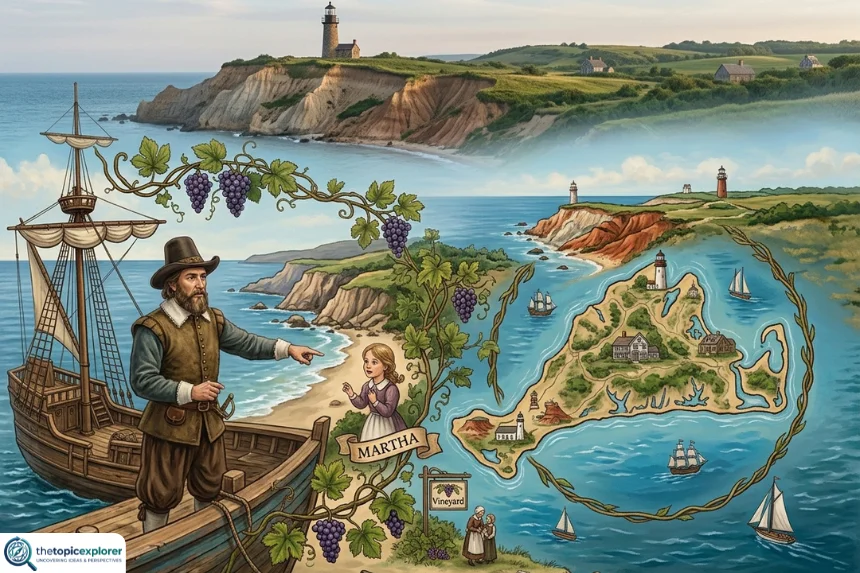

Many visitors ask, “Why is it called Martha’s Vineyard?” The name sounds as though it belongs to a woman who owned a large wine-producing estate. However, the real story reaches back to an English voyage along the New England coast in 1602.
Explorer Bartholomew Gosnold gave the island its English name. “Martha” traditionally refers to his young daughter, although historical research presents his mother-in-law, Martha Golding, as another possible namesake. Meanwhile, “Vineyard” probably described the wild grapevines or vine-like vegetation that Gosnold and his crew observed near the coast.
Nevertheless, the island’s history did not begin with Gosnold. Long before Europeans used the name Martha’s Vineyard, the Wampanoag knew their island as Noepe. The Wampanoag Tribe of Gay Head (Aquinnah) states that its ancestors have lived at Aquinnah and throughout Noepe for at least 10,000 years.
Quick answer: Martha’s Vineyard received its English name from explorer Bartholomew Gosnold in 1602. “Martha” most likely honored either his daughter or his mother-in-law, while “Vineyard” referred to the wild vines growing along the coast. Before Europeans applied that name, the Wampanoag called the island Noepe.
Why Is It Called Martha’s Vineyard? Quick Facts
| Question | Answer |
|---|---|
| Who named Martha’s Vineyard? | English explorer Bartholomew Gosnold |
| When was it named? | During Gosnold’s 1602 voyage |
| Who was Martha? | Traditionally identified as Gosnold’s daughter, although his mother-in-law is another credible possibility |
| Why “Vineyard”? | The word probably referred to wild grapevines or vine-covered coastal vegetation |
| Was it a commercial vineyard? | No evidence shows that Gosnold found an organized wine-producing vineyard |
| What was the island called earlier? | Noepe |
| What does Noepe mean? | The Wampanoag Tribe’s language resource translates it as “dry land” |
| Who lived there before Europeans arrived? | Wampanoag people with thousands of years of history on the island |
| Is the complete naming story certain? | No. The surviving record does not conclusively identify which Martha inspired the name |
Who Named Martha’s Vineyard?
Bartholomew Gosnold named Martha’s Vineyard during an English expedition in 1602. He sailed across the Atlantic with a relatively small group that intended to explore the North American coastline and investigate opportunities for trade and settlement.
During that voyage, Gosnold also applied the English name Cape Cod after his crew reportedly encountered large numbers of codfish in the surrounding waters. He later became involved in the establishment of Jamestown, although he died there in 1607, shortly after the colony’s founding.
For the Martha’s Vineyard article, however, his 1602 journey matters most. The official island visitor organization credits Gosnold with renaming the island that year and connects the name with his daughter Martha and the vine-like growth found near the shore.
Did Gosnold “Discover” Martha’s Vineyard?
It would be inaccurate to say that Gosnold discovered an unknown or uninhabited island.
Wampanoag people had already lived on Noepe for thousands of years. The Wampanoag Tribe of Gay Head (Aquinnah) traces its ancestors’ presence at Aquinnah and across the island back at least 10,000 years. Therefore, Gosnold’s arrival represents the beginning of the island’s recorded English naming history, not the beginning of its human history.
A more accurate statement is:
Bartholomew Gosnold gave Noepe the English name Martha’s Vineyard during his 1602 exploration of the New England coast.
This wording recognizes his role without erasing the island’s existing inhabitants, language and identity.
Who Was Martha in Martha’s Vineyard?
The simplest answer is that Martha was probably a member of Bartholomew Gosnold’s family. However, historians have not established her identity with complete certainty.
Two main explanations appear in historical discussions:
- Gosnold named the island after his daughter, Martha.
- He named it after his mother-in-law, Martha Golding.
The daughter explanation remains the most familiar version. Nevertheless, Martha’s Vineyard Museum publications preserve a long-running local debate over whether Gosnold’s mother-in-law provides a more convincing explanation.
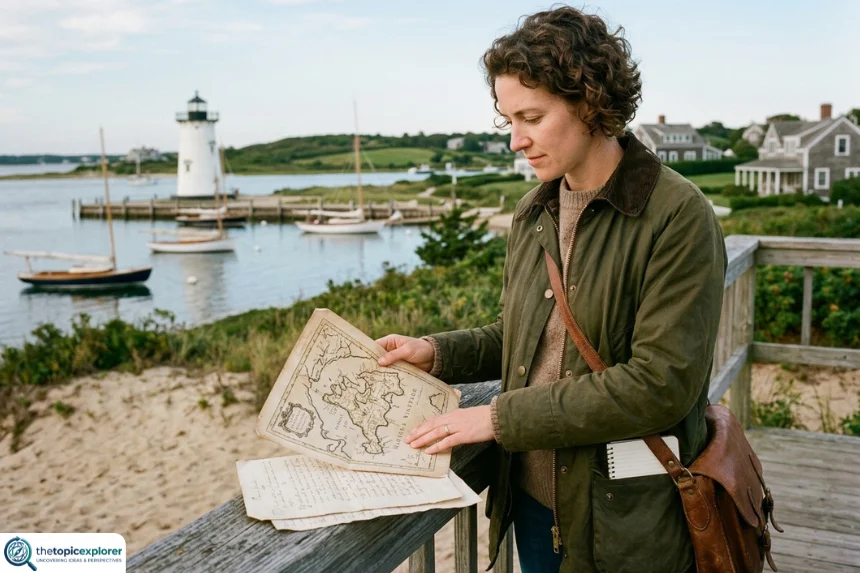
Theory One: Gosnold Named It After His Daughter
The traditional account says Gosnold named the island after his daughter Martha. The official Martha’s Vineyard visitor website presents this explanation, as do many popular history and travel summaries.
This explanation also fits a broader pattern in Gosnold’s voyage. Explorers often applied the names of family members, patrons, monarchs or associates to places they mapped.
However, the traditional story contains uncertainties. Surviving records do not include a clear statement from Gosnold explaining precisely why he chose “Martha.” Consequently, later writers have tried to reconstruct his reasoning from family relationships and naming customs.
Some accounts also differ over whether his daughter was alive when the name was chosen. Therefore, the finished article should avoid adding unverified emotional details, such as claiming that the name was definitely a memorial.
The safest wording is:
According to the most widely repeated account, Gosnold chose “Martha” in honor of his daughter.
That sentence explains the tradition without presenting it as indisputable proof.
Theory Two: The Name Honored Martha Golding
Another theory identifies Gosnold’s mother-in-law, Martha Golding, born Martha Judde, as the island’s namesake.
Historical articles preserved by the Martha’s Vineyard Museum argue that the elder Martha may provide a stronger explanation than Gosnold’s daughter. One museum publication describes Martha Golding as Gosnold’s mother-in-law and discusses her as the preferred candidate behind the name.
This possibility matters because English explorers frequently honored influential family members, patrons and people connected with their ventures. Still, the existing material does not settle the question beyond doubt.
Therefore, the article should present the mother-in-law explanation as a credible historical theory—not as a newly proven correction.
Which Martha Is the Most Likely Answer?
The daughter remains the best-known answer, especially in official tourism descriptions and popular histories. On the other hand, Martha Golding has substantial support in local historical research.
As a result, the most accurate conclusion is:
Martha was probably either Gosnold’s daughter or his mother-in-law, both of whom carried the name. The surviving historical record does not conclusively establish which woman he intended to honor.
This conclusion may appear less dramatic than selecting one theory. Nevertheless, it is more responsible because it distinguishes established history from tradition and interpretation.
Why Is It Called a “Vineyard”?
The word “Vineyard” probably came from the vines that Gosnold’s expedition saw growing naturally around the island.
The official Martha’s Vineyard visitor organization describes vine-like undergrowth along the coast. It also explains that grapevines can still be found around the island, even though the name did not originate from a large commercial wine estate.
Wild grapes grew in parts of coastal New England before European settlement. Therefore, the landscape may have reminded Gosnold and his companions of a vineyard, even though nobody had arranged the vines into cultivated rows or established a winery there.
Was Martha’s Vineyard an Actual Vineyard?
Not in the modern commercial sense implied by the name.
A vineyard usually refers to land deliberately planted and managed for growing wine grapes or table grapes. However, the name Martha’s Vineyard most likely described naturally occurring vines or dense vegetation rather than an organized agricultural property.
Therefore, three ideas should remain separate:
- Wild vines: Plants growing naturally in the island landscape.
- A cultivated vineyard: Managed land where people intentionally grow grapes.
- The place name: The descriptive English name applied during Gosnold’s voyage.
Confusing these ideas leads to the popular misconception that an unidentified woman named Martha once owned a winery on the island.
Did Gosnold See Wild Grapes?
The traditional explanation says that his party encountered grapevines or vine-covered undergrowth. Official island history continues to use this account when explaining the second half of the name.
However, historians cannot reconstruct every plant Gosnold observed or determine exactly how abundant those vines were. “Vineyard” may have reflected a general visual impression of the shore rather than a botanical survey.
Still, the explanation remains reasonable because European explorers often selected descriptive place names based on plants, animals, landforms and other immediately visible features.
What Was Martha’s Vineyard Called Before 1602?
Before Gosnold applied its English name, the island was known as Noepe by the Wampanoag.
The Wampanoag Tribe of Gay Head (Aquinnah) uses Noepe when describing the island and its long Indigenous history. The Tribe’s language resource translates the word as “dry land.”
This official Tribal translation deserves priority over simplified tourism explanations. Some secondary pages translate Noepe as “land amid the waters,” “land between the streams” or a similar phrase. However, the Wampanoag Tribe’s own language page gives “dry land.”
Therefore, a carefully sourced article should say:
The Wampanoag name for Martha’s Vineyard is Noepe, which the Wampanoag Tribe of Gay Head (Aquinnah) translates as “dry land.”
Why Noepe Belongs in the Name-Origin Story
An article answering “Why is it called Martha’s Vineyard?” could begin and end with Gosnold. However, that approach would imply that the island’s meaningful history started when an English explorer renamed it.
Including Noepe corrects that impression.
The Wampanoag had their own place names, cultural traditions, political communities and relationships with the island long before 1602. Moreover, the Wampanoag Tribe of Gay Head (Aquinnah) remains a living Tribal nation with continuing cultural and ancestral ties to Noepe.
Consequently, “Martha’s Vineyard” should be understood as the island’s surviving English name rather than its first or only historically meaningful name.
Did Martha Ever Live on the Island?
No reliable evidence shows that either proposed Martha lived on the island.
The name appears to have been an honorific chosen by Gosnold rather than a reference to a resident, landowner or vineyard operator. Therefore, readers should not imagine Martha as the proprietor of an estate on the Massachusetts coast.
In fact, the familiar question—“Who was Martha, and where was her vineyard?”—combines two misleading assumptions:
- Martha probably did not own the island.
- The “vineyard” probably was not a commercial grape farm.
Instead, the name joined a personal tribute with a description of the landscape.
Why the Familiar Story Needs a Careful Explanation
A simplified origin story usually says:
Bartholomew Gosnold named Martha’s Vineyard after his daughter because he found wild grapes there.
That explanation is useful as a starting point. However, it leaves out several important details:
- The island was already known as Noepe.
- Wampanoag history there extends back thousands of years.
- Martha’s identity remains disputed.
- The mother-in-law theory has support in local historical research.
- “Vineyard” referred to natural vegetation, not necessarily a cultivated wine estate.
- Some historical accounts suggest the name may originally have been applied to a different nearby island.
Therefore, a trustworthy answer should retain the memorable version while clearly identifying its uncertainties.
The Name Explained in One Sentence
Martha’s Vineyard is called that because Bartholomew Gosnold applied the English name in 1602, probably honoring a family member named Martha and describing the wild vines he encountered, while the Wampanoag had long known the island as Noepe.
Did the Name Martha’s Vineyard Originally Refer to Another Island?
The answer to why it is called Martha’s Vineyard becomes more complicated when historians examine records from Bartholomew Gosnold’s 1602 voyage.
A contemporary account by expedition member Gabriel Archer used the spelling “Marthaes Vineyard” for an island encountered during the journey. However, historians have disagreed about exactly which island Archer described. Some reconstructions suggest that the name initially referred to the smaller island now known as Nomans Land, located southwest of present-day Martha’s Vineyard.
Meanwhile, the much larger island eventually became permanently associated with the name Martha’s Vineyard.
This uncertainty exists because early navigational accounts were often brief, inconsistent and difficult to match with modern maps. Gosnold and his crew travelled through waters containing numerous islands, shoals and narrow passages. In addition, the surviving journals do not always describe their route clearly.
The Woods Hole Historical Museum’s detailed review of the voyage concludes that later parts of Gosnold’s route are difficult to reconstruct because the surviving reports contradict one another. The expedition probably stopped at present-day Martha’s Vineyard and Cuttyhunk, while it may also have visited Nomans Land and other nearby islands.
Therefore, the safest conclusion is:
Some historical interpretations suggest that “Martha’s Vineyard” may first have been applied to Nomans Land. However, the surviving records do not provide enough certainty to reconstruct every naming decision made during the 1602 voyage.
Why Might the Name Have Shifted?
Several explanations are possible.
First, early explorers sometimes produced inaccurate maps because they lacked modern navigational equipment. A small island viewed from a vessel could easily be confused with part of a larger landmass. Similarly, two islands might appear connected from a distance.
Second, handwritten journals and maps passed through multiple copyists. As a result, labels could move, change spelling or become attached to a different feature.
Finally, later mapmakers may have associated the memorable name with the larger and more geographically significant island. Once that usage appeared consistently in charts, official records and colonial documents, it became increasingly difficult to change.
The precise process remains uncertain. Nevertheless, the confusion shows that place names do not always become fixed at the moment someone first writes them down.
How Did the Name Become Permanent?
Although Gosnold’s exact route remains debated, early European maps began carrying the name forward.
A map prepared around 1610 included both Martha’s Vineyard and Elizabeth’s Isle, another name connected with Gosnold’s expedition. Therefore, the English name had already entered European cartography within a few years of the 1602 voyage.
Maps mattered because sailors, merchants, colonial officials and settlers relied on them when describing the New England coastline. Once several records used the same name for the larger island, that usage gained authority.
The process probably developed gradually:
- Gosnold or one of his companions selected the name.
- Expedition journals recorded a version of it.
- Mapmakers copied the name into later charts.
- English colonists used it in legal and geographic records.
- The name became part of government, commercial and everyday language.
This sequence is partly an inference from the surviving journals and maps. However, it explains how a name from one short expedition could eventually replace earlier European labels and become dominant in English usage.
Why Was Noepe Not Used on English Maps?
European mapmakers generally recorded names that served colonial navigation and administration. Therefore, they often replaced or altered Indigenous place names instead of preserving them accurately.
However, the Wampanoag name Noepe did not disappear from Wampanoag culture. The Wampanoag Tribe of Gay Head (Aquinnah) continues to use Noepe when describing its island homeland and its history. The Tribe states that Wampanoag ancestors have lived at Aquinnah and throughout Noepe for at least 10,000 years.
Consequently, the island has two important naming traditions:
- Noepe, rooted in Wampanoag language, history and continuing cultural identity.
- Martha’s Vineyard, the English name that entered colonial maps and became the island’s official modern name.
Recognising both names creates a more complete historical account.
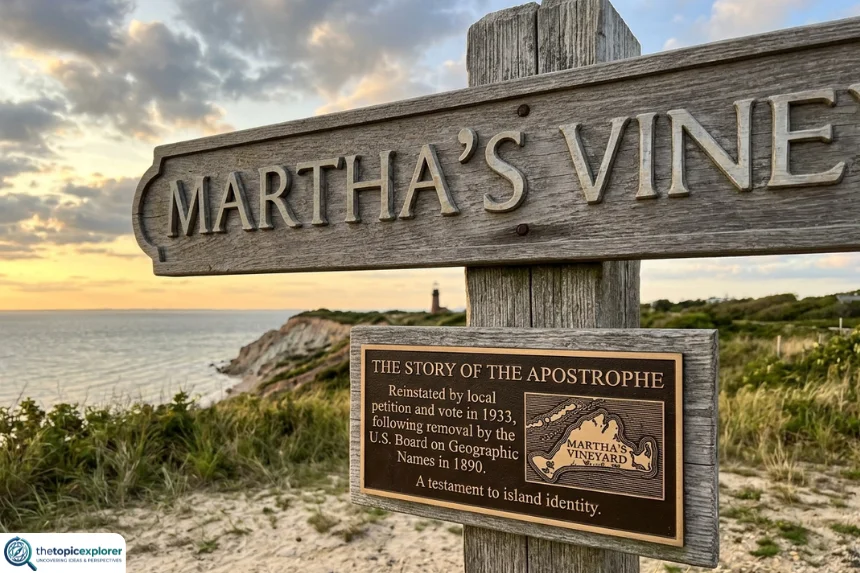
Why Does Martha’s Vineyard Have an Apostrophe?
The apostrophe in Martha’s Vineyard shows possession or association in English grammar.
In other words, the name can be read as:
The vineyard associated with Martha.
However, the possessive form does not mean that Martha legally owned the island, managed a winery or lived there. Instead, Gosnold apparently combined a personal dedication with a description of the landscape.
Early records did not always use modern punctuation or spelling. For example, Archer’s account used “Marthaes Vineyard” rather than the present apostrophe form.
Spelling was less standardised in the early 1600s. Moreover, handwritten documents frequently represented possessive endings in different ways. The modern spelling eventually became:
Martha’s Vineyard
Therefore, the apostrophe reflects the personal element of the name, not documented property ownership.
Why Is Martha’s Vineyard Often Called “the Vineyard”?
Residents, visitors and regional organisations frequently shorten Martha’s Vineyard to “the Vineyard.”
The shortened name works because the island is widely recognised throughout Massachusetts and New England. Within the local context, speakers generally do not need to clarify which vineyard they mean.
For example, regional organisations regularly use phrases such as:
- Island towns
- Vineyard residents
- Vineyard schools
- Vineyard history
- Vineyard planning
The Martha’s Vineyard Commission also uses “the Island” and related shorthand when discussing the community’s six towns. Those towns are Aquinnah, Chilmark, Edgartown, Oak Bluffs, Tisbury and West Tisbury.
Nevertheless, “the Vineyard” can confuse people who are unfamiliar with Massachusetts. They may assume that it refers to agricultural land rather than an island.
For this reason, an article should use the complete name at the beginning. Afterwards, it can occasionally use “the Vineyard” when the meaning is clear.
Is Martha’s Vineyard One Town?
No. Martha’s Vineyard is an island containing six separate towns, not one municipality.
They are:
| Town | Name-related note |
|---|---|
| Aquinnah | A Wampanoag name meaning the shore or end of the island |
| Chilmark | An English colonial place name |
| Edgartown | Named during the colonial period |
| Oak Bluffs | Reflects local landscape and later development |
| Tisbury | An English place name |
| West Tisbury | Developed from the western portion of Tisbury |
The Martha’s Vineyard Commission confirms that the island consists of six towns. Dukes County also includes Gosnold, the municipality covering the Elizabeth Islands.
This distinction matters because visitors sometimes describe Martha’s Vineyard as if it were a single town. In reality, each community has its own government, character and history.
Wampanoag Place Names Still Shape the Island
Although Martha’s Vineyard became the dominant English name, numerous Wampanoag place names remain visible across the island.
The Wampanoag Tribe of Gay Head (Aquinnah) records traditional names for locations throughout Noepe. These include:
- Aquinnah — the shore or end of the island
- Noepe — dry land
- Squibnocket — at the place of the red cliff or bank
- Chappaquiddick — place of the separate island
- Menemsha-related Wawitukq — winding or twisting river
- Taakemmy — a place associated with corn processing
These names preserve information about geography, settlement, food production and how Wampanoag people understood the landscape.
Therefore, the island’s naming history cannot be reduced to one English explorer and one family member. Its full linguistic landscape includes thousands of years of Wampanoag knowledge.
Why Place Names Matter
A place name can record:
- The physical appearance of an area
- The plants or animals found there
- The people associated with it
- A traditional activity
- A spiritual account
- A political or family relationship
- An event remembered by later generations
For example, the English word “Vineyard” probably describes vegetation. Meanwhile, several Wampanoag names describe cliffs, rivers, hunting areas or settlement locations.
Consequently, names work like compact historical records. Even when the landscape changes, the name may preserve an older observation.
Why Was Gay Head Renamed Aquinnah?
The island offers a modern example of an Indigenous place name returning to official use.
For many years, the westernmost town was officially called Gay Head, a name connected with European descriptions of the colourful cliffs. However, the community changed the town’s official name to Aquinnah in 1998.
The Wampanoag Tribe explains that the Massachusetts legislature approved the return to the former Wampanoag name. The change represented recognition of Wampanoag history in the region.
This renaming does not change the official name Martha’s Vineyard. Nevertheless, it demonstrates that place names can be reconsidered when communities seek to recognise a deeper or more accurate history.
Today, Aquinnah refers both to the town and to the ancestral homeland of the Wampanoag Tribe of Gay Head (Aquinnah).
The Naming Story in Historical Context
The English naming of Martha’s Vineyard occurred during a period when European powers were mapping coastlines and competing for trade, land and political influence.
European navigators frequently renamed places even when Indigenous communities already had established names for them. These new names might honour:
- Monarchs
- Financial supporters
- Family members
- Saints
- Expedition leaders
- Places in Europe
- Visible natural features
Gosnold’s naming choices followed this general pattern. Cape Cod referred to a natural resource, while Martha’s Vineyard apparently combined a family name with visible vegetation.
However, these names also served practical colonial purposes. They allowed English sailors and officials to create maps that reflected their own political and commercial interests.
Therefore, the name Martha’s Vineyard carries two layers:
- A personal and descriptive naming story.
- A broader history of European mapping and colonial expansion.
Acknowledging the second layer does not prevent readers from enjoying the familiar origin story. Instead, it explains why the English name became dominant even though the island already had a name.
A Timeline of the Martha’s Vineyard Name
| Period | Development |
|---|---|
| Thousands of years before European arrival | Wampanoag people live throughout Noepe and develop place names connected with the island’s landscape and communities. |
| Before 1602 | European navigators encounter and map parts of the New England coast, sometimes applying their own labels. |
| 1602 | Bartholomew Gosnold’s expedition uses the name Martha’s Vineyard during its voyage through the region. |
| Early 1600s | Maps and records begin carrying the English name forward. |
| Later colonial period | Martha’s Vineyard becomes established in English legal, navigational and administrative usage. |
| 1870 | Gay Head is incorporated as a Massachusetts town despite objections from Wampanoag residents, according to the Tribe’s history. |
| 1998 | Gay Head officially changes its name to Aquinnah, restoring a Wampanoag place name. |
The Wampanoag Tribe provides the historical context for Noepe, the 1870 incorporation and the 1998 return to the name Aquinnah.
Common Martha’s Vineyard Name Myths
Myth 1: Martha Owned the Island
No reliable evidence shows that either proposed Martha owned or lived on the island.
The name appears to have honoured a woman associated with Gosnold. Therefore, the possessive form should not be interpreted as a property record.
Myth 2: Martha Operated a Winery
There is no evidence that Martha managed a winery there.
“Vineyard” most likely referred to naturally growing vines observed during the expedition rather than an organised wine business.
Myth 3: Gosnold Was the First Person to Find the Island
Wampanoag people had lived on Noepe for thousands of years before Gosnold’s voyage. The Tribe identifies the Wampanoag as the first people of Noepe and describes a continuous connection to the island.
Therefore, Gosnold introduced the surviving English name; he did not discover an unknown land.
Myth 4: Historians Know Exactly Which Martha Inspired the Name
The daughter theory remains the familiar explanation. However, the mother-in-law theory also appears in local historical research.
Because the surviving record is incomplete, a responsible article should present the identity as uncertain.
Myth 5: The Name Has Always Referred Unambiguously to the Same Island
Some reconstructions suggest that the expedition may originally have used the name for Nomans Land. However, the historical route and early journal descriptions remain disputed.
Why Has the Name Lasted for More Than Four Centuries?
Martha’s Vineyard survived as a place name because it became embedded in maps, navigation, government and everyday language.
Moreover, the name is memorable. It combines a personal name with a vivid landscape image, which makes it easier to remember than many purely technical geographic labels.
Over time, it became connected with:
- Island communities
- Maritime history
- Fishing and whaling
- Tourism
- Summer residences
- Arts and culture
- African American history
- Wampanoag history and contemporary Tribal life
Nevertheless, the name’s familiarity should not hide the older identity of Noepe. Both terms reveal different parts of the island’s past and present.
Where Is Martha’s Vineyard?
Martha’s Vineyard is a Massachusetts island located off the southern coast of Cape Cod. The official island visitor organisation describes it as approximately seven miles from the Massachusetts mainland. Travellers generally reach the island by boat or aircraft because no bridge connects it to the mainland.
The island contains six separate towns:
- Aquinnah
- Chilmark
- Edgartown
- Oak Bluffs
- Tisbury
- West Tisbury
Therefore, Martha’s Vineyard is not the name of one town. Instead, it is the name of the entire island shared by those six municipalities. The Martha’s Vineyard Commission confirms that it serves all six island towns as part of its regional planning responsibilities.
This geographical distinction helps explain why residents commonly say that they live “on Martha’s Vineyard” rather than “in Martha’s Vineyard.”
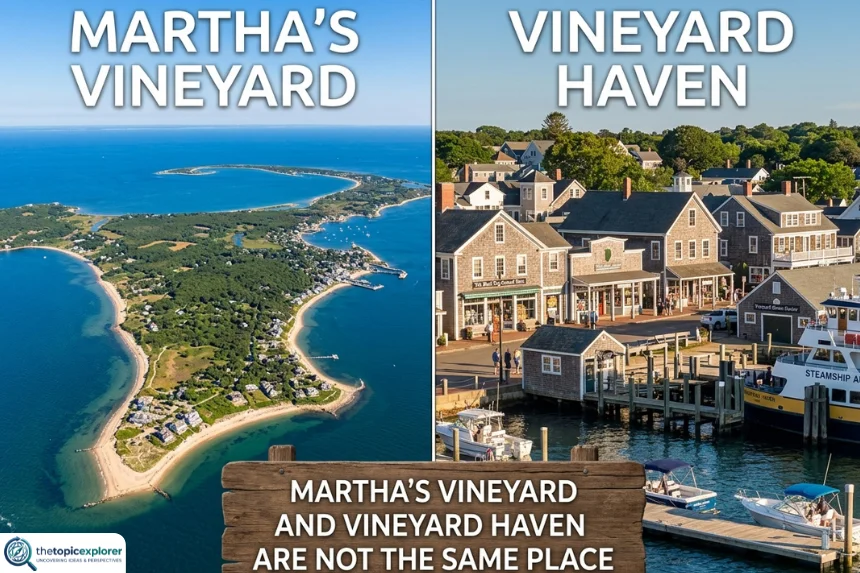
Martha’s Vineyard and Vineyard Haven Are Not the Same Place
Visitors sometimes confuse Martha’s Vineyard with Vineyard Haven. However, the two names refer to different geographical areas.
Martha’s Vineyard is the whole island. Meanwhile, Vineyard Haven is a village within the town of Tisbury. It is also one of the island’s main arrival points for ferry passengers.
The official visitor organisation explains that a traveller can arrive in Vineyard Haven while a navigation system identifies the location as Tisbury. Both descriptions are correct because Vineyard Haven is a community located inside the incorporated town of Tisbury.
Therefore:
| Name | What it describes |
|---|---|
| Martha’s Vineyard | The entire Massachusetts island |
| Tisbury | One of the island’s six towns |
| Vineyard Haven | A village and harbour within Tisbury |
| The Vineyard | A common shortened name for Martha’s Vineyard |
The word “Vineyard” appears in both Martha’s Vineyard and Vineyard Haven. Nevertheless, neither name means that the entire community functions as a commercial grape-growing estate.
Is There a Real Vineyard on Martha’s Vineyard Today?
The name naturally leads visitors to expect rows of cultivated grapes and working wineries. However, the official Martha’s Vineyard visitor website currently states that the island has no operating vineyards, although grapevines can still be found around the island.
Consequently, the word “Vineyard” is primarily historical and descriptive. It reflects the vines or vine-like coastal vegetation associated with the 1602 naming story rather than the island’s present-day economy.
That distinction answers a common misunderstanding:
Martha’s Vineyard is the name of an island, not the name of a single commercial vineyard.
Restaurants and shops may sell wine, and grapevines may grow in various locations. Nevertheless, those modern details did not create the island’s name.
Could a Vineyard Open There in the Future?
A future agricultural or wine-producing business would not change the historical explanation. Even if someone established a cultivated vineyard, the island would still owe its English name to the vines described in accounts of Bartholomew Gosnold’s voyage.
Therefore, modern business activity and historical name origin should remain separate in the article.
Why the Name Creates So Much Confusion
The phrase Martha’s Vineyard resembles a personal property name. It sounds similar to expressions such as “John’s farm” or “Sarah’s orchard.”
As a result, readers may reasonably assume that:
- Martha owned the island.
- Martha lived there.
- Martha planted grapes.
- Martha managed a winery.
- The island developed around her agricultural estate.
However, surviving accounts do not support those assumptions. The personal name probably honoured someone connected with Gosnold, while the landscape term described naturally occurring vegetation.
In other words, Martha and Vineyard represent two separate parts of the naming decision:
| Part of the name | Most likely explanation |
| Martha’s | A tribute to a member of Bartholomew Gosnold’s family |
| Vineyard | A description of wild vines or vine-like vegetation |
| Complete name | A personal dedication combined with a landscape observation |
This two-part explanation offers a clearer answer than imagining one historical woman who owned a grape farm.
Why Historians Cannot Give a Completely Certain Answer
The main naming event occurred in 1602. Therefore, historians must rely on surviving voyage accounts, maps, genealogical records and later interpretations.
Those sources establish several important facts. Gosnold travelled through the region, the name appeared in records connected with his expedition, and he had family members named Martha. However, no surviving statement from Gosnold clearly says:
I chose this name for this specific Martha for this specific reason.
That missing explanation creates room for competing interpretations.
The official visitor account follows the traditional daughter theory. In contrast, historical publications preserved by the Martha’s Vineyard Museum discuss Martha Golding, Gosnold’s mother-in-law, as another candidate. One museum study identifies her as the grandmother of Gosnold’s children and argues that she may have inspired both his daughter’s name and the island’s name.
Another museum publication questions the certainty of the familiar daughter explanation. Therefore, the most accurate article should acknowledge that the identity cannot be conclusively settled with the surviving evidence.
How Should the Story Be Worded?
Avoid writing:
Bartholomew Gosnold definitely named the island after his daughter.
Use this more accurate version:
Bartholomew Gosnold is traditionally said to have named the island after his daughter Martha, although local historical research identifies his mother-in-law, Martha Golding, as another possible namesake.
That sentence protects the article’s credibility while still giving readers the familiar answer.
The Three Layers of the Island’s Name
A complete explanation of the name contains three historical layers.
1. The Wampanoag name
The island was known as Noepe long before Gosnold’s voyage. The Wampanoag Tribe of Gay Head (Aquinnah) states that Wampanoag ancestors have lived at Aquinnah and throughout Noepe for at least 10,000 years. Its language resource translates Noepe as “dry land.”
2. The English personal dedication
Gosnold selected the name Martha, most likely to honour either his daughter or his mother-in-law.
3. The landscape description
The word “Vineyard” referred to vines or vine-like vegetation observed along the coast. The island’s official visitor organisation continues to explain the name through Martha and the vine-covered landscape.
Together, these layers show that the present name is not merely a charming tourism label. It reflects Indigenous continuity, European exploration, family connections and the natural appearance of the coastline.
Why Noepe Remains Important Today
Noepe is not simply an abandoned historical word. The Wampanoag Tribe of Gay Head (Aquinnah) continues to use it when discussing its homeland, history and cultural traditions.
Furthermore, the Wampanoag presence on the island continues through a living Tribal community. The Aquinnah Cultural Center works to preserve and communicate Wampanoag history, beliefs and lifeways to Tribal members and visitors.
Therefore, an accurate article should not describe Noepe only in the past tense. Although Martha’s Vineyard is the island’s official modern English name, Noepe remains culturally meaningful.
A respectful explanation can use both:
Martha’s Vineyard, traditionally known to the Wampanoag as Noepe, received its English name during Bartholomew Gosnold’s 1602 expedition.
How the Name Influences the Island’s Modern Identity
Over time, Martha’s Vineyard became more than a label on a map. The name now identifies the island’s communities, institutions, history, arts, businesses and coastal culture.
Local organisations use “Vineyard” as a regional adjective in expressions such as:
- Vineyard history
- Vineyard residents
- Vineyard schools
- Vineyard businesses
- Vineyard transportation
- Vineyard culture
However, the name’s popularity can sometimes overshadow the island’s longer Wampanoag history. For that reason, museums, Tribal organisations and cultural institutions increasingly provide historical context that extends well beyond the 1602 English naming story.
The modern identity of the island includes both traditions:
- Martha’s Vineyard as a recognised Massachusetts place name.
- Noepe as a continuing Wampanoag homeland and cultural name.
Neither part should be omitted from a complete historical account.
A Simple Explanation for Students
Students can explain the answer in four points:
- The Wampanoag called the island Noepe before Europeans arrived.
- Bartholomew Gosnold applied the English name in 1602.
- “Martha” probably honoured his daughter or mother-in-law.
- “Vineyard” probably described wild vines rather than a winery.
A concise school-ready answer would be:
Martha’s Vineyard received its English name from explorer Bartholomew Gosnold in 1602. He probably used “Martha” to honour a family member and “Vineyard” because he saw wild vines along the coast. The Wampanoag had already known the island as Noepe for thousands of years.
This wording is brief, historically responsible and easy to understand.
Frequently Asked Questions
Why is it called Martha’s Vineyard?
It is called Martha’s Vineyard because Bartholomew Gosnold applied the English name during his 1602 voyage. “Martha” probably honoured his daughter or his mother-in-law, while “Vineyard” most likely referred to vines or vine-covered vegetation along the coast.
Who was Martha in Martha’s Vineyard?
The traditional answer identifies Martha as Gosnold’s daughter. However, local historical research suggests that Martha Golding, his mother-in-law, may have been the namesake. The available records do not settle the question completely.
Did Martha own Martha’s Vineyard?
No reliable evidence shows that either proposed Martha owned, lived on or operated a business on the island. The name appears to have been an honour rather than a record of ownership.
Was Martha’s Vineyard really a vineyard?
It was not a cultivated commercial vineyard in the modern sense. “Vineyard” probably described naturally growing vines or vine-like undergrowth encountered by Gosnold’s expedition.
Are there vineyards on Martha’s Vineyard now?
The official island visitor website currently states that there are no operating vineyards, although grapevines can be found across the island.
What was Martha’s Vineyard originally called?
The Wampanoag name for the island is Noepe. The Wampanoag Tribe of Gay Head (Aquinnah) translates Noepe as “dry land.”
Who lived on Martha’s Vineyard before Europeans?
Wampanoag people lived throughout Noepe for thousands of years before Gosnold’s voyage. The Wampanoag Tribe traces its ancestors’ island presence back at least 10,000 years.
Who named Martha’s Vineyard?
English explorer Bartholomew Gosnold is associated with applying the name during his 1602 expedition.
Did Bartholomew Gosnold discover Martha’s Vineyard?
He did not discover an uninhabited or previously unknown island. Wampanoag communities had lived there for thousands of years. More accurately, Gosnold introduced the English name that later became dominant on colonial maps.
Why does Martha’s Vineyard have an apostrophe?
The apostrophe creates the possessive form of Martha. It presents the phrase as “Martha’s Vineyard,” or the vineyard associated with Martha. However, the grammar does not prove that she legally owned it.
Is Martha’s Vineyard one town?
No. It is an island containing six towns: Aquinnah, Chilmark, Edgartown, Oak Bluffs, Tisbury and West Tisbury.
Is Vineyard Haven the same as Martha’s Vineyard?
No. Martha’s Vineyard is the entire island, whereas Vineyard Haven is a village within the town of Tisbury.
Why do people call it “the Vineyard”?
“The Vineyard” is a convenient shortened form of Martha’s Vineyard. Residents, visitors and regional organisations commonly use it when the island context is already clear.
Did the name first belong to Nomans Land?
Some historical interpretations suggest that the 1602 expedition may initially have applied Martha’s Vineyard to the smaller nearby island now called Nomans Land. However, voyage records and route reconstructions are not clear enough to establish the sequence with certainty.
Is Martha’s Vineyard near Cape Cod?
Yes. It lies off the southern coast of Massachusetts near Cape Cod and is accessible by boat or air.
Conclusion
So, why is it called Martha’s Vineyard? Bartholomew Gosnold applied the English name during his 1602 voyage. He probably selected “Martha” to honour either his daughter or his mother-in-law. Meanwhile, “Vineyard” most likely described wild vines or vine-covered coastal vegetation rather than a developed winery.
However, that English origin story represents only one part of the island’s history. Long before Gosnold arrived, Wampanoag people knew their homeland as Noepe and had lived there for thousands of years.
Therefore, the most accurate explanation recognises both names. Martha’s Vineyard reflects the island’s English mapping history, while Noepe preserves its much older and continuing Wampanoag identity.
READ MORE ABOUT: What Is Ramie
