

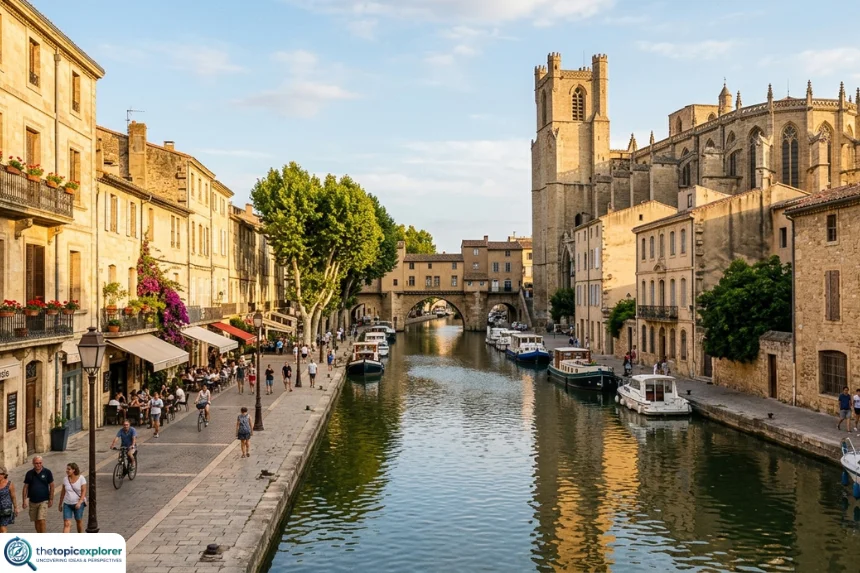

Narbonne France is a historic city in southern France where Roman ruins, medieval architecture, canals, markets and Mediterranean landscapes overlap within a relatively compact destination. Located in the Aude department of Occitanie, Narbonne had 57,587 residents in 2023, according to France’s official statistics agency, INSEE.
The city is especially notable because modern Narbonne stands on the site of Narbo Martius, a Roman colony founded in 118 BCE that later became a major provincial capital and Mediterranean trading center. Today, visitors can walk across a surviving section of the Via Domitia, descend into Roman underground galleries, explore a modern archaeological museum, visit a towering Gothic cathedral and follow a UNESCO-connected canal toward the Mediterranean.
What Is Narbonne?
Narbonne is a historic city in Occitanie in southern France, best known for its Roman origins, medieval cathedral, Archbishop’s Palace, Canal de la Robine and proximity to the Mediterranean coast. Founded as Narbo Martius in 118 BCE, it became an important Roman provincial capital before developing into a major medieval religious center.
Today, Narbonne combines functioning city life with archaeological and architectural heritage. It is large enough to have active neighborhoods, markets, restaurants and rail connections, yet its central historic sights remain close enough to explore largely on foot.
Narbonne Quick Facts
| Detail | Information |
|---|---|
| Country | France |
| Region | Occitanie |
| Department | Aude |
| Population | 57,587 in 2023 |
| Roman name | Narbo Martius |
| Roman foundation | 118 BCE |
| Historic importance | Roman provincial capital and major port |
| Major medieval landmark | Cathedral of Saint-Just and Saint-Pasteur |
| Main waterway | Canal de la Robine |
| Major archaeological museum | Narbo Via |
| Beach district | Narbonne-Plage |
| Distance to beach district | About 15 km / 9 miles |
| Main rail station | Narbonne |
| Language | French |
| Currency | Euro |
The population figure is from INSEE’s latest territorial comparison for Narbonne.
Where Is Narbonne?
Narbonne is in southern France, within the Aude department of Occitanie. INSEE identifies Narbonne as the center of its own arrondissement and urban area.
Geographically, the city sits between several major southern-French destinations.
Carcassonne lies inland to the west, while Béziers and Montpellier are farther east along the Mediterranean transport corridor. The actual historic center of Narbonne is inland, but the municipality extends toward the coast through Narbonne-Plage, its Mediterranean beach district.
That combination makes the city unusual: travelers can spend the morning exploring Roman and medieval architecture and later reach a sandy Mediterranean beach without leaving the municipality.
Why Narbonne Is Historically Important
Narbonne’s modern scale can make its ancient importance easy to underestimate.
Roman Narbonne was not a minor provincial settlement.
The official Narbo Via museum describes Narbo Martius as the first Roman colony established in Gaul, founded in 118 BCE. It later became capital of the Roman province of Gallia Narbonensis.
Its position was strategically valuable because Narbonne Narbonne France connected Mediterranean trade with major overland routes.
Moreover, the ancient city developed into an important port. Official Narbo Via material describes Narbo Martius at its height as one of the major ports of the western Mediterranean.
Consequently, today’s surviving Roman traces represent only a fraction of what once existed.
Roman Narbonne and Narbo Martius
The Roman Foundation
Rome founded Narbo Martius in 118 BCE.
Narbo Via’s historical material explains that the colony became a gateway for Roman expansion and administration in southern Gaul. Later, under Augustus, it became the capital of Gallia Narbonensis.
The ancient city contained monumental public buildings, temples, Narbonne France commercial areas and port infrastructure.
However, unlike places such as Nîmes or Arles, Narbonne’s largest Roman monuments did not survive intact above ground.
That makes its archaeological story different.
Instead of one giant amphitheater dominating the modern skyline, Roman Narbonne appears through buried remains, reused stone blocks, underground spaces, museum collections and fragments embedded in the current city.
Walk Across the Via Domitia
One of the easiest Roman remains to see costs nothing.
A visible section of the Via Domitia lies in the center of Place de l’Hôtel de Ville.
Narbonne’s municipal heritage service says the square was renovated in 1997 and displays a surviving section of the ancient road at its center.
The Via Domitia was the Roman road linking Italy with Roman territories toward Hispania.
Therefore, standing on the exposed stones is not simply seeing an old street. Visitors are standing on part of a transport network that connected major sections of the Roman Mediterranean world.
This is one of Narbonne’s most effective historical experiences because the ancient road appears directly within the modern city rather than behind museum glass.
Explore the Roman Horreum
Another important Roman site lies below street level.
The Horreum consists of underground galleries dating from the Roman period. Today, it forms part of the Narbo Via archaeological organization.
Although traditionally associated with storage, the exact functionNarbonne France of the galleries has been discussed by archaeologists.
For visitors, the main appeal is spatial: walking through the underground network gives a much stronger sense of Roman Narbonne’s physical layers than reading about them from street level.
Current opening arrangements can change seasonally, especially during extreme summer heat, so travelers should check the official information before visiting.
Official Horreum visitor information
Visit the Narbo Via Museum
For a broader understanding of Roman Narbonne, Narbo Via should be one of the highest-priority stops.
The museum brings together archaeological material that had previously been dispersed across different collections. Its displays examine Narbo Martius from its foundation through its development as an important Roman city.
One of the museum’s most distinctive features is its monumental display of reused Roman stone blocks.
The City of Narbonne says the permanent collection includes around 1,300 objects, while a large modular wall displays hundreds of funerary stone blocks.
The museum also helps compensate for the fact that much of ancient Narbonne no longer survives above ground.
Official Narbo Via museum information
Medieval Narbonne Is Just as Important
Narbonne’s story did not end with Rome.
During the medieval period, the city became an important ecclesiastical center. Its most dramatic surviving structures come from this later era rather than antiquity.
The historic center is dominated by two closely connected landmarks:
- Cathedral of Saint-Just and Saint-Pasteur
- Palace of the Archbishops
Together, they form one of the city’s most impressive architectural ensembles.
Cathedral of Saint-Just and Saint-Pasteur
Narbonne’s cathedral is one of the visual symbols of the city.
Construction began in the 13th century, and the building reflects the influence of northern French Gothic architecture. The city describes its choir, flying Narbonne France buttresses and towers as rising to more than 60 meters.
However, the cathedral is especially interesting because it was never completed as originally planned.
Only part of the ambitious medieval design was realized.
That incompleteness is not a flaw from a visitor’s perspective. Instead, it makes the cathedral a physical reminder of how changing finances, politics and urban constraints could shape medieval building projects.
The cathedral, cloister and Archbishop’s Palace together create the monumental core of central Narbonne.
Official Cathedral of Saint-Just and Saint-Pasteur visitor information
Explore the Palace of the Archbishops
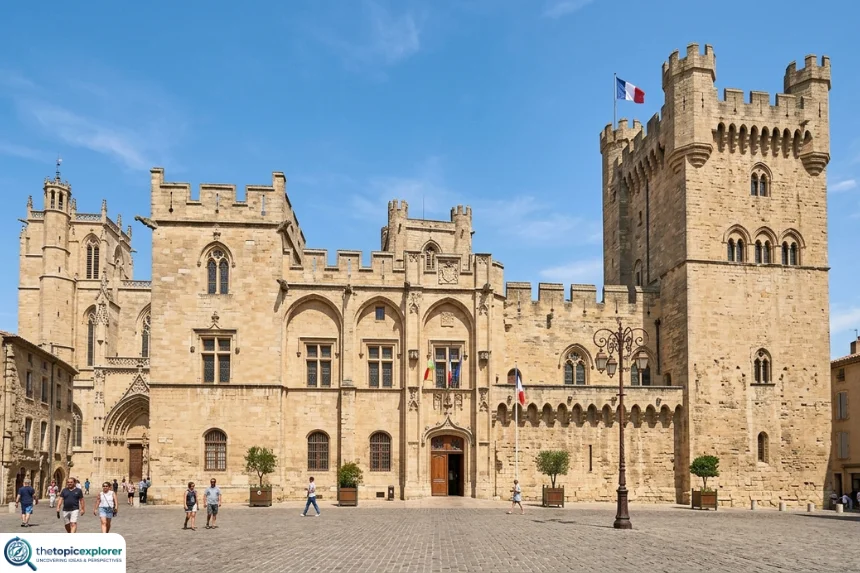
Next to the cathedral stands the Palais des Archevêques, or Palace of the Archbishops.
The City of Narbonne describes the complex as both a residence and fortress. Medieval towers, later additions and museum spaces illustrate the long political and religious influence of Narbonne’s archbishops.
The complex includes the imposing Gilles Aycelin keep, dating from the late 13th century.
From a visitor perspective, the palace helps explain why medieval Narbonne held importance far beyond its immediate local population.
Official Archbishop’s Palace information
The Canal de la Robine
The Canal de la Robine runs directly through central Narbonne and shapes much of the city’s atmosphere.
However, one common mistake should be corrected:
The Canal du Midi itself does not run through central Narbonne.
Instead, the Canal de la Robine connects the city toward the Canal du Midi system and the Mediterranean.
UNESCO’s official Canal du Midi listing includes a 36.6-kilometer section between Moussan and Port-la-Nouvelle incorporating part of the Canal de la Robine.
Therefore, it is accurate to describe the Robine as part of the wider UNESCO-listed Canal du Midi property, but not to say that central Narbonne sits directly on the main Canal du Midi channel.
The canal gives central Narbonne one of its most attractive walking environments, with waterside promenades, bridges, market activity and historic architecture.
UNESCO Canal du Midi World Heritage information
See the Pont des Marchands
The Pont des Marchands, or Merchants’ Bridge, is another unusual part of the historic center.
Narbonne’s heritage service explains that the bridge once had multiple arches and carried the Via Domitia into the ancient city from the south. Today, only one arch remains visible.
Buildings occupy the bridge above the water, creating one of the city’s most distinctive urban scenes.
The structure also demonstrates how Narbonne’s Roman, medieval and modern layers literally overlap one another.
Eat at Les Halles de Narbonne
For everyday local culture, Les Halles may be just as important as the monuments.
The city’s covered market occupies a historic pavilion inaugurated in 1901. Today it houses more than 70 food businesses, including butchers, fishmongers, bakers, produce sellers, delicatessens, wine merchants and bars.
The market sits beside the canal and remains part of daily life rather than functioning only as a tourist attraction.
That makes it an excellent place for visitors to experience local produce and food culture.
As of the city’s current information, Les Halles opens every day, although individual stall schedules can vary.
Official Les Halles de Narbonne information
What to Eat and Drink
Narbonne lies within one of southern France’s major wine-producing regions.
Local food reflects the wider Mediterranean and Languedoc environment, with seafood, charcuterie, cheeses, olives, produce and regional wines appearing throughout markets and restaurants.
Visitors do not need a formal tasting itinerary to experience that culture.
A morning at Les Halles followed by lunch in the historic center can provide a straightforward introduction.
Meanwhile, the surrounding Narbonnais countryside contains extensive vineyard landscapes, making wine a visible part of the region even for travelers who do not visit wineries.
Narbonne-Plage Brings the City to the Mediterranean
One of Narbonne’s most useful features is that the municipality includes its own Mediterranean beach district.
Narbonne-Plage lies about 15 km, or roughly 9 miles, from central Narbonne.
The city describes it as Narbonne’s Mediterranean Narbonne France frontage, located below the La Clape massif. It has approximately 4.5 km of sandy beach.
As a result, travelers do not necessarily have to choose between historical sightseeing and a beach day.
Narbonne can support both.
In summer, however, Narbonne-Plage becomes much busier than it is during the rest of the year. The city says its year-round population rises dramatically during peak summer season.
Official Narbonne-Plage information
Best Things to Do in Narbonne
For a first visit, the most worthwhile experiences are:
Walk the Via Domitia in Place de l’Hôtel de Ville.
Visit Narbo Via to understand the scale of Roman Narbo Martius.
Explore the Horreum for an underground archaeological experience.
Enter the cathedral and walk through the medieval monumental district.
Visit the Archbishop’s Palace and surrounding historic center.
Walk beside the Canal de la Robine.
Browse Les Halles in the morning.
See the Pont des Marchands.
Spend time at Narbonne-Plage when weather permits.
The advantage is that most central sights cluster within a walkable area.
Is Narbonne Worth Visiting?
Yes, particularly for travelers interested in Roman history, medieval architecture, markets and slower-paced southern French cities.
Narbonne offers something different from both nearby Narbonne France Carcassonne and larger Mediterranean cities.
Carcassonne is dominated by its spectacular fortified medieval citadel. Narbonne, in contrast, reveals its history in layers:
Roman road below your feet,
medieval towers above the streets,
a canal through the center,
a traditional food market nearby,
and Mediterranean beaches farther east.
It is therefore particularly rewarding for travelers who enjoy historical context rather than one single headline monument.
How Long Should You Spend in Narbonne?
A full day can cover the historic center reasonably well.
A typical one-day route might include:
Morning: Les Halles → Canal de la Robine → Via Domitia
Late morning: cathedral and Archbishop’s Palace
Afternoon: Narbo Via or the Horreum
Evening: canal-side walk and dinner
However, two days are better if you want to add Narbonne-Plage, museums or a slower pace.
A longer stay also works well for travelers using Narbonne as a base for exploring the wider Aude and Mediterranean region.
Getting to Narbonne
Narbonne has strong rail connections for a city of its size.
Current SNCF schedules include direct TGV service between Paris and Narbonne, with the fastest listed journeys taking approximately 4 hours 25 minutes.
That makes rail one of the easiest ways to reach the city after arriving in France.
Narbonne also lies on the major rail corridor linking destinations such as Montpellier, Béziers and southern routes toward Spain.
Travel times vary by date, train type and engineering works, so schedules should be checked for the exact travel day.
Current SNCF Paris–Narbonne train schedules
Can You Visit Without a Car?
Yes.
The central historic attractions are concentrated enough that many visitors can explore central Narbonne on foot.
A car becomes more useful for:
- beaches
- vineyard areas
- small surrounding villages
- nature reserves
- rural attractions
Therefore, travelers focusing on Roman and medieval Narbonne can manage well by train and walking, while broader regional exploration benefits from a vehicle.
Best Time to Visit
For sightseeing, spring and early fall offer an attractive balance.
Temperatures are generally easier for walking than during the hottest part of summer, while the city remains active.
Summer works particularly well for travelers combining cultural sightseeing with Narbonne-Plage.
However, July and August are also the busiest period on the coast.
Winter is quieter and may appeal to travelers focused primarily on history, food and museums rather than beach activities.
Museum and monument opening hours can vary seasonally, so checking official pages shortly before visiting is sensible.
Modern Narbonne: More Than a Historic Center
Narbonne is not merely a preserved tourist district.
The latest INSEE data record a population of 57,587 in 2023, up from 54,700 in 2017. The average annual population growth rate between 2017 and 2023 was 0.9%.
The commune contained more than 30,000 households in 2023.
Therefore, the city functions as an active regional center with schools, businesses, housing, services and surrounding residential districts beyond the historic core.
That distinction matters because visitors are experiencing a working city rather than an open-air heritage park.
Roman History vs. What You Can Actually See
Visitors sometimes arrive expecting enormous standing Roman monuments.
Narbonne’s Roman importance was indeed substantial, but relatively little monumental architecture survives intact above ground.
Instead, evidence appears through:
- the Via Domitia
- Horreum galleries
- archaeological fragments
- inscriptions
- funerary stones
- museum collections
- ancient street and port archaeology
Narbo Via exists partly because so much archaeological evidence requires interpretation rather than simply standing in place.
Consequently, travelers interested in Roman history should prioritize the museum rather than expecting an amphitheater comparable to Nîmes.
Is Narbonne a UNESCO World Heritage Site?
Not as an entire city.
This distinction is important.
Narbonne itself is not listed wholesale as a UNESCO World Heritage city.
However, the Canal de la Robine is partly included within the UNESCO World Heritage property of the Canal du Midi. UNESCO specifically identifies the Moussan–Port-la-Nouvelle section incorporating part of the Robine among the property’s components.
Therefore, statements such as “Narbonne’s whole old town is UNESCO-listed” would be inaccurate.
Narbonne France Timeline
| Period | Event |
|---|---|
| Before Roman rule | Indigenous communities occupy the wider Narbonne area |
| 118 BCE | Romans found Narbo Martius |
| Late 1st century BCE | Narbonne develops as capital of Gallia Narbonensis |
| Roman Imperial period | City grows into a major commercial and port center |
| Late antiquity | Christianity becomes increasingly important |
| 12th–14th centuries | Major medieval religious and civic construction |
| 13th century | Work begins on Saint-Just and Saint-Pasteur Cathedral |
| Later medieval era | Archbishop’s Palace complex expands |
| 19th century | Railways and wine contribute to renewed growth |
| 1901 | Current Les Halles market pavilion opens |
| 1997 | Place de l’Hôtel de Ville is renovated and the Via Domitia remains are displayed |
| 2021 | Narbo Via museum opens to the public in its modern form |
| 2023 | Official population reaches 57,587 |
Narbo Via and municipal heritage material provide the strongest foundation for the Roman and medieval chronology.
Frequently Asked Questions
Where is Narbonne France?
Narbonne is in the Aude department of the Occitanie region in southern France. It lies inland from the Mediterranean, although the municipality also includes the coastal district of Narbonne-Plage.
What is Narbonne famous for?
Narbonne is best known for its Roman history, surviving Via Domitia, Narbo Via museum, medieval cathedral, Archbishop’s Palace, Canal de la Robine and Les Halles covered market.
Was Narbonne a Roman city?
Yes. The Romans founded Narbo Martius in 118 BCE, and it later became capital of Gallia Narbonensis and an important Roman port.
Is Narbonne worth visiting?
Yes. It is particularly worthwhile for travelers interested in archaeology, medieval architecture, traditional markets and less crowded southern French cities.
How many days do you need?
One full day covers the main central attractions, while two days allow time for museums, slower exploration and Narbonne-Plage.
Does Narbonne have a beach?
The historic city center is inland, but Narbonne-Plage lies about 15 km away within the municipality and offers approximately 4.5 km of sandy Mediterranean beach.
Is Narbonne on the Canal du Midi?
Not directly on the canal’s main course. The Canal de la Robine passes through Narbonne and connects with the Canal du Midi system. Part of this branch is included in the UNESCO Canal du Midi World Heritage property.
What is the population of Narbonne?
INSEE records 57,587 residents in 2023, the latest official reference population available in 2026.
Can you walk around Narbonne?
Yes. The historic center is highly walkable, with the cathedral, palace, Via Domitia, canal, Pont des Marchands and Les Halles relatively close together.
Can you travel from Paris to Narbonne by train?
Yes. Current SNCF schedules include direct TGV services, with the fastest Paris–Narbonne trips taking about 4 hours 25 minutes.
What should you not miss in Narbonne?
For a first visit, prioritize the Via Domitia, Narbo Via, Cathedral of Saint-Just and Saint-Pasteur, Archbishop’s Palace, Canal de la Robine, Pont des Marchands and Les Halles.
Why Narbonne Deserves More Attention
Narbonne France offers an unusual combination of ancient history and everyday southern French life.
Its importance began with Narbo Martius, founded by Rome in 118 BCE and later elevated into a provincial capital. Medieval religious power then reshaped the skyline through the cathedral and Archbishop’s Palace. Meanwhile, the Canal de la Robine, Les Halles and surrounding neighborhoods keep the city connected to living commerce rather than only its past.
Most importantly, Narbonne does not require visitors to choose one type of trip.
You can study Roman archaeology, explore Gothic architecture, Narbonne France eat in a century-old market hall, walk beside a UNESCO-connected waterway and reach Mediterranean sand within the same stay.
For travelers who want a historic southern French destination without relying on one famous monument alone, Narbonne is well worth considering.
