

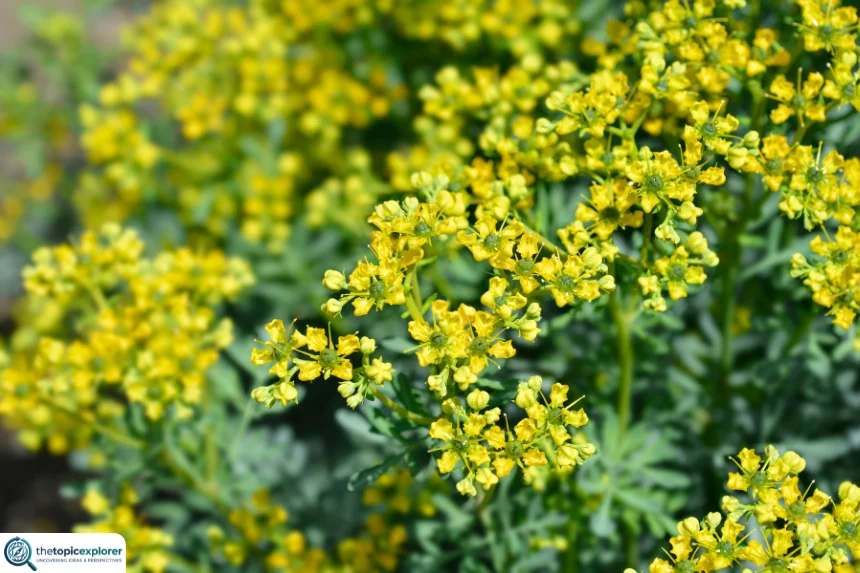

The rue flower is the small yellow blossom of Ruta graveolens, commonly known as rue, common rue, garden rue, or herb of grace. Rather than being a typical soft-stemmed garden flower, rue is an aromatic perennial subshrub in the Rutaceae, or citrus, family. It is especially recognizable by its blue-green, finely divided foliage and clusters of yellow flowers held above the leaves in summer. NC State Extension describes common rue as a 2–3-foot plant that becomes woody with age and performs well in sunny, well-drained gardens.
Rue also has an unusually broad story. Gardeners grow it for its foliage, flowers, drought tolerance, and value to butterflies. Meanwhile, the plant has centuries of cultural associations with grace, regret, and traditional herbal use. However, rue also deserves careful handling because its foliage can irritate skin, an issue covered in detail later in this guide.
For U.S. gardeners, the key is to understand rue as both an ornamental and a historically significant plant—not simply as a medicinal herb or symbolic flower.
What Is a Rue Flower?
A rue flower is the yellow flower produced by common rue, scientifically known as Ruta graveolens.
Kew Science recognizes Ruta graveolens as an accepted species in the genus Ruta and places it in the Rutaceae family, the same botanical family that includes citrus plants. Kew describes the species as a subshrub native from the northern Balkan Peninsula toward Crimea.
In gardens, rue is valued for several features at once:
- small yellow summer flowers;
- blue-green ornamental foliage;
- aromatic leaves;
- drought tolerance;
- a compact, shrubby habit;
- and wildlife value.
Therefore, the term “rue flower” technically refers to the bloom, although most gardeners discussing rue are really talking about the entire Ruta graveolens plant.
Rue Flower Quick Answer
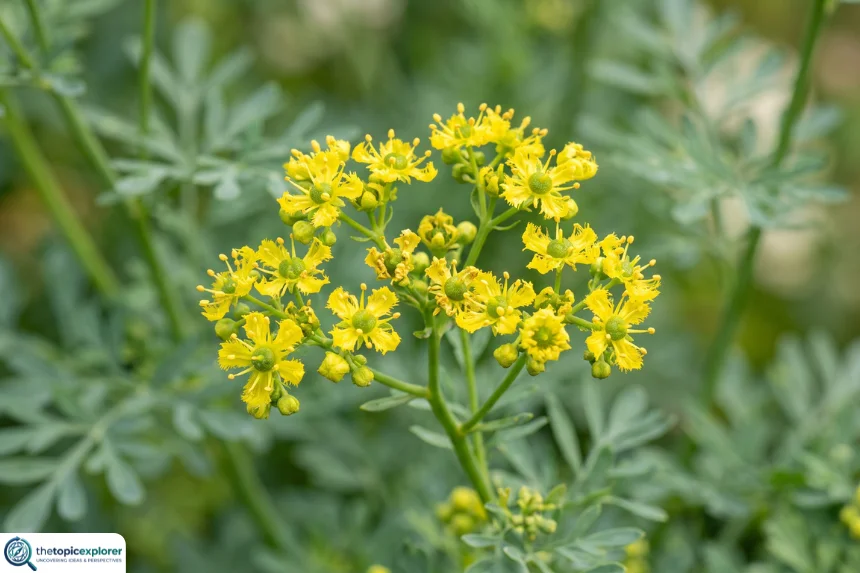
Rue flower usually refers to the small yellow blossoms of common rue (Ruta graveolens), a perennial aromatic subshrub in the citrus family. The plant normally grows around 2–3 feet tall and wide, produces yellow flowers in upright clusters during summer, and develops distinctive blue-green foliage.
NC State Extension also notes that rue attracts pollinators and serves as a host plant for several swallowtail butterflies.
Rue Flower Quick Facts
| Rue Flower Fact | Detail |
|---|---|
| Scientific name | Ruta graveolens |
| Genus | Ruta |
| Family | Rutaceae |
| Common names | Rue, common rue, garden rue, herb of grace |
| Plant type | Perennial subshrub |
| Typical height | About 2–3 ft |
| Typical width | About 2–3 ft |
| Flower color | Yellow to dull yellow |
| Flower size | Less than 1 inch |
| Petals | Usually 4–5 |
| Bloom season | Mainly summer, sometimes into fall |
| Foliage | Blue-green, divided, fern-like |
| Growth habit | Upright to mounding |
| Older stems | Become woody |
| Native range | Northern Balkan Peninsula to Crimea |
| Native to U.S.? | No |
| U.S. presence | Introduced in multiple states |
| Pollinator value | Attracts pollinators |
| Butterfly value | Host plant for swallowtails |
| Handling caution | Leaves can irritate skin |
NC State provides the plant-size, bloom, flower, foliage, and garden-use details, while Kew provides the accepted taxonomy and native distribution.
What Does a Rue Flower Look Like?
Rue flowers are relatively small, but they stand out because they rise above the plant’s blue-green foliage in terminal clusters.
NC State describes them as small, dull yellow flowers in upright terminal clusters. The individual blooms are less than an inch across and have a radial, open shape.
The combination of yellow flowers and cool-toned foliage gives rue a distinctive appearance.
A flowering rue plant generally has:
- blue-green leaves near the lower and middle stems;
- branching upright stems;
- clusters of yellow flowers at the tips;
- and a slightly rounded or shrubby overall shape.
Unlike plants grown primarily for large ornamental blossoms, common rue often attracts attention because the foliage and flowers work together visually.
What Color Are Rue Flowers?
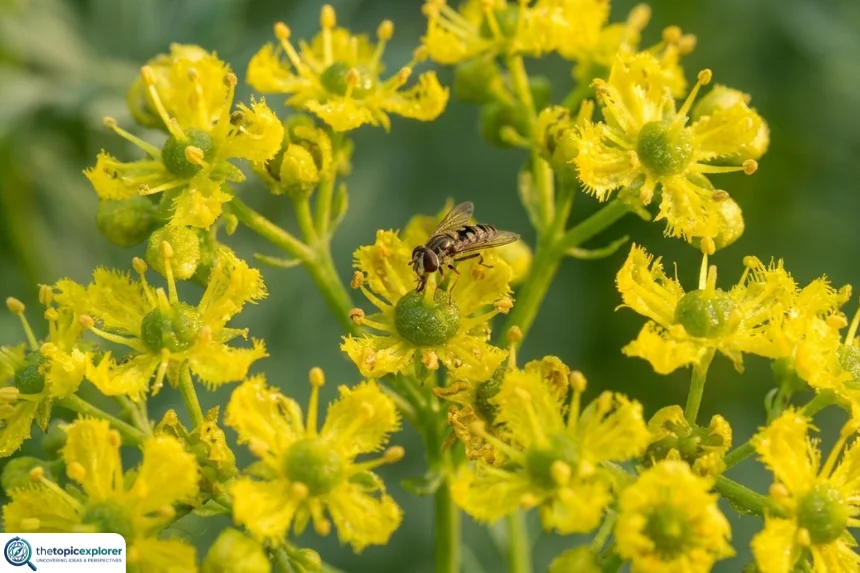
Rue flowers are yellow.
NC State classifies the flower color as gold/yellow and describes the blooms as dull yellow.
Depending on:
- sunlight;
- flower age;
- camera lighting;
- cultivar;
- and growing conditions,
the flowers may appear bright yellow, muted yellow, or somewhat yellow-green.
Therefore, seeing a slightly greenish tone does not necessarily mean the plant is a different species.
How Many Petals Does a Rue Flower Have?
Rue flowers generally have four or five petals.
NC State specifically records the flower as having 4–5 petals or rays.
This detail is useful for identification because some simplified plant descriptions incorrectly say that every rue flower always has five petals.
A better botanical description is:
Common rue produces small radial flowers with four or five yellow petals.
The flowers also surround a green central ovary, which contributes to their unusual structured appearance.
What Does the Rue Plant Look Like?
For many gardeners, the foliage is even more recognizable than the actual rue flower.
Common rue develops soft blue-green leaves that are deeply divided and fern-like.
NC State describes the leaves as:
- aromatic when bruised;
- deeply lobed;
- twice pinnately divided;
- gland-dotted;
- and fern-like.
The leaves are typically arranged alternately along the stems.
Young stems begin green and relatively soft. However, as the plant matures, older stems become woody.
Consequently, a mature rue plant often looks more like a small aromatic shrub than a typical annual herb.
What Color Are Rue Leaves?
Rue foliage is commonly described as:
blue-green,
gray-green,
or
bluish green.
That cool-toned foliage is one of the main reasons gardeners use rue ornamentally.
Moreover, it creates a strong contrast with the warm yellow flowers.
Does Rue Have a Strong Smell?
Yes.
The leaves are aromatic when bruised or handled.
However, people react differently to the scent.
Some describe it as strongly herbal, while others find it sharp or unpleasant.
Therefore, it is safer to describe rue as strongly aromatic rather than promising a pleasant fragrance.
How Big Does a Rue Plant Get?
Common rue typically grows around 2 to 3 feet tall and about 2 to 3 feet wide.
NC State gives that mature size range and describes the plant as an erect to mounding ornamental subshrub.
That makes rue compact enough for:
- cottage gardens;
- herb gardens;
- pollinator beds;
- butterfly gardens;
- borders;
- rock gardens;
- and drought-tolerant plantings.
Rue Plant Size at a Glance
| Growth Feature | Typical Size or Form |
| Mature height | 2–3 ft |
| Mature spread | 2–3 ft |
| Growth habit | Erect to mounding |
| Growth rate | Medium |
| Stem type | Green when young, woody with age |
| Overall form | Compact subshrub |
Because growing conditions vary, an individual rue plant may remain smaller or become fuller than the typical range.
Sunlight, moisture, soil, winter conditions, pruning, and plant age can all influence its final size.
Is Rue a Perennial Flower?
Yes, common rue is perennial.
However, calling it simply a “perennial flower” can be slightly misleading.
Botanically, Ruta graveolens is better described as a perennial subshrub because its older growth becomes woody rather than dying completely back like many herbaceous perennials. Kew also classifies the species as a subshrub.
NC State notes that rue can remain evergreen in warmer winter climates.
Therefore, its winter appearance depends partly on climate.
In milder regions, more foliage may persist.
Meanwhile, colder climates may cause more seasonal dieback.

How Long Does a Rue Plant Live?
NC State describes common rue as relatively short-lived, with an approximate lifespan of around five years, although it can self-seed and replace itself in suitable garden conditions.
Therefore, gardeners should not necessarily expect one individual rue plant to remain unchanged for decades.
However, self-seeding can allow rue to remain present in a garden over a longer period.
When Does Rue Flower?
The main bloom season for rue is summer.
NC State says the yellow flowers are held above the foliage in mid to late summer and records bloom time across summer and fall.
Therefore, the most accurate general statement is:
Rue normally flowers during summer, with blooming sometimes extending into fall depending on local climate and growing conditions.
This is more useful for a U.S. audience than claiming one exact month nationwide.
A plant growing in:
- California;
- Texas;
- North Carolina;
- New York;
- or Wisconsin
may not begin flowering at exactly the same time.
Does Rue Flower Every Year?
A healthy established rue plant can flower annually under suitable conditions.
However, flowering depends on factors such as:
- sufficient sunlight;
- plant maturity;
- drainage;
- winter survival;
- pruning;
- and overall plant health.
Too much shade or poor drainage may reduce plant performance.
Later sections of this guide will explain the best growing conditions in more detail.
What Happens to Rue After It Flowers?
After flowering, rue develops seed capsules.
NC State describes the mature fruit as a small brown capsule that splits into sections and reveals several dark seeds.
Therefore, the plant changes visually as the season progresses:
yellow flowers
→ developing green capsules
→ mature brown seed capsules
→ dark seeds
This makes seed pods another useful identification feature.
Moreover, rue can self-seed, which helps compensate for its relatively short individual lifespan.
Is Rue Native to the United States?
No. Common rue is not native to the United States.
Kew Science gives the native range of Ruta graveolens as extending from the northern Balkan Peninsula to Crimea.
Its native distribution includes areas associated with:
- Albania;
- Bulgaria;
- the northwestern Balkan Peninsula;
- European Türkiye;
- and Crimea.
Over time, people cultivated and transported rue far beyond its original range.
Consequently, the species now occurs as an introduced plant in many parts of the world.
Does Rue Grow Wild in the United States?
Rue has been introduced in multiple parts of the United States.
Kew records Ruta graveolens as introduced in jurisdictions including:
- Arizona;
- California;
- Connecticut;
- District of Columbia;
- Illinois;
- Michigan;
- Missouri;
- New Jersey;
- New York;
- North Carolina;
- Pennsylvania;
- Rhode Island;
- Texas;
- Vermont;
- Virginia;
- West Virginia;
- and Wisconsin.
However, “introduced” does not mean the plant is native.
This distinction is important.
Native
A species naturally occurred in a region without human introduction.
Introduced
A species arrived outside its original natural range, often because people cultivated, transported, or planted it.
Therefore, common rue may grow successfully in many U.S. gardens while still being a non-native species.
Is Rue Flower Part of the Citrus Family?
Yes.
Common rue belongs to the family Rutaceae.
Rutaceae is widely known as the rue or citrus family.
This botanical relationship may surprise gardeners because rue does not visually resemble an orange or lemon tree.
Nevertheless, they share the same plant family.
Botanical Classification of Rue
| Classification | Rue |
| Kingdom | Plantae |
| Order | Sapindales |
| Family | Rutaceae |
| Genus | Ruta |
| Species | Ruta graveolens |
Kew currently recognizes Ruta graveolens as an accepted species within the genus Ruta.
Is Every Rue Flower Ruta graveolens?
No.
This is an important botanical distinction.
Ruta is a genus rather than a single species.
Kew currently lists multiple accepted species within the genus, including:
- Ruta graveolens
- Ruta angustifolia
- Ruta chalepensis
- Ruta corsica
- Ruta montana
- and others.
However, common rue (Ruta graveolens) is the species most frequently meant when U.S. gardeners search for “rue flower” or “rue plant.”
Therefore, this guide focuses primarily on Ruta graveolens.
Common Names for Rue Flower
Ruta graveolens appears under several common names.
NC State lists:
- common rue
- garden rue
- herb of grace
- rue.
These names generally refer to the same plant when used in standard U.S. horticultural contexts.
However, common names can sometimes create confusion because unrelated plants may also contain the word “rue.”
That is why the scientific name Ruta graveolens is especially useful.
Why Is Botanical Identification Important?
Correct identification matters for more than gardening accuracy.
Rue has:
- distinctive cultural uses;
- traditional herbal associations;
- wildlife value;
- and important handling precautions.
Therefore, confusing Ruta graveolens with another species can lead to incorrect assumptions about:
- care;
- toxicity;
- medicinal history;
- butterfly value;
- or skin safety.
The scientific name removes much of that ambiguity.
Rue Flower Identification Summary
A likely common rue plant will usually show the following combination:
Flowers:
small, yellow, radial, clustered near stem tips
Petals:
usually four or five
Leaves:
blue-green, finely divided, fern-like, aromatic
Growth:
upright to mounding
Size:
roughly 2–3 feet tall and wide
Stems:
green when young, becoming woody with age
Bloom period:
primarily summer
Plant type:
perennial subshrub
Family:
Rutaceae
No single feature should always be used alone for identification. However, together these characteristics create a strong visual profile of Ruta graveolens.
Why Gardeners Still Grow Rue
Rue has remained in cultivation because it offers several qualities in one compact plant.
It can provide:
- unusual blue-green foliage;
- yellow summer flowers;
- drought tolerance;
- pollinator interest;
- butterfly-host value;
- and historic garden character.
Moreover, it tolerates conditions that many softer garden plants dislike.
NC State describes it as tolerant of drought, dry soil, rocky soil, and deer browsing while also recommending it for butterfly, pollinator, and drought-tolerant gardens.
However, those advantages come with one important qualification:
rue should be handled carefully.
Its leaves contain compounds capable of irritating skin, especially under certain conditions. Therefore, gardeners should understand both its ornamental value and its safety profile before planting it.
The next part focuses on the practical side of growing rue successfully—including sunlight, soil, watering, U.S. growing conditions, butterfly use, propagation, pruning, and deer resistance.
How to Grow Rue Flower
Growing rue flower successfully is relatively straightforward once the plant has the conditions it prefers.
Common rue (Ruta graveolens) does best in a sunny location with well-drained soil. Once established, it tolerates dry conditions better than constantly wet ground. NC State Extension describes rue as drought tolerant and adaptable to dry, rocky soils, making it useful in herb gardens, pollinator beds, and low-water landscapes. (plants.ces.ncsu.edu)
The main growing priorities are:
- plenty of sun;
- good drainage;
- moderate watering while establishing;
- lighter watering after establishment;
- and enough space for a mature plant roughly 2–3 feet wide.
However, gardeners should also remember that rue can irritate skin. Therefore, gloves are sensible whenever pruning, dividing, or handling the foliage.
How Much Sun Does Rue Need?
Rue grows best in full sun, although it can tolerate partial shade.
NC State lists its light requirements as:
- full sun;
- partial shade;
- and dappled sunlight. (plants.ces.ncsu.edu)
For the most compact growth and strongest flowering, a location receiving several hours of direct sunlight is usually preferable.
Does Rue Flower Better in Full Sun?
Generally, yes.
More sunlight usually supports:
- stronger flowering;
- denser growth;
- sturdier stems;
- and the compact form gardeners expect from common rue.
However, extremely hot climates may benefit from some afternoon protection, especially if plants are newly established.
Therefore, the best sun exposure depends partly on local summer conditions.
What Soil Is Best for Rue?
Rue prefers well-drained soil.
This is more important than providing unusually rich soil.
NC State notes that Ruta graveolens can grow in:
- loam;
- sandy soil;
- shallow rocky soil;
- and other well-drained conditions. (plants.ces.ncsu.edu)
The plant also tolerates a relatively broad soil pH range.
Therefore, gardeners usually do not need to create a highly specialized soil mix.
What Rue Does Not Like
Constantly wet soil is a bigger problem.
Poor drainage can weaken the roots and reduce plant vigor.
Consequently, heavy clay soil may need improvement before planting.
Possible improvements include:
- planting on a slight mound;
- adding coarse organic matter where appropriate;
- choosing a raised bed;
- or selecting a naturally better-drained location.
How Often Should You Water Rue?
Young rue plants need more regular watering while they establish roots.
However, established plants generally need less frequent irrigation.
A practical approach is:
Water deeply when the soil becomes dry rather than keeping the ground constantly moist.
Exact watering frequency varies with:
- temperature;
- rainfall;
- soil type;
- container size;
- sun exposure;
- and plant age.
Therefore, a fixed “water every three days” rule is not reliable across the United States.
Is Rue Drought Tolerant?
Yes.
NC State specifically lists common rue as drought tolerant once established. (plants.ces.ncsu.edu)
That makes it useful in:
- xeric-style gardens;
- dry borders;
- rock gardens;
- and other low-water landscapes.
However, drought tolerance does not mean a newly planted rue should be left completely dry.
Young roots still need consistent moisture while they establish.
Can Rue Grow in Containers?
Yes, rue can grow in containers if drainage is excellent.
A container should have:
- drainage holes;
- enough room for root development;
- a fast-draining potting medium;
- and good sunlight.
Because mature rue can reach several feet across, choose a reasonably large container rather than a very small herb pot.
Moreover, container soil dries faster than garden soil.
Therefore, potted rue may need more frequent watering than plants growing in the ground.
Where Can Rue Grow in the United States?
Common rue can grow in many parts of the United States.
NC State lists it across a broad range of USDA hardiness zones, approximately 4a through 10b, although actual winter survival depends on local conditions. (plants.ces.ncsu.edu)
That means gardeners in many regions can grow rue successfully.
However, winter performance can differ considerably between:
- northern inland climates;
- humid southeastern gardens;
- dry western landscapes;
- and mild coastal areas.
Rue in Colder Climates
In colder zones, rue may experience more winter dieback.
A protected site and good drainage can help.
Wet winter soil can sometimes be more damaging than cold alone.
Rue in Warm Climates
In mild regions, common rue may retain more foliage through winter.
However, intense summer heat can increase water stress.
Therefore, gardeners should watch young plants carefully during their first season.
Is Rue Easy to Grow?
For many gardeners, yes.
Once established in an appropriate location, rue generally requires relatively little maintenance.
Its main strengths include:
- drought tolerance;
- adaptation to poorer soils;
- deer resistance;
- and relatively few serious pest problems.
However, it is not completely maintenance-free.
The most important challenges are:
- poor drainage;
- excessive shade;
- aggressive self-seeding in favorable conditions;
- and skin irritation during handling.
Does Rue Flower Attract Butterflies?
Yes.
Rue is particularly valuable because it can serve as a larval host plant for swallowtail butterflies.
That means the plant does more than provide flowers.
Its leaves can provide food for caterpillars.
NC State lists rue as useful in butterfly and pollinator gardens and identifies it as a host plant for several swallowtails. (plants.ces.ncsu.edu)
Colorado State University Extension also lists rue among butterfly larval host plants. (gardentheplains.extension.colostate.edu)
Which Butterflies Use Rue as a Host Plant?
Rue is especially associated with swallowtails.
Depending on region, species that may use rue include:
- black swallowtail;
- giant swallowtail;
- and other related swallowtail species.
Colorado State Extension specifically lists rue in connection with black swallowtail and giant swallowtail host-plant use. (gardentheplains.extension.colostate.edu)
Therefore, gardeners interested in butterfly conservation may deliberately plant rue for caterpillars.
Why Are Caterpillars Eating My Rue?
If you find caterpillars chewing rue leaves, do not immediately assume the plant has a destructive pest problem.
Swallowtail caterpillars may be using the plant exactly as nature intended.
Because rue functions as a larval host plant, leaf loss can sometimes be a sign of ecological value rather than plant disease.
What Should You Do?
If the goal is to support butterflies:
- avoid spraying broad-spectrum insecticides;
- allow some leaf damage;
- watch for caterpillar development;
- and consider planting more than one rue plant.
This gives both the plant and caterpillars a better chance to coexist.
How to Use Rue in a Butterfly Garden
Rue can work well in butterfly gardens when planted thoughtfully.
A useful placement is:
- near other pollinator plants;
- in full sun;
- somewhere caterpillar feeding is acceptable;
- and away from narrow walkways where people may brush against the foliage.
That last point is important because rue can irritate skin.
Therefore, placing it slightly back from paths can reduce accidental contact.
Good Butterfly-Garden Strategy
Combine rue with nectar plants that support adult butterflies.
Rue mainly serves as a host plant, while nearby flowering plants can provide nectar.
This creates a garden supporting multiple butterfly life stages.
Should You Use Pesticides on Rue?
If you are growing rue specifically for swallowtails, avoid broad-spectrum insecticides whenever possible.
Those products can kill the very caterpillars the plant is intended to support.
Instead, inspect the plant carefully before treating anything as a pest.
A caterpillar on rue may be beneficial.
How to Propagate Rue
Common rue can be propagated through:
- seed;
- stem cuttings;
- and division.
NC State lists all three methods. (plants.ces.ncsu.edu)
Growing Rue From Seed
Rue can be started from seed.
Because mature plants produce capsules containing dark seeds, gardeners can sometimes collect seed after flowering.
A simple approach is to:
- allow seed capsules to mature;
- collect dry seed;
- sow in a well-drained seed-starting medium;
- keep lightly moist until germination;
- provide strong light as seedlings develop.
Because germination conditions vary, avoid assuming that every batch will germinate at the same speed.
Does Rue Self-Seed?
Yes, it can.
NC State notes that rue may self-seed under suitable conditions. (plants.ces.ncsu.edu)
Therefore, gardeners who do not want additional plants may remove seed heads before they mature.
Growing Rue From Cuttings
Stem cuttings provide another propagation option.
Use healthy, non-flowering growth when possible.
General steps include:
- taking a clean stem cutting;
- removing the lower leaves;
- inserting the stem into a well-drained rooting medium;
- keeping it lightly moist;
- and providing bright indirect light while roots develop.
Wear gloves while taking cuttings because increased leaf and sap contact may irritate sensitive skin.
Can Rue Be Divided?
Yes.
NC State lists division as another propagation method.
However, division may be less convenient once older plants develop woody stems.
Therefore, younger established plants are generally easier to divide than mature woody specimens.
When Should You Prune Rue?
Rue can benefit from pruning in early spring.
NC State recommends cutting plants back toward older wood at that time. (plants.ces.ncsu.edu)
Spring pruning can help:
- remove damaged growth;
- improve shape;
- encourage compact new growth;
- and prevent plants from becoming overly woody.
Should Rue Be Deadheaded?
Deadheading is optional.
Removing faded flowers can:
- reduce self-seeding;
- keep the plant looking tidier;
- and redirect some energy away from seed production.
However, leaving seed heads can be useful if you want to collect seed or allow natural reseeding.
Wear Gloves When Pruning Rue
This point deserves emphasis.
Colorado State University Extension advises wearing gloves when handling rue because its oils can irritate or burn sensitive skin. (gardentheplains.extension.colostate.edu)
Therefore, use gloves when:
- pruning;
- dividing;
- harvesting seed;
- taking cuttings;
- or removing damaged foliage.
The detailed reason for this skin reaction is covered in Part C.
Is Rue Deer Resistant?
Yes, rue is generally considered deer resistant.
NC State lists it as resistant to deer and rabbits. (plants.ces.ncsu.edu)
Its strongly aromatic foliage may make it less appealing to browsing animals.
However, “deer resistant” does not mean “deer proof.”
Hungry wildlife can sometimes eat plants they normally ignore.
Therefore, rue is best described as less attractive to deer than many softer garden plants.
Is Rue Rabbit Resistant?
NC State also lists common rue as rabbit resistant. (plants.ces.ncsu.edu)
Again, resistance is not a guarantee.
However, this characteristic can make rue useful in gardens where browsing pressure is a recurring problem.
Common Rue Plant Problems
Rue is generally resilient, but several problems can reduce its performance.
Poor Drainage
Too much moisture is one of the most important concerns.
If soil remains constantly wet, roots may decline and the plant can become weak.
Therefore, drainage should be improved before planting.
Too Much Shade
Rue tolerates partial shade, but heavy shade may lead to:
- fewer flowers;
- weaker growth;
- and a less compact shape.
For best flowering, provide more sun.
Overwatering
An established rue plant does not normally need constantly moist soil.
Repeated overwatering can create the same problems as poor drainage.
Caterpillar Feeding
This is often beneficial rather than harmful.
Swallowtail caterpillars may remove noticeable foliage, but the plant can often recover.
If butterfly support is the goal, some feeding damage should be expected.
Excessive Self-Seeding
Where conditions are favorable, rue may produce volunteers around the parent plant.
Remove seed heads before they mature if unwanted seedlings become a problem.
Winter Damage
In colder areas, stems may suffer winter injury.
Wait until early spring to assess damage, then prune back dead material.
Does Rue Have Many Insect Pests?
Rue generally has relatively few serious insect problems.
Its aromatic foliage and natural plant chemistry may make it less attractive to some herbivores.
However, remember that butterfly caterpillars are an intentional exception.
Therefore, identifying the insect before treating it is important.
Does Rue Need Fertilizer?
Rue generally does not require heavy feeding.
Because it tolerates relatively lean soils, excessive fertilizer may encourage soft growth rather than compact structure.
If garden soil is reasonably healthy, heavy fertilization is usually unnecessary.
A light application of compost or a balanced soil amendment may be enough where fertility is low.
Best Places to Plant Rue Flower
Rue works especially well in:
- herb gardens;
- butterfly gardens;
- pollinator gardens;
- rock gardens;
- dry borders;
- cottage gardens;
- Mediterranean-style plantings;
- and low-water landscapes.
However, avoid placing it directly beside:
- children’s play areas;
- frequently used narrow paths;
- or spots where people constantly brush against foliage.
The reason is not that rue is inherently unsuitable for gardens.
Rather, thoughtful placement reduces unnecessary skin contact while preserving its ornamental and wildlife value.
Rue Flower Care at a Glance
| Care Requirement | Best Practice |
|---|---|
| Sun | Full sun to partial shade |
| Soil | Well-drained |
| Water | Moderate while establishing; lower once established |
| Drought tolerance | Good |
| Mature size | About 2–3 ft |
| Fertilizer | Usually light or minimal |
| Pruning | Early spring |
| Propagation | Seed, cuttings, division |
| Self-seeding | Possible |
| Butterfly use | Swallowtail host plant |
| Deer resistance | Generally good |
| Rabbit resistance | Generally good |
| Handling | Gloves recommended |
Is Rue Flower Low Maintenance?
In the right location, yes.
Rue is generally easier to manage once established because it tolerates:
- drought;
- poorer soils;
- deer browsing;
- and relatively low fertility.
However, low maintenance does not mean zero attention.
The best results come from:
- choosing a sunny site;
- providing good drainage;
- avoiding overwatering;
- pruning in spring;
- and wearing gloves while handling the plant.
For butterfly gardeners, another important principle is patience.
A partly eaten rue plant may actually be supporting swallowtail caterpillars and doing exactly what it was planted to do.
That combination of drought tolerance, wildlife value, and distinctive foliage explains why common rue continues to earn a place in modern gardens.
However, its garden value must always be balanced with one important issue: rue can irritate skin and may cause more serious phototoxic reactions when plant compounds are followed by sunlight exposure.
Is Rue Flower Poisonous?
Yes. Rue flower and the wider Ruta graveolens plant should be handled with care.
NC State Extension classifies common rue as a plant with medium-severity poison characteristics. Its leaves contain biologically active compounds, including furocoumarins and related substances. Large ingestions can cause serious symptoms, while direct skin contact may also trigger irritation.
Therefore, rue should not be treated as harmless simply because it has a long history as an herb.
For most home gardeners, the safest approach is to appreciate rue primarily as:
- an ornamental perennial;
- a butterfly host plant;
- a historical garden herb;
- and a culturally significant plant.
Its traditional medicinal history does not mean concentrated preparations or homemade remedies are automatically safe.
Can Touching Rue Cause a Rash?
Yes. Touching rue can cause skin irritation, and exposure followed by sunlight can produce a more serious phototoxic reaction.
Peer-reviewed medical literature documents cases of phytophotodermatitis associated with Ruta graveolens. Rue contains psoralen-type compounds that can remain on the skin and react when the affected area is subsequently exposed to ultraviolet A light.
As a result, a person may not notice the full reaction immediately after handling the plant.
Symptoms documented in medical reports can include:
- redness;
- burning or irritation;
- blistering;
- and later changes in skin pigmentation.
What Is Rue Phytophotodermatitis?
Phytophotodermatitis is a phototoxic skin reaction caused when certain plant chemicals contact the skin and are then activated by sunlight.
With rue, the basic sequence is:
rue plant compounds on skin
→ UVA exposure
→ phototoxic skin inflammation
A PubMed-indexed report specifically describes this reaction after exposure to Ruta graveolens and explains that psoralens in the plant can react with subsequent UVA exposure.
Importantly, this is different from saying everyone who touches rue will develop a severe reaction.
Risk depends on factors such as:
- how much plant material contacted the skin;
- whether sap or crushed leaves were involved;
- duration of contact;
- individual sensitivity;
- and how much sunlight followed exposure.
Nevertheless, the risk is sufficiently documented that protective handling makes sense.
Should You Wear Gloves When Handling Rue?
Yes. Wearing gloves is a sensible precaution when handling rue.
This is especially important when:
- pruning;
- taking cuttings;
- dividing plants;
- removing damaged foliage;
- collecting seed;
- or working with crushed stems and leaves.
Additionally, avoid touching your face or eyes while working with the plant.
Afterward, wash exposed skin thoroughly, particularly before spending extended time in bright sunlight.
NC State specifically warns that skin contact can cause irritation, while medical case reports demonstrate that sunlight can amplify the reaction through phytophotodermatitis.
Is Rue Safe to Eat?
Rue has been used as a flavoring and traditional herb in some cultures. However, that history should not be confused with a recommendation to consume the plant freely.
NC State warns that large ingestions can produce significant poisoning symptoms. Poison Control also documents serious toxicity associated with deliberate medicinal ingestion of Ruta graveolens, particularly when concentrated preparations were used for reproductive purposes.
Therefore, this guide does not recommend:
- homemade medicinal rue tea;
- concentrated rue extracts;
- rue essential oil taken internally;
- fertility-related preparations;
- or self-treatment with rue.
People should not assume a dose is safe simply because a recipe appears in traditional herbal literature.
Can Rue Be Dangerous During Pregnancy?
Rue has a historical association with attempts to stimulate menstruation or induce miscarriage. However, that use can be dangerous.
Poison Control warns that herbal preparations used for abortion or fertility regulation can cause severe adverse effects, and it specifically discusses Ruta graveolens in that context. Reported serious toxicity has included organ injury and other potentially life-threatening complications.
Therefore:
Rue should not be used as a homemade method to induce miscarriage, regulate fertility, or treat pregnancy-related conditions.
Historical use is not proof of safety.
What Was Rue Traditionally Used For?
Rue has an unusually long cultural history.
Across different periods and regions, people have used it in connection with:
- traditional herbal practices;
- food flavoring;
- household customs;
- religious symbolism;
- ornamental gardens;
- and protective folklore.
However, historical use tells us what people did, not necessarily what modern science considers safe or effective.
That distinction matters greatly with rue because the same plant that appears in historical herbals also contains compounds capable of irritating skin and causing toxicity when misused.
Therefore, an evidence-based article should describe traditional uses historically without presenting them as modern medical recommendations.
Does Rue Flower Have Medicinal Benefits?
It is more accurate to say that rue has a history of medicinal use than to claim that a rue flower provides proven medical benefits.
Traditional medicine has attributed many effects to the plant. Nevertheless, historical claims do not automatically meet modern standards for clinical effectiveness or safety.
Moreover, the known toxicity of concentrated rue preparations makes casual self-medication particularly inappropriate. Poison Control documents serious adverse outcomes associated with some traditional uses of Ruta graveolens.
For this reason, the safest wording is:
Rue has a significant medicinal history, but that history should not be interpreted as evidence that homemade or concentrated rue remedies are safe.
Rue Flower Meaning and Symbolism
Beyond gardening, rue flower meaning has developed through centuries of religion, literature, herbal traditions, and wordplay.
Rue is especially associated with:
- regret;
- repentance;
- grace;
- sorrow;
- and, in some traditions, protection.
These meanings are not botanical properties.
Instead, they developed culturally as the plant became connected with religious practices, literature, and the emotional meanings attached to its name.
What Does Rue Flower Symbolize?
In Western literary and garden traditions, the strongest associations are repentance, regret, sorrow, and grace.
The Shakespeare Birthplace Trust describes rue as an herb associated with repentance and notes its traditional “Herb of Grace” symbolism.
Therefore, giving rue as a symbolic flower can carry a very different meaning from giving roses or daisies.
Rather than romance, rue historically suggests reflection, remorse, or spiritual grace.
Why Does Rue Symbolize Regret?
Part of the association comes from the English word “rue,” meaning sorrow or regret.
However, it is better not to oversimplify this by saying the plant was botanically named because it means regret.
Cultural symbolism developed through language, religious interpretation, bitter taste, and literary tradition.
The Shakespeare Birthplace Trust specifically connects rue with sorrow or remorse and describes it as an herb of repentance.
Consequently, “rue” became especially useful to writers who wanted a plant carrying several emotional meanings at once.
Why Is Rue Called Herb of Grace?
Herb of grace is one of rue’s oldest and most recognizable common names.
The expression became associated with rue through religious and symbolic traditions involving repentance and grace.
Its cultural history made the plant suitable as a symbol for:
- repentance after wrongdoing;
- forgiveness;
- spiritual cleansing;
- and divine grace.
Moreover, the name became firmly embedded in English literature.
Shakespeare himself explicitly uses the phrase in Hamlet.
What Does Rue Mean in Shakespeare’s Hamlet?
Rue appears in one of the most famous flower scenes in Hamlet.
During Ophelia’s flower speech, she distributes plants carrying symbolic associations. She mentions rosemary for remembrance, pansies for thoughts, and then rue.
In the Folger Shakespeare Library text, Ophelia refers to rue and immediately calls it “herb of grace.”
That phrase is especially significant because rue already carried cultural associations with:
- repentance;
- sorrow;
- regret;
- and grace.
Therefore, Shakespeare could use the plant to create several possible meanings at once.
Does Rue Mean Only Regret in Hamlet?
No.
Interpreting Shakespearean flower symbolism as a simple one-flower-equals-one-meaning code can be misleading.
Rue had several overlapping associations in Shakespeare’s period.
Consequently, readers and scholars may connect Ophelia’s rue with:
- repentance;
- remorse;
- sorrow;
- grace;
- or combinations of those ideas.
The Shakespeare Birthplace Trust likewise discusses rue in connection with repentance and the “Herb of Grace” tradition.
Why Is Rue Important in Historical Gardens?
Rue belongs naturally in historical herb-garden discussions because people cultivated it for far more than appearance.
Its:
- distinctive scent;
- unusual blue-green foliage;
- yellow flowers;
- religious associations;
- culinary history;
- and traditional medicinal reputation
made it a recognizable garden plant for centuries.
Today, however, modern gardeners may value rue for a different combination of reasons.
It works as:
- an ornamental foliage plant;
- a drought-tolerant perennial;
- a swallowtail host plant;
- and a botanical connection to historical gardening.
That combination gives rue unusual value in heritage or educational gardens.
Is Common Rue the Same as Syrian Rue?
No. Common rue and Syrian rue are different plants.
This distinction is extremely important because their common names can cause confusion.
Common Rue
Scientific name: Ruta graveolens
Genus: Ruta
Family: Rutaceae
Syrian Rue
Scientific name: Peganum harmala
Genus: Peganum
Family: Nitrariaceae
Kew Science recognizes Peganum harmala as a separate accepted species in the family Nitrariaceae, not Rutaceae.
Therefore:
Common rue and Syrian rue should never be treated as interchangeable plants.
Their chemistry, horticulture, traditional uses, and safety considerations differ.
Why Does the Syrian Rue Name Cause Confusion?
The problem comes from common names.
Two completely different plants can share part of the same everyday name even though botanists place them in different genera and families.
Therefore, when reading information about:
- toxicity;
- traditional medicine;
- cultivation;
- seeds;
- or historical uses,
always check the scientific name.
For this article:
rue flower = primarily Ruta graveolens
not Peganum harmala.
Is Rue Flower Safe Around Children?
Because rue can irritate skin and may be harmful if substantial amounts are swallowed, it makes sense to place the plant where young children are unlikely to handle or eat it.
NC State identifies the plant as poisonous to humans and specifically warns about skin irritation and potentially serious symptoms from large ingestion.
Therefore, avoid positioning rue:
- directly beside play areas;
- beside frequently touched railings;
- or where small children routinely pick garden plants.
Thoughtful placement can preserve its garden value while reducing unnecessary exposure.
Is Rue Flower Safe Around Pets?
The human toxicity and skin-irritation evidence is much clearer in the authoritative sources used for this article than species-specific veterinary guidance.
Therefore, this article should not make broad claims such as:
“Rue is perfectly safe for all pets.”
or
“Rue is deadly to every dog or cat.”
Instead, the prudent garden approach is to prevent pets from chewing unfamiliar ornamental or medicinal plants and seek veterinary guidance if significant ingestion occurs.
Can Rue Be Used in a Pollinator Garden Despite Its Toxicity?
Yes.
A plant can contain compounds irritating to humans while still providing ecological value.
Rue is a good example.
NC State specifically recommends common rue for butterfly and pollinator gardens and identifies it as a host plant for swallowtail butterflies. At the same time, the same source warns gardeners about contact dermatitis and ingestion hazards.
Therefore, the two ideas are not contradictory:
Rue can be valuable for butterflies while still requiring careful human handling.
Rue Flower Benefits for the Garden
When the word benefits refers to horticulture rather than medicine, rue offers several clear advantages.
Butterfly Host Value
Its foliage can support swallowtail caterpillars.
Drought Tolerance
Established plants tolerate dry conditions.
Deer and Rabbit Resistance
NC State lists rue as resistant to both.
Distinctive Foliage
The blue-green leaves provide contrast even when the plant is not flowering.
Summer Flowers
Clusters of yellow blooms add seasonal interest.
Historical Character
Rue works particularly well in heritage, Shakespeare, herb, and cottage gardens.
Consequently, the plant has more garden value than its relatively small flowers might initially suggest.
Is Rue Flower Right for Your Garden?
Rue may be a good choice when you want:
- a drought-tolerant perennial;
- blue-green foliage;
- a swallowtail host plant;
- deer resistance;
- an unusual historical herb;
- or a plant suited to a sunny, well-drained garden.
However, it may be less suitable immediately beside:
- narrow walkways;
- children’s play spaces;
- high-contact garden areas;
- or locations where gardeners frequently brush through foliage.
Therefore, placement matters just as much as growing conditions.
Rue Flower: Advantages and Cautions
| Feature | What Gardeners Should Know |
|---|---|
| Yellow flowers | Provide summer garden interest |
| Blue-green foliage | Strong ornamental feature |
| Perennial habit | Returns for multiple seasons |
| Drought tolerance | Good once established |
| Butterfly value | Host plant for swallowtails |
| Deer resistance | Generally resistant |
| Historical meaning | Regret, repentance, grace |
| Skin contact | Can cause irritation |
| Sun + skin exposure | Risk of phytophotodermatitis |
| Ingestion | Large amounts may be toxic |
| Medicinal use | Historical; not automatically safe |
| Pregnancy-related use | Should not be used for self-managed abortion |
| Best handling | Wear gloves and wash exposed skin |
Frequently Asked Questions About Rue Flower
What is a rue flower?
A rue flower is the small yellow blossom of common rue, Ruta graveolens, an aromatic perennial subshrub in the Rutaceae family.
What does a rue flower look like?
Rue produces small yellow flowers in clusters above distinctive blue-green, finely divided foliage.
What color is rue flower?
Rue flowers are yellow, although they may appear dull yellow or slightly greenish-yellow.
How many petals does a rue flower have?
Common rue flowers typically have four or five petals.
Is rue a perennial?
Yes. Ruta graveolens is a perennial subshrub that becomes woody as it matures.
How tall does rue grow?
Common rue usually reaches around 2–3 feet tall and a similar width, according to NC State Extension.
When does rue bloom?
Rue primarily blooms during summer, although flowering may extend later depending on climate and local growing conditions.
Does rue need full sun?
Rue performs particularly well in full sun, although it can tolerate partial shade.
What soil does rue prefer?
Well-drained soil is most important. Rue tolerates comparatively dry, rocky, and poorer soil better than persistently wet ground.
Is rue drought tolerant?
Yes. Established rue is considered drought tolerant.
Does rue attract butterflies?
Yes. Common rue can serve as a host plant for several swallowtail butterflies.
Why are caterpillars eating my rue?
Swallowtail caterpillars may be feeding on the leaves because rue is one of their host plants. Therefore, leaf damage can sometimes indicate successful butterfly use rather than a conventional pest infestation.
Is rue poisonous?
Rue has documented toxicity concerns. NC State classifies it as having medium-severity poison characteristics and warns about both skin irritation and large ingestion.
Can rue burn your skin?
Rue can contribute to a phototoxic skin reaction called phytophotodermatitis when plant compounds contact skin and the area is later exposed to UVA light.
Should you wear gloves when touching rue?
Yes. Gloves are a sensible precaution when pruning, dividing, cutting, or otherwise handling rue.
Can you make tea from rue?
Rue has historically been prepared in herbal remedies, but concentrated ingestion can cause serious toxicity. Therefore, this article does not recommend homemade medicinal rue tea.
What does rue flower symbolize?
Rue is historically associated with regret, repentance, sorrow, and grace.
Why is rue called herb of grace?
The name developed through the plant’s long religious and symbolic associations with repentance and grace. Shakespeare also explicitly calls rue “herb of grace” in Hamlet.
What does rue mean in Hamlet?
Ophelia includes rue among her symbolic flowers. Its historical associations with repentance, sorrow, and grace add layers of meaning to the scene.
Is rue native to the United States?
No. Ruta graveolens originated outside North America and was later introduced into parts of the United States.
Is rue part of the citrus family?
Yes. Common rue belongs to Rutaceae, the rue or citrus family.
Is rue the same as Syrian rue?
No. Common rue is Ruta graveolens in the Rutaceae family, whereas Syrian rue is Peganum harmala in the Nitrariaceae family.
Can rue grow in pots?
Yes, provided the container has good drainage, enough space for the roots, and adequate sunlight.
Is rue deer resistant?
Yes, NC State lists common rue as deer resistant, although no garden plant should be considered completely deer-proof.
Final Thoughts on Rue Flower
The rue flower belongs to one of the more unusual plants a U.S. gardener can grow.
Common rue, or Ruta graveolens, combines small yellow summer flowers with attractive blue-green foliage, a perennial shrubby habit, drought tolerance, and important butterfly-host value.
At the same time, its story extends far beyond gardening.
For centuries, rue has carried associations with regret, repentance, grace, herbal traditions, and literature. Shakespeare’s use of rue in Hamlet helped preserve some of those symbolic meanings for modern readers.
However, its historical reputation should never obscure its safety profile.
Rue can irritate skin, and medical literature documents phytophotodermatitis when plant compounds are followed by UVA exposure. Furthermore, significant ingestion can be harmful.
Therefore, the best way to enjoy rue is to respect both sides of the plant:
its ornamental and ecological value
and
its need for careful handling.
With a sunny, well-drained location, thoughtful placement, and gloves during pruning or propagation, rue can become a distinctive addition to butterfly gardens, historical gardens, herb gardens, and drought-tolerant landscapes.
Read more about Entertainment topics
