



Seeing a retracted breathing baby can be frightening. Retractions happen when the skin around or between a baby’s ribs, below the rib cage, or near the neck pulls inward while the baby breathes. This means the baby is working harder than normal to move air.
Importantly, visible retractions in an infant should not be treated as a routine symptom to watch at home. The American Academy of Pediatrics’ HealthyChildren guidance lists ribs pulling inward with each breath as a reason to seek emergency evaluation. Moreover, severe breathing difficulty, stopped breathing, unresponsiveness, or blue lips or face requires immediate emergency help.
Several conditions can cause retractions, including RSV and bronchiolitis, pneumonia, croup, and other airway or lung problems. However, parents do not need to identify the cause before seeking help. Instead, the priority is recognizing that the baby is working too hard to breathe.
Medical note: This article provides general educational information and does not replace evaluation by a pediatrician or emergency clinician. Breathing difficulty in a baby can worsen quickly.
Baby Having Retractions? Know When to Get Emergency Help
If your baby’s chest or ribs are visibly pulling inward with each breath, seek prompt medical evaluation.
HealthyChildren specifically recommends going to the emergency department when an infant under 1 year has trouble breathing or when the ribs pull inward with each breath.
Call 911 Now If Your Baby:
- is struggling severely for every breath
- stops breathing
- becomes unresponsive
- has blue or gray lips, tongue, or face
- can barely cry because breathing is so difficult
- suddenly develops severe breathing difficulty after choking
- develops severe breathing difficulty after an allergic reaction
The American Academy of Pediatrics lists severe breathing difficulty, stopped breathing, bluish lips or face, choking, and sudden breathing trouble after an allergic trigger among reasons to call 911.
Additionally, a recent HealthyChildren emergency-care guide says chest pulling inward between the ribs or around the collarbone is a sign that a child is working very hard to breathe and requires emergency evaluation.
Therefore, do not wait for retractions to become severe before taking them seriously.
What Does a Retracted Breathing Baby Look Like?
Retracted breathing in a baby means the skin of the chest wall is being pulled inward during breathing. The pulling may appear between the ribs, underneath them, around the breastbone, or near the collarbones and neck.
Doctors call these movements retractions.
Normally, breathing should look relatively easy and quiet. In contrast, retractions indicate increased work of breathing, which means the baby is using extra effort to move air.
HealthyChildren defines respiratory distress as working hard to breathe and specifically identifies ribs pulling inward with each breath as a warning sign.
A simple way to remember it is:
Normal breathing moves the chest and abdomen. Retractions pull soft tissue inward.
However, parents should not spend time trying to determine exactly how severe a retraction looks. If the ribs or chest are clearly sucking inward during breathing, the baby needs medical assessment.
Normal Baby Breathing vs. Retractions
Babies often breathe differently from older children and adults. For example, their abdomen may rise and fall noticeably because they rely heavily on the diaphragm.
A retracted breathing baby shows inward pulling of the chest or ribs rather than only normal belly movement.
Therefore, visible belly movement alone does not necessarily mean a baby is in respiratory distress.
The important difference is whether the baby looks comfortable or whether the soft tissues of the chest are being pulled inward.
| What You Notice | What It May Mean |
|---|---|
| Belly gently rises and falls | Often normal diaphragmatic breathing |
| Chest and belly move without visible struggle | Usually less concerning |
| Skin pulls inward between the ribs | Retraction / increased work of breathing |
| Skin sucks inward under the rib cage | Retraction |
| Tugging appears around the collarbones or lower neck | Increased breathing effort |
| Nostrils widen with each breath | Nasal flaring; concerning sign |
| Baby makes a grunting sound while breathing | Increased respiratory effort |
| Breathing is much faster than usual | Possible respiratory distress |
| Baby struggles to feed because of breathing | Needs prompt medical assessment |
| Lips, tongue, or face appear blue or gray | Emergency |
HealthyChildren lists retractions, unusually fast breathing, noisy breathing, difficulty crying because of tight breathing, and blue coloration among important signs of respiratory distress.
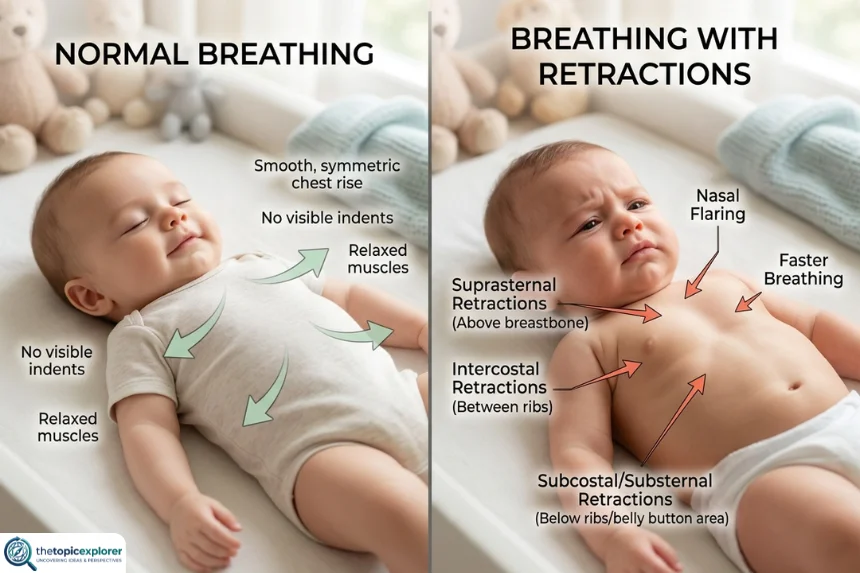
A Key Difference to Watch For
With normal belly breathing, the abdomen generally moves outward as the baby breathes in.
With a retraction, however, part of the soft chest wall sucks inward.
For example, you may see:
- a groove forming between two ribs
- skin disappearing underneath the rib cage
- a hollow appearing near the base of the throat
- pulling above the collarbones
Consequently, the direction of the movement matters.
What Do Retractions Look Like in a Baby?
Retractions may look like the baby’s skin is being sucked toward the chest cavity with each breath.
A retracted breathing baby may have visible sinking between the ribs, below the rib cage, or near the neck.
Instead of the chest expanding smoothly, certain areas pull inward repeatedly as the baby inhales.
The movement often becomes easier to notice when the baby’s shirt is removed and the chest can be seen directly.
However, do not delay medical care simply to observe the breathing pattern for a long period.
Baby Ribs Pulling In When Breathing
One of the most recognizable signs is the ribs becoming unusually prominent because the skin between them pulls inward.
HealthyChildren describes this specifically as ribs pulling in with each breath and considers it a sign of breathing trouble.
Parents may describe it as:
- ribs showing more than usual
- skin sinking between the ribs
- chest looking hollow between breaths
- ribs appearing to “suck in”
Although the appearance can vary, repeated inward pulling is not the same as ordinary chest movement.
Baby Chest Sucking In While Breathing
Sometimes the pulling appears mostly below the ribs instead of between them.
For example, the skin underneath the rib cage may move sharply inward every time the baby inhales.
This is especially easy to confuse with normal belly breathing. However, normal abdominal breathing involves movement of the belly, whereas a retraction creates visible inward pulling of the chest wall.
Neck or Collarbone Tugging
Retractions can also appear higher on the body.
For example, the skin may pull inward:
- above the breastbone
- near the base of the throat
- above the collarbones
HealthyChildren’s current emergency-care guidance specifically describes chest pulling inward between the ribs or around the collarbone as a sign of serious breathing effort.
Therefore, retractions are not limited to the lower chest.
Types of Retractions in a Retracted Breathing Baby
Healthcare professionals use different terms depending on where the inward pulling occurs.
In a retracted breathing baby, the location of the inward pulling determines the type of retraction doctors describe.
Parents do not need to memorize these names before seeking care. Nevertheless, understanding the terminology can make conversations with doctors easier.
Subcostal Retractions in a Baby
Subcostal retractions occur below the ribs.
The skin underneath the lower rib cage pulls inward as the baby inhales.
Parents may describe this as:
“My baby’s belly is moving, but the skin right under the ribs keeps sucking in.”
Subcostal retractions indicate increased breathing effort.
Intercostal Retractions in a Baby
Intercostal retractions occur between the ribs.
The spaces between the ribs become more pronounced because the soft tissue is pulled inward during inhalation.
This is one of the most commonly recognized forms of chest retraction.
Substernal Retractions
Substernal retractions occur below the breastbone, also called the sternum.
The area at the center and lower part of the chest may appear to sink inward while the baby breathes.
Suprasternal Retractions
Suprasternal retractions occur above the breastbone, near the base of the neck.
Parents may notice a hollow or tugging motion at the top of the chest.
Supraclavicular Retractions
Supraclavicular retractions happen above the collarbones.
The skin in this area may visibly sink inward with inhalation.
Do You Need to Know Which Type It Is?
No.
If your baby has visible inward pulling around the ribs, chest, collarbones, or neck, the most important step is to recognize increased work of breathing and seek medical evaluation.
Trying to decide whether the movement is technically subcostal, intercostal, or suprasternal should never delay care.
Retracted Breathing Baby vs. Normal Belly Breathing
The difference between normal baby belly breathing and retractions causes a great deal of confusion for parents.
The key difference is that a retracted breathing baby uses noticeably more effort to breathe.
Babies naturally use their diaphragm heavily when breathing. As a result, their belly can rise noticeably during inhalation and fall during exhalation.
That movement can look dramatic, particularly in a small newborn.
However, the abdomen moving does not automatically mean respiratory distress.
Is Belly Breathing Normal in Babies?
Visible belly movement can be normal when:
- the baby looks comfortable
- breathing is quiet
- the ribs are not sucking inward
- the nostrils are not repeatedly flaring
- there is no grunting
- the baby’s color remains normal
- feeding is comfortable
Therefore, focus on the baby’s overall breathing effort rather than belly movement alone.
When Belly Breathing Becomes Concerning
Belly movement becomes more concerning when it occurs together with signs such as:
- ribs pulling inward
- skin sinking beneath the rib cage
- neck or collarbone tugging
- nasal flaring
- grunting
- wheezing
- harsh noisy breathing
- persistent rapid breathing
- trouble feeding
- unusual tiredness
- blue or gray coloration
HealthyChildren identifies several of these findings—including retractions, noisy breathing, much faster breathing, and blue lips or face—as signs of breathing trouble.
Moreover, its bronchiolitis guidance specifically tells parents to watch for ribs pulling inward, noisy breathing, and unusually fast breathing.
Simple Comparison
Think of the difference this way:
Normal belly breathing: the belly moves because the diaphragm is working.
Retractions: the chest wall is being pulled inward because breathing requires extra effort.
Although this comparison is useful, it should not replace medical evaluation. If you are unsure whether what you are seeing is a retraction—especially in a young infant—contact a healthcare professional promptly.
Why Retractions Matter in Babies
Babies have smaller airways and less respiratory reserve than older children. Therefore, breathing problems can become serious quickly.
Retractions tell clinicians that breathing requires extra effort.
The cause may eventually turn out to be RSV, bronchiolitis, pneumonia, croup, another airway problem, or a different condition. However, the first priority is not naming the illness.
Instead, the first priority is recognizing respiratory distress.
HealthyChildren states that trouble breathing requires immediate medical attention and places infants under 1 year with breathing difficulty and children with ribs pulling inward in its emergency-care category.
Therefore, parents should not assume that visible retractions are simply caused by congestion or that they will disappear after a nap.
The next step is understanding the other signs that can accompany retractions, including fast breathing, nasal flaring, grunting, wheezing, stridor, feeding difficulty, and color changes.

Signs to Watch in a Retracted Breathing Baby
A retracted breathing baby may also have nasal flaring, grunting, rapid breathing, or feeding difficulty.
Retractions rarely deserve attention in isolation. Instead, parents should look at the baby’s overall work of breathing, color, alertness, and ability to feed.
Respiratory distress means a baby is having difficulty moving enough air without extra effort. According to the American Academy of Pediatrics’ HealthyChildren guidance, important signs include ribs pulling inward, breathing much faster than normal, noisy breathing, and struggling for each breath.
Therefore, a retracted breathing baby may also show one or more of the following:
- ribs or chest pulling inward
- nasal flaring
- unusually fast breathing
- rhythmic grunting
- head bobbing with breathing
- wheezing
- stridor or another harsh breathing sound
- difficulty feeding
- decreased activity or alertness
- pale, gray, or blue skin, lips, or nail beds
- pauses in breathing
HealthyChildren specifically describes fast breathing, flared nostrils, head bobbing, grunting, wheezing, and tugging between the ribs or lower neck among signs seen when babies with RSV or bronchiolitis are working hard to breathe.
Nasal Flaring
Nasal flaring happens when a baby’s nostrils widen repeatedly during breathing.
A brief change in nostril shape is not enough to diagnose respiratory distress. However, persistent flaring together with chest retractions or unusually fast breathing suggests the baby is using extra effort to breathe.
For example, HealthyChildren includes nasal flaring among signs of increased breathing difficulty in babies with bronchiolitis.
Therefore, nasal flaring becomes especially important when it appears alongside:
- retractions
- grunting
- rapid breathing
- feeding difficulty
- abnormal color
Grunting While Breathing
A baby in respiratory distress may make a short grunting sound, often repeatedly with breathing.
Grunting can be a sign that the baby is working harder to maintain airflow. Moreover, HealthyChildren includes rhythmic grunting among warning signs associated with lower-respiratory illness such as bronchiolitis.
Consequently, repeated grunting combined with retractions should not simply be attributed to fussiness.
Head Bobbing With Breathing
In young babies, increased breathing effort may sometimes cause the head to move rhythmically with each breath.
HealthyChildren lists head bobbing together with nasal flaring and fast breathing among signs that can occur when an infant develops bronchiolitis from RSV.
Therefore, repeated head movement that appears synchronized with difficult breathing deserves prompt attention.
Wheezing
Wheezing is generally described as a musical, whistling, or purring-type breathing sound.
It can occur when smaller airways become narrowed. For example, bronchiolitis commonly causes wheezing in infants. MedlinePlus also describes wheezing and breathing difficulty among bronchiolitis symptoms.
However, parents should not use the presence or absence of wheezing to judge whether retractions are serious.
A baby can have significant respiratory distress without wheezing.
Stridor
Stridor is a harsh or high-pitched breathing sound, typically associated with narrowing higher in the airway.
Croup is one condition that can cause stridor. Furthermore, HealthyChildren advises emergency evaluation when a child has ribs pulling inward with each breath and urgent assessment for current stridor. An infant under 1 year with stridor is treated particularly cautiously.
Therefore, noisy breathing with visible retractions should not be managed by trying to decide at home whether the sound is technically wheezing or stridor.
What Causes a Retracted Breathing Baby?
A retracted breathing baby can have several possible respiratory or airway problems.
Retractions are a sign, not a diagnosis.
They show that breathing requires more effort than normal. However, several different illnesses or airway problems can create that increased effort.
MedlinePlus lists causes of intercostal retractions including:
- bronchiolitis
- croup
- pneumonia
- airway foreign bodies
- severe allergic reactions
- newborn respiratory distress syndrome
- other conditions that obstruct or narrow the airway
Therefore, parents should avoid assuming the cause based only on how the retractions look.
For example, ribs pulling inward could occur with RSV bronchiolitis, but similar respiratory effort can occur with pneumonia or an upper-airway problem.
The safest approach is to recognize the breathing difficulty first and allow a medical professional to determine the cause.
RSV and a Retracted Breathing Baby
Respiratory syncytial virus (RSV) is an especially important cause of breathing problems in infants.
With RSV, a retracted breathing baby may also develop faster breathing, wheezing, grunting, or reduced feeding.
For many children, RSV begins with symptoms resembling a cold. However, the virus can move into the lower respiratory tract and cause bronchiolitis or pneumonia.
HealthyChildren notes that RSV is a major cause of hospitalization among infants in the United States and that some babies with RSV need hospital treatment for oxygen support or fluids.
Additionally, current CDC information emphasizes that RSV can be dangerous for infants and some young children. Its March 2026 pediatric guidance notes that RSV has historically been a leading cause of infant hospitalization in the United States.
What Do RSV Retractions Look Like?
RSV-related retractions do not have a unique appearance that lets parents identify RSV by sight.
Instead, the retractions show that the baby is working hard to breathe.
HealthyChildren advises parents to watch the rib cage as the infant inhales. When the chest wall caves inward or the area beneath the neck forms a noticeable hollow, those movements are chest-wall retractions.
RSV breathing trouble may also include:
- faster breathing
- nostril flaring
- head bobbing
- grunting
- wheezing
- tugging between the ribs
- pulling around the lower neck
- reduced feeding
Therefore, a search such as “RSV baby ribs pulling in” describes a potentially important respiratory-distress sign rather than a normal feature of a cold.
Can RSV Start Like a Simple Cold?
Yes.
RSV may initially cause:
- congestion
- runny nose
- cough
- sneezing
- fussiness
- reduced feeding
However, some babies then develop lower-airway symptoms.
HealthyChildren explains that bronchiolitis can add fast breathing, nasal flaring, grunting, wheezing, and chest-wall retractions to the earlier cold-like symptoms.
Consequently, parents should pay attention when a baby’s breathing pattern becomes noticeably harder even if the illness began as an ordinary-looking cold.
Bronchiolitis and a Retracted Breathing Baby
Bronchiolitis is inflammation of the small airways in the lungs. RSV is a common cause, although other viruses can cause it as well.
As the smaller airways become swollen and filled with mucus, breathing may require more effort.
MedlinePlus lists:
- breathing difficulty
- wheezing
- cough
- nasal flaring
- intercostal retractions
- fatigue
- possible bluish skin when oxygen is inadequate
among possible bronchiolitis findings.
Therefore, bronchiolitis baby retractions are a sign that deserves prompt medical attention.
How Can Bronchiolitis Affect Feeding?
Babies normally coordinate sucking, swallowing, and breathing while they eat.
When breathing becomes difficult, however, feeding can become exhausting.
A baby may:
- drink for shorter periods
- repeatedly stop to catch a breath
- take much less milk than usual
- appear tired during feeding
- produce fewer wet diapers
HealthyChildren advises prompt medical attention when a child with bronchiolitis takes less than half the normal amount of milk or develops signs of dehydration.
Therefore, feeding is not separate from the respiratory assessment. A sudden drop in intake can provide another clue that the illness is becoming more significant.

Which Babies Are More Vulnerable to Severe RSV?
Although any infant can become sick with RSV, some babies have a higher risk of severe illness.
Current CDC guidance particularly emphasizes protection for young infants and certain children entering their first or second RSV seasons. Groups that may warrant special consideration include premature infants and children with conditions such as chronic lung disease, severe immune compromise, or severe cystic fibrosis.
However, being a healthy full-term baby does not make visible retractions normal.
Therefore, emergency decisions should be based on the baby’s actual breathing difficulty rather than assuming that a previously healthy child cannot become seriously ill.
Can Pneumonia Cause Retractions in Babies?
Yes. Pneumonia can be associated with retractions and increased breathing effort.
Pneumonia affects the lungs and can make effective breathing more difficult. As a result, a baby may breathe faster or use additional muscles around the chest.
MedlinePlus specifically includes pneumonia among medical conditions that can cause intercostal retractions.
However, parents should not try to distinguish pneumonia from bronchiolitis based on retractions alone.
A clinician may consider:
- the baby’s age
- fever
- breathing sounds
- oxygen level
- respiratory rate
- feeding
- physical examination
- other symptoms
Therefore, the presence of retractions tells you that breathing requires attention—not exactly which lung condition is responsible.
Can Croup Cause Retractions?
Yes. More significant croup can cause increased work of breathing and retractions.
Croup typically affects the upper airway and is well known for a barking cough and stridor. MedlinePlus includes croup among conditions that may produce intercostal retractions.
Moreover, HealthyChildren recommends ER evaluation when ribs pull inward with every breath in a child with croup.
Croup With Stridor and Retractions
A baby with croup may have:
- a bark-like cough
- hoarse voice or cry
- harsh breathing sounds
- stridor
- increased breathing effort
- retractions
However, the severity cannot be judged only from the cough.
For example, a baby who has a dramatic barking cough but breathes comfortably may be in a different situation from a baby whose chest is visibly pulling inward with each breath.
Therefore, work of breathing matters greatly.
Can Congestion Cause a Baby’s Chest to Pull In?
Young babies rely heavily on breathing through their noses, so congestion can make them sound noisy and can interfere with feeding.
However, parents should be careful about attributing visible chest retractions to simple nasal congestion.
A stuffy nose may make breathing appear uncomfortable. Nevertheless, repeated inward pulling of the ribs, chest, or lower neck indicates increased respiratory effort.
HealthyChildren places ribs pulling inward with each breath in its emergency-evaluation category for bronchiolitis.
Therefore:
Persistent retractions should not simply be dismissed as congestion.
If clearing obvious nasal mucus does not change the baby’s breathing effort—or if the baby continues to retract—medical assessment remains important.
Can Choking Cause Retractions?
A foreign object in the airway can cause severe breathing difficulty.
MedlinePlus lists a foreign body in the windpipe among possible causes of intercostal retractions.
Choking becomes particularly concerning when breathing difficulty begins suddenly, especially during eating or after the baby has had access to a small object.
If the baby cannot breathe, cry, or respond normally, this is an emergency.
Therefore, sudden severe respiratory distress should not be assumed to be a viral illness simply because the baby also has chest pulling.
Can an Allergic Reaction Cause Retractions?
A severe allergic reaction, or anaphylaxis, can cause airway swelling and serious breathing difficulty.
MedlinePlus includes anaphylaxis among conditions associated with intercostal retractions.
Warning signs may develop rapidly after exposure to a triggering food, medication, insect sting, or another allergen.
Therefore, sudden breathing difficulty after a possible allergic exposure—particularly when accompanied by swelling, widespread hives, collapse, or severe respiratory distress—requires emergency care.
Feeding Problems in a Retracted Breathing Baby
A baby’s ability to feed provides useful information about how well they are coping with a respiratory illness.
A retracted breathing baby may find feeding difficult because breathing already requires extra effort.
Breathing and feeding happen together. Consequently, an infant who is working very hard to breathe may struggle to maintain normal feeding.
Parents may notice that the baby:
- repeatedly pulls away from the breast or bottle
- stops sucking to breathe
- becomes sweaty or exhausted during feeding
- takes much less than usual
- feeds for very short periods
- produces fewer wet diapers
HealthyChildren advises medical attention for bronchiolitis when milk intake falls below half of normal or when dehydration is suspected. Signs listed include no urine for more than eight hours, very dry mouth, dark urine, and absence of tears.
Additionally, AAP RSV guidance advises contacting a pediatrician for dehydration, difficulty breathing, pauses in breathing, or significantly decreased activity and alertness.
Why Fewer Wet Diapers Matter
Wet diapers provide one practical way to monitor hydration.
When babies breathe rapidly, feed poorly, or have fever, fluid intake can fall. As a result, dehydration can develop alongside the respiratory illness.
However, parents should not wait for dehydration before seeking help when retractions are already visible.
Retractions themselves indicate increased work of breathing.
What About Fever in a Young Baby?
Fever deserves special attention in very young infants.
HealthyChildren advises prompt medical evaluation for a baby younger than 12 weeks with a rectal temperature of 100.4°F (38°C) or higher.
Therefore, a young infant who has both fever and abnormal breathing needs medical assessment rather than home diagnosis.
Moreover, parents should not assume that absence of fever rules out a significant respiratory infection. RSV, for example, does not always cause fever in every infant.
Why the Cause Should Not Delay Care
Parents understandably want to know whether the problem is:
RSV, bronchiolitis, pneumonia, croup, congestion, or something else.
However, determining the exact diagnosis is secondary when a baby is visibly working hard to breathe.
MedlinePlus describes intercostal retractions themselves as a medical emergency sign and advises seeking medical help right away.
Therefore, the safer sequence is:
Notice the retractions → assess for severe warning signs → seek appropriate medical care → let clinicians determine the cause.
The next important questions are when to go to the emergency room, when to call 911, whether parents should count breathing rates, and whether a home pulse oximeter can safely guide the decision.
When Should a Retracted Breathing Baby Go to the ER?
Visible chest retractions in an infant deserve urgent attention.
The American Academy of Pediatrics’ HealthyChildren symptom guidance recommends going to the emergency room when a baby under 1 year has trouble breathing or when the ribs pull inward with each breath.
Therefore, do not wait for additional symptoms before seeking help if your baby’s ribs are repeatedly sucking inward.
Go to the ER when you notice:
- ribs pulling inward with each breath
- chest pulling in around the collarbones
- trouble breathing in a baby under 1 year
- breathing difficulty with loud wheezing
- breathing difficulty with stridor
- increasing respiratory effort
- unusual sleepiness or reduced alertness
Additionally, HealthyChildren’s current emergency-care guidance identifies chest pulling inward between the ribs or at the collarbone as a sign that a child is working very hard to breathe.
Do Retractions Always Mean an Emergency Room Visit?
For an infant, retractions should be taken seriously.
Parents sometimes wonder whether mild-looking retractions can simply be watched at home. However, the appearance can be difficult to judge accurately, especially in a small baby.
Moreover, breathing problems can worsen quickly.
Consequently, HealthyChildren places ribs pulling in with each breath under its “Go to ER Now” guidance.
A parent does not need to decide whether the retraction is “mild,” “moderate,” or “severe” before getting help.
When Should You Call 911 for a Retracted Breathing Baby?
Some breathing problems require 911 rather than driving the baby to the hospital yourself.
Call 911 if your baby:
- is struggling severely for every breath
- can barely cry because breathing is so difficult
- stops breathing
- becomes unconscious or unresponsive
- has blue or gray lips or face
- suddenly develops severe breathing difficulty after choking
- develops sudden severe breathing trouble after a possible allergic reaction
HealthyChildren lists severe respiratory distress, stopped breathing, blue lips or face, choking, and sudden allergic breathing problems among reasons to call 911 immediately.
Therefore, if the baby appears critically ill, do not delay emergency assistance while trying home remedies or checking symptoms online.
Should You Count a Retracted Breathing Baby’s Breaths?
Parents often notice that their baby is breathing quickly and wonder whether counting breaths will help.
It can provide useful information. However, breathing rate should never be used by itself to decide whether visible retractions are safe.
To count breaths:
- Wait until the baby is relatively calm.
- Watch the chest or abdomen.
- Count each rise as one breath.
- Count for a full minute when possible.
Crying, fever, feeding, and activity can temporarily increase the breathing rate.
For newborns, the American Academy of Pediatrics identifies more than 60 breaths per minute as fast breathing that may be concerning, while also noting that babies normally breathe faster than adults.
However, that number should not become a reason to ignore other warning signs.
For example, a baby whose breathing rate seems below a particular cutoff but whose ribs are visibly retracting still needs evaluation.
What Matters More Than the Number?
Look at the whole baby.
Important signs include:
- effort needed to breathe
- chest retractions
- nasal flaring
- grunting
- color
- alertness
- feeding ability
- unusual breathing sounds
Therefore, how hard the baby is working to breathe can be as important as how fast the baby is breathing.
Should You Use a Home Pulse Oximeter for Baby Retractions?
A home pulse oximeter may seem reassuring because it displays an oxygen-saturation number.
However, parents should not use a home oxygen reading to overrule visible signs of respiratory distress.
The FDA advises people using pulse oximeters at home not to rely only on the device. Symptoms and worsening condition also matter.
Therefore, if your baby’s ribs or chest are pulling inward, do not delay medical care simply because a monitor displays a number that appears normal.
FDA Warning About Unauthorized Infant Monitors
In September 2025, the FDA issued a safety warning about unauthorized infant monitors that claim to measure oxygen saturation, breathing rate, pulse, or other vital signs.
The FDA warned that inaccurate measurements could:
- fail to detect a worsening condition
- delay treatment
- produce unnecessary alerts
- lead caregivers to rely too heavily on the device
Additionally, the FDA states that unauthorized infant monitors have not been evaluated for safety and effectiveness.
Are All Infant Oxygen Monitors Unauthorized?
No.
This distinction is important.
The FDA maintains an authorized medical-device category for over-the-counter infant pulse-rate and oxygen-saturation monitors under product code QYU.
Therefore, the correct message is not that every infant oxygen monitor is unsafe or unauthorized.
Instead:
Use only an appropriate FDA-authorized device when one is recommended for your baby’s needs, and never let a monitor replace attention to visible breathing difficulty.
A baby who is retracting still needs medical assessment even when a device appears reassuring.
Can a Retracted Breathing Baby Have Retractions While Sleeping?
Parents often notice breathing movements more clearly while their baby sleeps.
A retracted breathing baby can still show chest-wall pulling while asleep.
A sleeping baby’s abdomen may rise and fall visibly. Additionally, newborn breathing can sometimes appear irregular.
However, true retractions are different from ordinary sleep-related belly movement.
Watch for:
- skin sucking inward between the ribs
- pulling underneath the rib cage
- tugging near the breastbone
- hollowing around the lower neck or collarbones
- nasal flaring
- grunting
- abnormal color
If these movements are present, do not assume they are normal simply because the baby is asleep.
HealthyChildren identifies ribs pulling inward with each breath as respiratory distress regardless of whether a child is awake or resting.
Should You Wake a Baby Who Seems to Be Retracting?
If you think your sleeping baby is struggling to breathe, check them immediately.
Look at:
- color
- responsiveness
- breathing effort
- chest movement
However, do not spend a long time observing at home when clear retractions are present.
Instead, follow emergency guidance based on the baby’s condition.
Retracted Breathing Baby: What About Newborns?
Retracted breathing in a newborn deserves especially prompt attention.
Newborn babies naturally breathe faster than adults, and their bellies often move noticeably. Nevertheless, chest-wall retractions are not simply normal newborn breathing.
The American Academy of Pediatrics lists several concerning newborn respiratory signs, including:
- breathing faster than 60 breaths per minute
- retractions between the ribs
- nasal flaring
- grunting
- persistent blue coloring
Therefore, parents should have a low threshold for seeking medical help when a newborn appears to be working hard to breathe.
Why Can Newborns Develop Retractions?
Possible causes vary and may include:
- infection
- airway problems
- lung conditions
- premature lung development
- respiratory distress syndrome
- other medical problems
However, the exact diagnosis cannot be determined by looking at the retractions alone.
A clinician needs to assess the newborn.
Can Retractions Come and Go?
Yes, respiratory effort can sometimes fluctuate.
For example, breathing may briefly look easier when:
- a baby settles after crying
- nasal mucus clears
- fever decreases
- body position changes
However, temporary improvement does not necessarily mean the problem has resolved.
If you have clearly seen the ribs, chest, or neck sucking inward with breathing, especially in a baby under 1 year, current AAP guidance supports emergency evaluation.
Therefore, do not wait for the retractions to become constant before seeking help.
What Will Doctors Check in a Retracted Breathing Baby?
Medical teams first assess how well the baby is breathing and whether immediate respiratory support is needed.
When examining a retracted breathing baby, clinicians assess breathing effort, oxygen level, color, feeding, and alertness.
Depending on the situation, clinicians may evaluate:
- breathing rate
- work of breathing
- oxygen saturation
- heart rate
- skin and lip color
- lung sounds
- airway sounds
- hydration
- feeding
- alertness
- temperature
- recent illness history
Additionally, they may consider conditions such as RSV, bronchiolitis, pneumonia, croup, or another airway or lung problem.
However, not every baby needs the same tests.
The medical evaluation depends on the baby’s age, symptoms, examination, and severity.
Will Every Baby With Retractions Need Oxygen?
Not necessarily.
Treatment depends on the cause and severity.
Some infants may need oxygen or other respiratory support. Meanwhile, others may need help with hydration, nasal suctioning, or treatment directed at another condition.
Therefore, parents should avoid trying to predict treatment from the appearance of the retractions alone.
What Can Parents Do While Getting Medical Help?
The priority is obtaining appropriate care.
While arranging care, keep the baby where you can observe breathing and color closely.
Additionally:
- keep the baby’s airway area unobstructed
- avoid smoke exposure
- do not force a baby who is struggling to breathe to take a large feeding
- follow instructions from emergency dispatchers or healthcare professionals
If nasal congestion is contributing to discomfort, saline and gentle suction may sometimes help clear the nose. However, improvement after clearing mucus does not make persistent chest retractions normal.
HealthyChildren specifically recommends emergency evaluation when the ribs continue pulling inward with each breath.
What Should Parents Avoid Doing?
When a baby is retracting, avoid:
- waiting for a home monitor alarm before seeking help
- repeatedly checking oxygen readings instead of watching symptoms
- assuming the problem is only congestion
- diagnosing RSV at home based on retractions
- forcing feeds when breathing is difficult
- delaying care to record a long video
- assuming sleeping means the baby is improving
A brief video of the breathing pattern may sometimes be useful to a clinician if it can be taken without delaying care.
However, safety comes first.
How Can RSV Be Prevented in Babies?
Because RSV is a common cause of serious lower-respiratory illness in infants, prevention deserves brief attention.
Current CDC guidance recommends protecting infants from severe RSV disease through either maternal RSV vaccination during pregnancy or an infant long-acting RSV monoclonal antibody, depending on the circumstances. Most infants do not need both.
The infant antibody options currently include:
- nirsevimab
- clesrovimab
For eligible infants, these antibodies are generally given around the RSV season. In most of the United States, CDC guidance describes the season as roughly October through March.
Which Babies May Receive an RSV Antibody?
CDC recommends an infant RSV antibody for babies younger than 8 months entering or born during their first RSV season when:
- the mother did not receive an RSV vaccine during pregnancy
- maternal vaccination status is unknown
- the baby was born within 14 days after maternal vaccination
Additionally, some children ages 8–19 months who have increased risk of severe RSV disease may qualify for nirsevimab before their second RSV season.
Parents should discuss individual eligibility and timing with their pediatric clinician.
Does RSV Prevention Mean Retractions Can Be Watched at Home?
No.
Preventive immunization reduces the risk of severe RSV disease, but it does not make respiratory distress harmless.
Moreover, RSV is only one possible cause of retractions.
Therefore, a baby’s current breathing symptoms should guide the need for medical care regardless of RSV immunization history.
Frequently Asked Questions About Retracted Breathing in Babies
What does retracted breathing look like in a baby?
Retracted breathing looks like the skin between or below a baby’s ribs, near the breastbone, or around the collarbones and neck is being sucked inward during inhalation. These movements indicate increased work of breathing.
Are retractions in babies an emergency?
Retractions in an infant need prompt medical assessment. HealthyChildren recommends ER evaluation when a baby’s ribs pull inward with each breath and when an infant under 1 year has trouble breathing.
Why are my baby’s ribs pulling in when breathing?
Ribs pull inward when breathing requires extra effort. Possible causes include RSV and bronchiolitis, pneumonia, croup, airway obstruction, or other respiratory conditions. The appearance alone cannot identify the cause.
What are subcostal retractions in a baby?
Subcostal retractions occur when the skin directly below the rib cage pulls inward during inhalation. They are a form of increased work of breathing.
What are intercostal retractions in a baby?
Intercostal retractions occur when the spaces between the ribs pull inward during breathing. They are a sign that breathing requires extra effort.
Is belly breathing normal in babies?
Visible belly movement can be normal because babies rely heavily on their diaphragm. However, inward pulling between or below the ribs is different and may represent respiratory distress.
Can RSV cause retractions in babies?
Yes. RSV can cause bronchiolitis or pneumonia and may lead to increased breathing effort in infants. Current CDC guidance emphasizes that RSV can be particularly serious in young babies.
Can congestion cause retractions?
Nasal congestion may make a baby sound noisy or make feeding harder. However, persistent ribs or chest pulling inward should not simply be dismissed as congestion. HealthyChildren recommends ER evaluation for retractions.
Can a baby have retractions without wheezing?
Yes. Wheezing is only one possible respiratory sign. A baby can have significant breathing difficulty and visible retractions without wheezing.
Can a baby have retractions without fever?
Yes. Fever is not required for respiratory distress. Therefore, the absence of fever should not be used to dismiss chest retractions.
Can retractions happen while a baby sleeps?
Retractions can still occur during sleep. Normal belly movement may be more noticeable while sleeping, but inward pulling between or underneath the ribs or around the neck remains concerning.
Should I count my baby’s breaths?
Breathing rate can provide useful information, particularly when the baby is calm. However, counting should not delay care when clear retractions or other severe breathing signs are present.
Should I check my baby’s oxygen level at home?
A home pulse oximeter should not replace assessment of symptoms. The FDA advises people not to rely only on pulse-ox readings and has warned against unauthorized infant vital-sign monitors.
When should I call 911 for my baby’s breathing?
Call 911 for severe difficulty breathing, stopped breathing, unresponsiveness, blue or gray lips or face, severe choking, or sudden severe breathing difficulty after a possible allergic reaction.
When should I go to the ER for baby retractions?
HealthyChildren recommends emergency-room evaluation when a baby’s ribs pull inward with every breath or an infant under age 1 has trouble breathing.
What to Remember About a Retracted Breathing Baby
A retracted breathing baby is showing increased work of breathing. The skin may pull inward between or below the ribs, around the breastbone, or near the neck and collarbones.
Although RSV, bronchiolitis, pneumonia, croup, congestion-related illness, and other conditions can contribute to breathing trouble, parents do not need to determine the diagnosis before seeking help.
Most importantly, current American Academy of Pediatrics guidance recommends ER evaluation when an infant has trouble breathing or the ribs pull inward with each breath. Severe breathing difficulty, stopped breathing, unresponsiveness, or blue lips or face requires 911.
Finally, do not let a reassuring home oxygen-monitor reading override visible respiratory distress. The baby’s actual breathing effort matters.
READ MORE ABOUT: White Bump on Side of Tongue
