



The first country to celebrate New Year is Kiribati. More precisely, Kiritimati and the other Line Islands of Kiribati reach midnight first because they use Line Islands Time, or UTC+14—the earliest civil time zone currently in use.
However, the entire country does not enter January 1 at the same instant. Kiribati spans three time zones. Kiritimati celebrates first, the Phoenix Islands follow one hour later, and the capital, Tarawa, enters the new year two hours after Kiritimati.
Quick Facts About the Global New Year Timeline
| Question | Verified answer |
|---|---|
| First country to enter the New Year | Kiribati |
| First inhabited place commonly named | Kiritimati, also called Christmas Island |
| Island group | Line Islands |
| Time zone | Line Islands Time, UTC+14 |
| Time of midnight in UTC | 10:00 a.m. on December 31 |
| First place after Kiritimati | Chatham Islands, New Zealand, 15 minutes later |
| First major cities | Auckland, Wellington, Apia, and Nukuʻalofa are among the earliest |
| Kiribati time zones | UTC+12, UTC+13, and UTC+14 |
| Last inhabited places | Niue and American Samoa, both UTC−11 |
| Last land areas | Baker and Howland Islands, UTC−12, both uninhabited |
| Time for all inhabited places to reach January 1 | About 25 hours |
| Time including uninhabited UTC−12 islands | About 26 hours |
| Date-line change affecting Kiribati | Eastern islands skipped December 31, 1994 |
| First recorded ancient New Year celebrations | Ancient Babylonia, a different historical question |
Which Is the First Country to Celebrate New Year?
Kiribati is the first country with inhabited territory to reach midnight on January 1.
Specifically, the distinction belongs to the country’s eastern Line Islands. Kiritimati is the best-known inhabited island in that group. It follows UTC+14 throughout the year and does not use daylight saving time.
The IANA Time Zone Database entry for Pacific/Kiritimati records a UTC+14 offset after the end of 1994. Likewise, the Kiritimati time-zone page lists Line Islands Time at UTC+14 with no seasonal clock change.
Therefore, when Kiritimati reaches 12:00 a.m. on January 1, it is only 10:00 a.m. UTC on December 31.
Is Kiribati the First Country or Is Kiritimati the First Place?
Both statements can be correct, but they answer slightly different questions.
- Kiribati is the first country to enter the new year.
- Kiritimati is the inhabited place most often identified as the first community to reach midnight.
- The Line Islands are the first region within Kiribati to enter January 1.
For precision, a strong answer should mention both the country and the specific island group.
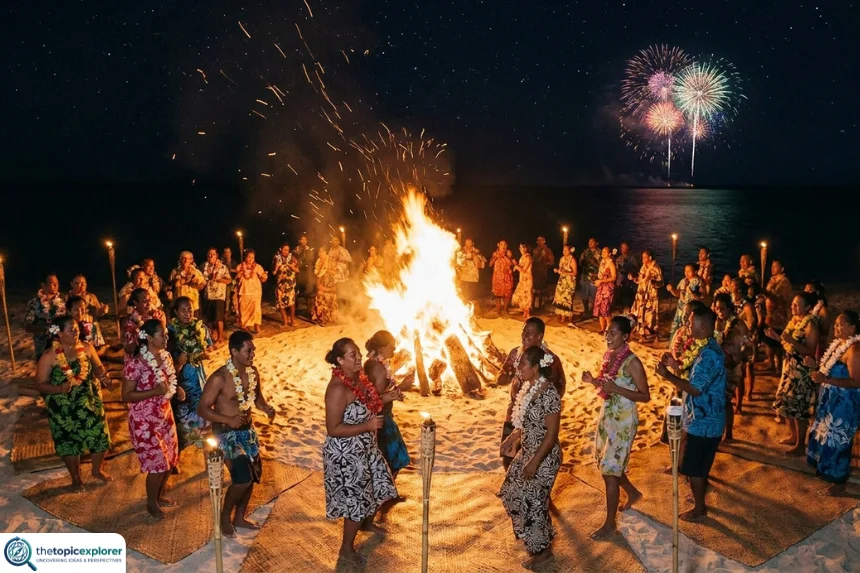
Why Does Kiritimati Celebrate First?
Kiritimati celebrates first because its legal time is 14 hours ahead of Coordinated Universal Time.
UTC offsets determine local midnight. The largest positive offset currently used by an inhabited location is UTC+14. Consequently, a UTC+14 community reaches a new calendar date before places using UTC+13, UTC+12, or any smaller offset.
This ordering reflects civil time rather than physical sunrise alone. Governments choose legal time zones for administrative, economic, and political reasons. As a result, the first clock to show January 1 does not depend simply on which island lies farthest east.
What Does UTC+14 Mean?
UTC+14 means that the local clock runs 14 hours ahead of UTC.
For example:
- At 10:00 a.m. UTC on December 31, Kiritimati reaches midnight on January 1.
- At 5:00 a.m. Eastern Standard Time, Kiritimati reaches midnight.
- At 2:00 a.m. Pacific Standard Time, Kiritimati reaches midnight.
- At 3:00 p.m. Pakistan Standard Time, Kiritimati reaches midnight.
Thus, many Americans are still asleep on the morning of December 31 when the first New Year countdown finishes in Kiribati.
Kiribati Does Not Celebrate All at Once
Kiribati covers a vast stretch of the central Pacific and uses three time zones.
The time zones in Kiribati are:
| Island group | Time-zone name | UTC offset | Example location | New Year order |
| Line Islands | Line Islands Time | UTC+14 | Kiritimati | First |
| Phoenix Islands | Phoenix Island Time | UTC+13 | Kanton Island | One hour later |
| Gilbert Islands | Gilbert Island Time | UTC+12 | Tarawa | Two hours later |
Therefore, saying “Kiribati celebrates first” does not mean every resident of the country counts down simultaneously.
Kiritimati reaches midnight first. After one hour, Kanton Island enters January 1. Finally, Tarawa and the Gilbert Islands follow another hour later.
Why Do Some Lists Rank New Zealand Above Kiribati?
Some lists rank whole countries according to their capitals or largest cities rather than their earliest territory.
That method can place New Zealand first because Wellington and Auckland use UTC+13 during the Southern Hemisphere summer. Meanwhile, Kiribati’s capital, Tarawa, uses UTC+12.
However, the keyword asks which country reaches the New Year first, not which national capital celebrates first. Because Kiritimati is part of the sovereign Republic of Kiribati, Kiribati takes the first position.
A 2025 Khaleej Times article illustrated this confusion by listing New Zealand first while also acknowledging that Kiritimati entered 2026 one hour earlier. A more consistent ranking uses the earliest inhabited territory within each country.
How Kiribati Became the First Country to Celebrate New Year
Kiribati did not always hold its current position.
Before 1995, the International Date Line effectively divided the country. The Gilbert Islands used a calendar date nearly one day ahead of the Phoenix and Line Islands. Consequently, government offices and businesses within one nation could operate on different weekdays.
Kiribati solved that administrative problem by changing the civil time of its eastern islands.
The current IANA data shows that Kanton moved from UTC−11 to UTC+13, while Kiritimati moved from UTC−10 to UTC+14 at the end of 1994. In practical terms, those islands moved their clocks forward by 24 hours.
Did Kiribati Skip a Day?
Yes. The affected eastern islands moved directly from Friday, December 30, 1994, to Sunday, January 1, 1995.
They did not experience a local December 31, 1994.
Afterward, all three island groups could share the same calendar date, even though their clocks still differed by as much as two hours.
The change also gave Kiribati a valuable international distinction. Its Line Islands could market themselves as the first inhabited places to enter a new day, a new year, and the new millennium.
Did Kiribati Literally Move the International Date Line?
People commonly say that Kiribati “moved the International Date Line.” That wording is understandable but slightly simplified.
The International Date Line does not operate through one binding global treaty. Instead, governments choose the dates and civil time observed in their territories. Mapmakers then draw the line around those legal choices.
The IANA discussion of the International Date Line notes that no international standard, convention, or treaty defines its complete path.
Therefore, Kiribati technically changed the legal time of its eastern islands. Maps subsequently depicted the date line bending around the country.
What Place Celebrates Immediately After Kiribati?
The Chatham Islands of New Zealand enter the New Year 15 minutes after Kiritimati.
During New Year’s Eve, the Chatham Islands use Chatham Daylight Time at UTC+13:45. That unusual 45-minute offset places them between Kiritimati at UTC+14 and the UTC+13 group.
The current global New Year schedule lists this order:
- Kiritimati, Kiribati — UTC+14
- Chatham Islands, New Zealand — UTC+13:45
- New Zealand mainland, Samoa, Tonga, and other UTC+13 locations
- Fiji, Tarawa, and other UTC+12 locations
- Eastern Australia and other UTC+11 locations
Thus, New Zealand is the second country to begin entering the New Year, only 15 minutes after Kiribati.
Which Major City Celebrates First?
Kiritimati has communities rather than a globally prominent city.
Among major urban countdowns, Auckland is one of the first widely broadcast cities to reach midnight. Wellington, Apia, and Nukuʻalofa enter the new year at the same UTC+13 stage.
Sydney follows later. Its famous harbor fireworks receive enormous international coverage, which can create the false impression that Australia celebrates first.
Is New Zealand the First Country to Celebrate New Year?
No. New Zealand is among the first, but Kiribati reaches midnight earlier.
The Chatham Islands enter the New Year 15 minutes after Kiritimati. Mainland New Zealand follows 45 minutes after the Chatham Islands and one hour after Kiritimati.
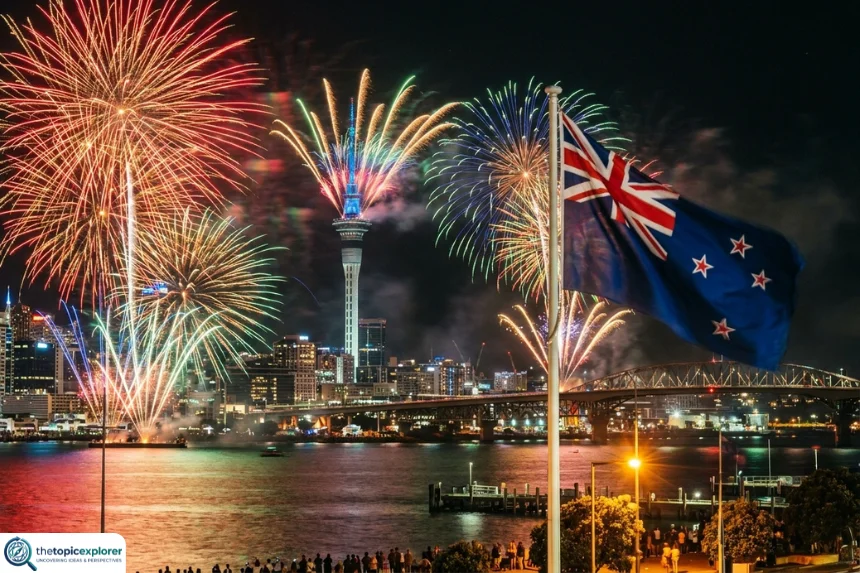
New Zealand often appears first in television coverage because Auckland stages a highly visible countdown. By comparison, Kiribati has a much smaller population and receives less live international broadcasting.
Visibility, however, does not determine the time-zone order.
Is Samoa the First Country to Celebrate New Year?
No. Samoa is among the early countries, but Kiritimati reaches midnight one hour sooner.
Samoa currently uses UTC+13. It moved across the date line in 2011 to align its working week more closely with Australia and New Zealand.
Before that change, Samoa ranked among the last places to enter a new day. After skipping December 30, 2011, it moved to the early side of the global calendar.
The National Geographic explanation of the first and last New Year locations notes that Samoa changed sides of the date line in 2011. Nevertheless, Kiribati’s UTC+14 Line Islands remain one hour ahead.
Why Did Some News Reports Call Samoa First?
Some older articles used an incomplete list or ignored Kiribati’s Line Islands.
For example, a 2017 article from The News International called Samoa the first country to celebrate 2018. Yet Kiritimati was already using UTC+14 at that time, while Samoa used UTC+13.
Therefore, that headline was inaccurate under the standard civil-time comparison.
Is Tonga the First Country to Celebrate New Year?
No. Tonga uses UTC+13 and celebrates one hour after Kiritimati.
Tonga shares its New Year moment with several other UTC+13 locations. These include Samoa and mainland New Zealand during daylight saving time.
Historically, Tonga promoted itself as a place “where time begins.” Nevertheless, Kiribati took the earliest position after its 1995 time-zone realignment.
Is Australia the First Country to Celebrate New Year?
No. Australia celebrates early, but several Pacific islands enter the new year first.
Sydney normally uses Australian Eastern Daylight Time, UTC+11, on December 31. Therefore, Kiritimati reaches midnight three hours before Sydney.
The usual order is:
- Kiribati’s Line Islands
- Chatham Islands
- New Zealand mainland, Samoa, Tonga, and other UTC+13 locations
- UTC+12 locations
- Sydney and other UTC+11 locations
Australia’s fireworks dominate international television because Sydney hosts one of the world’s largest and most recognizable displays. However, spectacle and timing are separate questions.
Kiritimati Is Not Australia’s Christmas Island
Kiritimati is often called Christmas Island, which creates a common geographic mix-up.
There are two different islands:
| Place | Political status | Ocean | Time zone | First to celebrate? |
| Kiritimati, also called Christmas Island | Part of Kiribati | Pacific Ocean | UTC+14 | Yes |
| Christmas Island | Australian external territory | Indian Ocean | UTC+7 | No |
The Kiribati National Tourism Office explains that “Kiritimati” is a local respelling of the English word “Christmas.”
Therefore, articles should use “Kiritimati, Kiribati” rather than writing only “Christmas Island.” That wording prevents readers from confusing it with the Australian territory.
What Time Does Kiribati Celebrate in the United States?
When Kiritimati reaches midnight on January 1, the continental United States is still in the early morning of December 31.
| U.S. time zone | Local time when Kiritimati reaches midnight |
| Eastern Standard Time | 5:00 a.m., December 31 |
| Central Standard Time | 4:00 a.m., December 31 |
| Mountain Standard Time | 3:00 a.m., December 31 |
| Pacific Standard Time | 2:00 a.m., December 31 |
| Alaska Standard Time | 1:00 a.m., December 31 |
| Hawaii Standard Time | 12:00 a.m., December 31 |
These conversions assume the standard U.S. offsets in effect on December 31.
As a result, Kiritimati begins January 1 exactly 24 hours before Hawaii begins January 1. American Samoa waits another hour beyond Hawaii.
Which Places Celebrate New Year Last?
The last inhabited places to enter the New Year are Niue and American Samoa.
Both use UTC−11. They reach midnight 25 hours after Kiritimati.
American Samoa is a U.S. territory. It should not be confused with the independent country of Samoa, which uses UTC+13 and celebrates 24 hours earlier.
Niue is a self-governing island state in free association with New Zealand. Although classifications differ in some country lists, it functions as a distinct political entity and uses UTC−11.
What Is the Absolute Last Place to Enter the New Year?
Baker Island and Howland Island use UTC−12 and reach January 1 one hour after Niue and American Samoa.
However, both islands are uninhabited U.S. territories. Therefore, no resident population holds a countdown there.
This distinction produces two valid answers:
- Last inhabited places: Niue and American Samoa
- Last land territories: Baker and Howland Islands
How Long Does New Year Take to Travel Around the World?
The New Year takes about 25 hours to reach every inhabited time zone.
Kiritimati begins at UTC+14. Niue and American Samoa finish the inhabited sequence at UTC−11. The difference between those offsets is 25 hours.
If uninhabited Baker and Howland Islands count, the complete civil-time span reaches 26 hours because those territories use UTC−12.
Therefore, the global New Year is not a single instant. It is a rolling transition that lasts longer than one full day.
Does Kiribati See the First Sunrise of the New Year?
Kiribati is first by civil time, but “first sunrise” is a more complicated astronomical claim.
Sunrise depends on season, latitude, longitude, terrain, and the exact definition of the location being compared. Civil midnight, by contrast, follows legal time zones.
The Kiribati National Tourism Office promotes Kiritimati as the first place to welcome the New Year. That statement works for the legal calendar. However, writers should avoid assuming that the same island always receives the planet’s first visible sunrise under every astronomical definition.
What Was the First Country to Celebrate New Year Historically?
This question has a different answer.
If “first” means the modern annual time-zone sequence, the answer is Kiribati.
If “first” means the earliest recorded civilization to hold New Year festivities, historians commonly point to ancient Babylonia in Mesopotamia. The history of New Year celebrations traces recorded festivities back about 4,000 years to Babylon.
Those ancient celebrations did not occur on January 1. Babylonians marked the new year around the first new moon after the spring equinox.
Therefore, articles should separate these two search intents:
- First country each January 1: Kiribati
- Earliest recorded New Year celebration: Ancient Babylonia
Can the First Country Change in the Future?
Yes. Governments can change time zones, daylight saving rules, or their relationship to the date line.
Kiribati became first only after the 1994–1995 change. Samoa also transformed its position by moving from UTC−11 to UTC+13 in 2011.
Nevertheless, time-zone databases current in 2026 continue to place Kiritimati at UTC+14. Therefore, Kiribati remains first under the rules currently scheduled for the next New Year.
Publishers should still verify the time-zone order before updating year-specific articles because political decisions can alter it.
Common Myths About the First Country to Celebrate New Year
Myth: New Zealand is always the first country. Kiritimati in Kiribati reaches midnight 15 minutes before New Zealand’s Chatham Islands and one hour before mainland New Zealand.
Myth: The whole of Kiribati celebrates simultaneously. The country uses three time zones, so Tarawa celebrates two hours after Kiritimati.
Myth: Samoa is first. Samoa uses UTC+13, one hour behind Kiritimati.
Myth: Australia celebrates first because Sydney appears on television first. Sydney is three hours behind Kiritimati during New Year’s Eve.
Myth: Kiritimati is the Australian Christmas Island. Kiritimati belongs to Kiribati in the Pacific; Australia’s Christmas Island lies in the Indian Ocean.
Myth: The date line is a perfectly straight official border. It bends around territories, and no single global treaty defines its complete path.
Myth: Kiribati physically moved its islands. The government changed the legal calendar and UTC offsets of its eastern islands.
Myth: Every place on Earth celebrates within 24 hours. The inhabited sequence takes about 25 hours.
Myth: Baker and Howland host the world’s last parties. They enter the year last, but they have no permanent residents.
Myth: The earliest annual country and earliest historical civilization are the same question. Kiribati is first today by time zone; ancient Babylonia held the earliest recorded celebrations.
FAQs About the First Country to Celebrate New Year
1. What Is the First Country to Celebrate New Year?
Kiribati is the first country to celebrate New Year because its Line Islands use UTC+14.
2. What Is the First Place to Enter the New Year?
Kiritimati, an inhabited island in Kiribati’s Line Islands, is the place most commonly identified as first.
3. Is New Zealand the First Country to Celebrate?
No. The Chatham Islands of New Zealand celebrate 15 minutes after Kiritimati, while mainland New Zealand celebrates one hour later.
4. Why Is Kiribati First?
Kiritimati uses UTC+14, the earliest civil time zone currently used by an inhabited community.
5. Does All of Kiribati Celebrate at the Same Time?
No. Kiribati uses UTC+12, UTC+13, and UTC+14, so its island groups enter the new year at three different times.
6. What Time Does Kiribati Celebrate in New York?
Kiritimati reaches midnight at 5:00 a.m. Eastern Standard Time on December 31.
7. Is Samoa the First Country to Celebrate?
No. Samoa uses UTC+13 and celebrates one hour after Kiritimati.
8. Which Country or Place Celebrates Last?
Niue and American Samoa are the last inhabited places. Baker and Howland Islands enter the year one hour later but are uninhabited.
9. How Long Does the New Year Take to Reach the Whole World?
It takes about 25 hours to reach every inhabited place and 26 hours if uninhabited UTC−12 territories are included.
10. Which Civilization First Celebrated New Year in History?
The earliest recorded New Year festivities are commonly traced to ancient Babylon about 4,000 years ago.
Conclusion: Why Kiribati Welcomes the New Year First
The first country to celebrate New Year is Kiribati, specifically its UTC+14 Line Islands.
Kiritimati reaches January 1 before every other inhabited community. The Chatham Islands follow 15 minutes later, while mainland New Zealand, Samoa, and Tonga follow at the UTC+13 stage.
However, Kiribati itself spans three time zones. Therefore, Kiritimati celebrates first, while Tarawa waits two more hours.
The answer ultimately reflects legal time rather than simple map position. Kiribati changed the civil time of its eastern islands at the end of 1994, unified the country’s calendar date, and gained its modern place at the front of the global New Year countdown.
Read more at The Topic Explorer
