

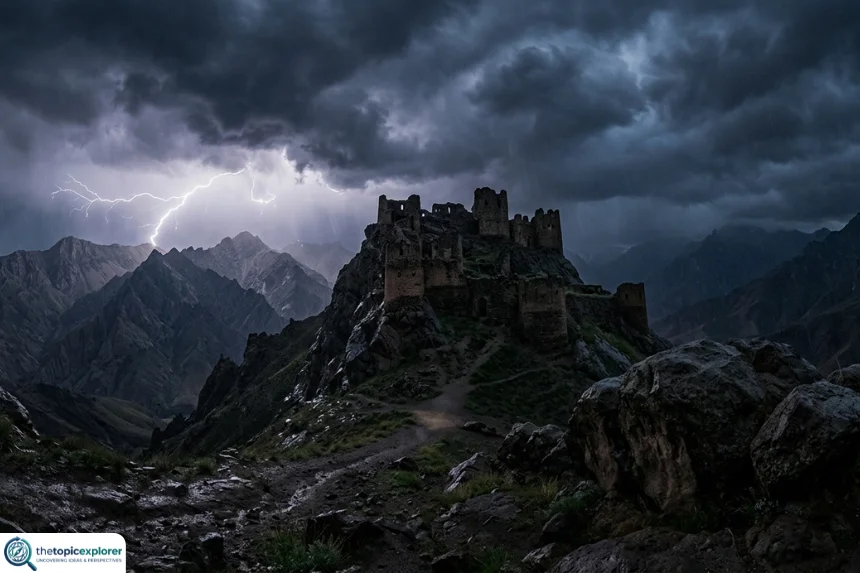

Alamut Castle is a ruined mountain fortress in Iran’s Qazvin Province that became the headquarters of the Nizari Ismaili state after Hasan-i Sabbah took control in 1090. From its rocky position in the Alborz Mountains, Alamut served as a political, military, religious, and intellectual center until the Mongol conquest of 1256. Moreover, UNESCO inscribed the castle and six related fortifications on the World Heritage List in 2026.
The site is often described as the “Castle of the Assassins.” However, that popular label mixes documented history with hostile medieval accounts, later European legends, and modern fiction. The more accurate story is complex: Alamut was a defensive network, a center of scholarship, and the symbol of a small state that survived among much larger regional powers for 166 years.
Alamut Castle Quick-Answer Table
| Question | Verified answer |
|---|---|
| What is Alamut Castle? | A ruined mountain fortress and the former headquarters of the medieval Nizari Ismaili state. |
| Where is it? | Near Gazor Khan in the Alamut region of Qazvin Province, northern Iran. |
| When was the first fortress built? | Traditional historical accounts attribute it to a Justanid ruler around 860. |
| When did Hasan-i Sabbah take it? | 1090 CE. |
| How long was it the Nizari center? | From 1090 until the Mongol conquest in 1256. |
| Was it taken by force? | Scholarly accounts say Hasan gained it through infiltration, while the Mongols received its surrender rather than storming it. |
| Why is it famous? | Its strategic location, Nizari history, library, water systems, political assassinations, and later legends. |
| Is it a UNESCO World Heritage Site? | Yes. UNESCO inscribed Alamut Castle and six related fortifications in 2026 under criterion (iii). |
| What remains today? | Archaeological ruins, rock-cut spaces, defensive remains, and traces of water-storage and settlement systems. |
| Is travel advised for Americans? | No. As of July 30, 2026, the U.S. Department of State continues to list Iran at Level 4: Do Not Travel. |
What Is Alamut Castle?
Alamut Castle was the best-known stronghold in a wider network of Nizari Ismaili fortifications across medieval Iran. Although popular culture presents it mainly as an assassin headquarters, UNESCO recognizes it as part of a cultural landscape that also supported government, defense, religion, learning, and community life.
The official UNESCO World Heritage List describes Alamut as the political, military, and intellectual center of the Nizari Ismailis from the late 11th century. In addition, UNESCO treats the property as a serial site rather than a single isolated ruin. Therefore, the World Heritage designation covers Alamut Castle together with six associated fortifications in the surrounding mountain system.
The castle did not begin with Hasan-i Sabbah. Instead, traditional accounts place an earlier fortress on the rock in the ninth century. Hasan later transformed the site, strengthened its defenses, and connected it to a larger territorial and religious movement.
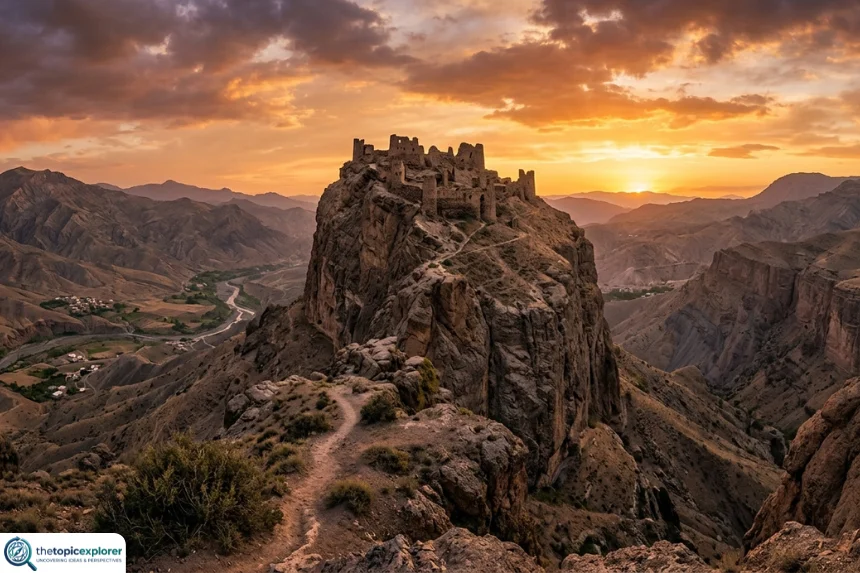
Where Is the Alamut Fortress Located?
Alamut Castle stands near the village of Gazor Khan in the central Alborz Mountains of northern Iran. It belongs to Qazvin Province and rises on a narrow rocky crest above the surrounding valleys.
The broader Alamut region lies between the Qazvin plain and the mountainous approaches toward the southern Caspian area. Consequently, the landscape created natural barriers while still allowing the Nizaris to communicate with other strongholds and settlements.
Some travel pages give sharply different distances from Qazvin or Tehran. However, those figures often mix straight-line distance, road distance, and the location of the wider valley. The reliable geographic point is that the castle sits above Gazor Khan in a remote part of Qazvin Province, while the winding mountain roads make practical travel much longer than a simple map measurement suggests.
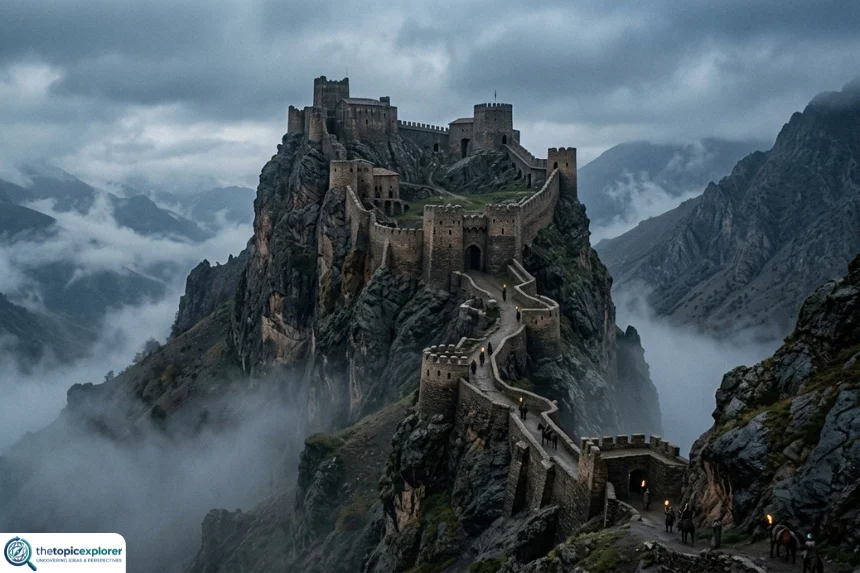
What Does the Name Alamut Mean?
“Eagle’s Nest” is the most common English rendering of Alamut. Nevertheless, the historical etymology is not completely certain.
The Institute of Ismaili Studies overview of Alamut explains a traditional story in which an eagle showed a Daylami ruler the strategic site. Scholarly discussions connect the name to words associated with an eagle and teaching or indication. Therefore, “the eagle taught” or “the eagle indicated” may reflect the legend more closely than a literal translation of “nest.”
Alamut Castle History: A Chronological Timeline
The history of Alamut Castle stretches from a pre-Ismaili mountain fort to a UNESCO-listed archaeological landscape. The following timeline separates well-supported events from later legend.
| Date | Event |
| Around 860 | A Justanid ruler of Daylam is traditionally credited with constructing the early fortress. |
| 1090 | Hasan-i Sabbah gains control of Alamut through planned infiltration rather than a conventional assault. |
| 1090–1124 | Hasan strengthens the fortress, expands irrigation and cultivation, and establishes Alamut as the center of his movement. |
| 1092 | Seljuk forces attack Nizari positions, but Alamut remains under Hasan’s control. |
| 1094 | The succession dispute after the death of the Fatimid caliph al-Mustansir contributes to the emergence of the independent Nizari branch. |
| 1124 | Hasan-i Sabbah dies at Alamut; his successors continue to rule from the fortress. |
| 1164 | Hasan II proclaims the qiyama, a major religious development in the Nizari community. |
| 13th century | Scholars, including Nasir al-Din al-Tusi, find protection within Nizari territories during a period of regional upheaval. |
| 1256 | Rukn al-Din Khurshah surrenders to Hülegü’s Mongol forces; Alamut capitulates and suffers partial demolition and the loss of much of its library. |
| 1275 | Nizari forces briefly regain control of the Alamut region. |
| Safavid era | Authorities restore parts of the castle and use it as a prison. |
| 2026 | UNESCO inscribes Alamut Castle and Related Fortifications on the World Heritage List. |
Who Built Alamut Castle?
Hasan-i Sabbah did not build the original Alamut Castle. Instead, historical tradition attributes the first fortress to a Justanid ruler around 860, more than two centuries before Hasan arrived.
However, reliable sources use careful language because the early construction history rests partly on later written traditions. The exact identity of the builder and the precise form of the ninth-century fortress cannot be reconstructed with complete certainty. Ultimately, Hasan deserves credit for turning the older stronghold into the headquarters of the Nizari Ismaili state, not for founding the site from nothing.
How Did Hasan-i Sabbah Take Alamut?
Hasan-i Sabbah gained control of Alamut in 1090 through infiltration and political organization. He did not conquer it through a large battlefield assault.
According to Encyclopaedia Iranica’s biography of Hasan-i Sabbah, Hasan focused on Daylam because its mountain terrain lay beyond the strongest centers of Seljuk control. His supporters gradually entered the area and won local converts. Consequently, the transfer of power came through careful preparation from within.
Popular retellings sometimes add a precise payment, a dramatic trick involving the area covered by an animal hide, or a bloodless handover with fully documented terms. Reliable sources do not consistently confirm every detail of those stories. Therefore, the safest conclusion is that Hasan used infiltration and negotiation, then assumed control in 1090.
Why Did Alamut Become the Nizari Headquarters?
Alamut offered security, visibility, water-management potential, and access to a network of defensible valleys. Moreover, it allowed Hasan to challenge the Seljuk political order without trying to match a much larger empire on an open battlefield.
After taking the fortress, Hasan improved cultivation and irrigation in the valley. He also established a major library and supported the storage systems needed for long resistance. As a result, Alamut became more than a refuge; it became the administrative and intellectual center of a dispersed state with strongholds across parts of Iran and Syria.
Why Was the Alamut Fortress So Difficult to Conquer?
Alamut Castle combined a naturally defensive rock formation with deliberate engineering. Its narrow approaches limited the size of attacking forces, while its elevated position gave defenders a broad view of the surrounding landscape.
Mountain Position and Fortifications
The fortress occupied a rocky crest roughly 2,000 meters above sea level. Steep slopes protected much of the site, while a narrow approach controlled access.
Therefore, an enemy could not easily move large siege forces onto the summit. The defenders could observe movement in the valleys, protect the entrance, and use the terrain as an extension of the walls. Notably, the scholarly record states that neither Hasan nor the Mongols captured Alamut through a successful direct storming of the fortress.
Water, Food, and Long-Siege Planning
The Nizaris improved water collection, cisterns, canals, and agricultural systems around their strongholds. In addition, they stored provisions so that isolated communities could resist prolonged pressure.
The detailed Encyclopaedia Iranica entry on Alamut describes a wider fortification system equipped with cisterns, qanats, canals, and substantial storage capacity. Because the defenders planned for isolation, attackers could not rely on a quick blockade. Instead, the Mongol campaign succeeded after political collapse and surrender across the Nizari leadership network.
Was Alamut Castle Really the Fortress of the Assassins?
Alamut Castle was the headquarters of the Nizari Ismaili state, whose agents sometimes carried out targeted political killings. However, the word “Assassins” carries centuries of hostile storytelling and should not replace the community’s historical name.
Who Were the Nizari Ismailis?
The Nizari Ismailis formed a branch of Ismaili Shi‘i Islam after a succession dispute within the Fatimid world in the late 11th century. Hasan-i Sabbah supported Nizar’s claim and developed an independent Nizari mission in Iran.
Because the Nizaris lacked the manpower of the Seljuk Empire and other rivals, they relied on fortresses, diplomacy, local alliances, and selective violence. Some devoted agents, often called fida’is, assassinated high-ranking political or military enemies. Nevertheless, reducing the entire community to killers ignores its religious institutions, villages, scholars, libraries, and long-term social organization.
Did the Assassins Use Hashish?
Reliable evidence does not establish that Hasan drugged operatives with hashish before missions. The famous garden-and-drug story appears in later hostile and European narratives rather than secure contemporary Nizari documentation.
Moreover, modern scholarship emphasizes that many surviving accounts came from enemies of the Nizaris. The Institute of Ismaili Studies’ discussion of modern scholarship on the Assassin legends traces how imaginative stories spread through medieval Europe. Therefore, writers should present the hashish claim as legend, not fact.
Is the “Old Man of the Mountain” Story Accurate?
“The Old Man of the Mountain” became a flexible Western label for Nizari leaders. However, Crusader-era references often focused on Rashid al-Din Sinan, the influential Nizari leader in Syria, rather than Hasan-i Sabbah at Alamut.
Later writers blended different people, locations, and periods into one dramatic character. Similarly, the story that Hasan, the poet Omar Khayyam, and the vizier Nizam al-Mulk were school friends who made a pact does not withstand chronological scrutiny. Reputable scholarship treats that “three schoolfellows” tale as a legend.
What Happened During the Mongol Conquest?
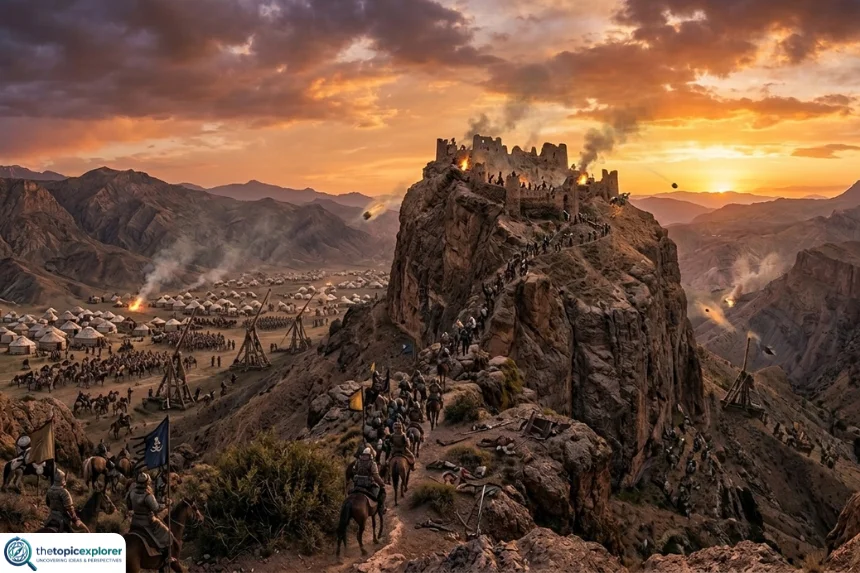
Alamut Castle fell during Hülegü’s campaign against the Nizari state in 1256. Yet the Mongols did not capture the fortress through a triumphant assault on its walls.
Rukn al-Din Khurshah, the last Nizari ruler of the period, negotiated with the Mongols and surrendered at Maymun-Diz. Afterward, other fortresses received orders to submit, although some resisted longer. Alamut then capitulated, and Mongol forces partially dismantled it.
The loss of the library caused lasting damage to the historical record. The historian Ata-Malik Juvayni examined the collection and preserved some materials, but authorities destroyed many books and records. Consequently, later historians often had to rely on accounts written by opponents of the Nizaris, which makes careful source criticism essential.
What Survived After the Mongol Conquest?
The Mongol victory ended Alamut’s role as the capital of an independent Nizari state, but it did not erase the community or the site. Nizari forces briefly recovered the region in 1275, although the restoration did not last.
Later, Safavid authorities repaired parts of Alamut and used the fortress as a prison. Meanwhile, weather, treasure hunting, reuse of building material, and centuries of neglect weakened the surviving structures. Archaeological ruins still remain, including traces of defensive walls, rock-cut chambers, storage areas, and water-management features.
The Nizari Ismaili community also continued beyond the fall of the medieval state. Therefore, the destruction of Alamut should not be described as the extinction of the Nizari tradition.
Why Did UNESCO List Alamut Castle in 2026?
UNESCO inscribed Alamut Castle and Related Fortifications in 2026 because the network offers exceptional testimony to the Nizari Ismaili state and its political, religious, intellectual, and defensive organization. The property entered the list under cultural criterion (iii).
The serial property covers 672.29 hectares, with a buffer zone of 10,201.67 hectares. More importantly, UNESCO’s decision recognizes that Alamut operated within a coordinated landscape rather than as a lone castle. Consequently, the listing corrects the popular image of one mysterious fortress by highlighting a complete regional system.
Which Fortifications Are Included?
The UNESCO property includes seven components:
- Alamut Castle
- Lambesar Castle
- Navizaršāh Castle
- Šams Kelāyeh Fortification
- Qosṭinlār Fortification
- Širkūh Fortification
- Ilān Fortification
Together, these sites controlled routes, protected settlements, and supported the resilience of the Nizari community. In addition, their locations reveal how the state used mountain geography as part of its political structure.
Can Visitors Explore the Alamut Ruins Today?
The ruins function as an archaeological and cultural destination, and visitors have historically reached the site from the Gazor Khan area by climbing a steep mountain approach. However, access conditions, local transportation, site hours, and conservation restrictions can change.
Therefore, readers should not rely on old blog posts for current ticket prices, taxi schedules, lodging, or trail conditions. Publicly available official English-language information remains limited, and the 2026 UNESCO inscription may lead to new conservation or visitor-management rules.
Travel Safety for U.S. Readers
As of July 30, 2026, the U.S. Department of State continues to classify Iran as Level 4: Do Not Travel. Its official Iran Travel Advisory warns of risks that include terrorism, unrest, kidnapping, arbitrary arrest, and wrongful detention.
Moreover, the United States has no embassy in Iran and cannot provide normal consular services there. Consequently, a U.S.-focused article should not present Alamut as a routine vacation recommendation. Readers should check the advisory directly because security conditions and government guidance can change without notice.
Why Alamut Castle Still Matters
Alamut Castle matters because it preserves evidence of how a small medieval community used geography, planning, scholarship, and political strategy to survive among larger powers. Although targeted killings formed part of the conflict, they represent only one part of the site’s history.
The fortress also demonstrates the cost of historical mythmaking. Hostile chronicles, Crusader tales, Marco Polo’s later account, novels, films, and video games transformed a complicated society into an exotic secret order. However, modern research can separate documented events from stories about drugged killers, hidden gardens, and absolute obedience.
Finally, the 2026 UNESCO inscription gives Alamut a new international status. It encourages readers to understand the castle as part of a seven-site cultural landscape and not merely as the background for the word “assassin.”
FAQs About Alamut Castle
1. What is Alamut Castle famous for?
Alamut Castle is famous as the headquarters of the Nizari Ismaili state from 1090 to 1256. Moreover, it became known for its mountain defenses, library, water systems, and later “Assassin” legends.
2. Where is the Alamut fortress in Iran?
The fortress stands near Gazor Khan in the Alamut region of Qazvin Province. Because it occupies a rocky crest in the Alborz Mountains, road access involves winding mountain routes.
3. Who built Alamut Castle?
Traditional accounts credit a Justanid ruler with constructing the first fortress around 860. However, Hasan-i Sabbah later expanded and transformed the older site after taking control in 1090.
4. When did Hasan-i Sabbah capture Alamut?
Hasan-i Sabbah gained control of Alamut Castle in 1090 CE. Rather than storming the walls, he used a planned process of infiltration and local organization.
5. Was the fortress ever taken by force?
Scholarly accounts state that Hasan acquired it through strategy and that the Mongols received its surrender in 1256. Therefore, neither change of control resulted from a successful direct assault on the summit fortress.
6. Did the Assassins use hashish?
The available evidence does not establish that Nizari agents used hashish before missions. Instead, the drug story belongs mainly to hostile medieval traditions and later European legend.
7. What happened to Alamut’s library?
Mongol forces destroyed much of the library after the 1256 surrender. However, the historian Juvayni reportedly selected and preserved some books and scientific materials before the destruction.
8. Is Alamut a UNESCO World Heritage Site?
Yes. UNESCO inscribed Alamut Castle and six related fortifications in 2026 under criterion (iii). Consequently, the designation recognizes a regional defensive and cultural network, not only one ruin.
9. Can Americans visit Alamut?
Iran may admit some foreign visitors under its entry rules, but the U.S. Department of State currently says Americans should not travel to Iran. Moreover, the United States has no embassy there, so travelers cannot expect normal consular support.
10. Is Alamut connected to Assassin’s Creed?
The game franchise draws inspiration from the medieval Nizari Ismailis and popular Assassin legends. However, its characters, clothing, secret technologies, and dramatic rituals belong largely to historical fiction.
Conclusion: The Real Legacy of Alamut Castle
Alamut Castle was a mountain stronghold, a seat of government, a religious center, and a hub of learning before the Mongol conquest ended its political role in 1256. Although stories about hashish, paradise gardens, and a mysterious “Old Man” dominate popular culture, reliable evidence presents a more nuanced history.
Ultimately, Alamut’s greatest significance lies in the wider system it anchored. UNESCO’s 2026 recognition of Alamut Castle and six related fortifications confirms that the site represents the organization, resilience, and intellectual life of the medieval Nizari Ismaili state as much as its warfare and legends.
Read more at The Topic Explorer
