



Ptolemy of Mauretania was a North African king, Roman client ruler, and one of the most remarkable surviving links between Cleopatra VII’s dynasty and the early Roman Empire. He was the son of King Juba II and Cleopatra Selene II, which made him the grandson of Cleopatra VII of Egypt and Mark Antony. After sharing some governmental responsibilities during his father’s later years, Ptolemy became sole king of Mauretania around 23 CE and ruled until Emperor Caligula ordered his execution in 40 CE.
However, describing him simply as “Cleopatra’s grandson” leaves out most of his historical importance.
Ptolemy ruled a substantial North African kingdom, maintained a complicated alliance with Rome, issued his own royal coinage, and inherited traditions from both an indigenous North African dynasty and the Ptolemaic royal family. Eventually, his death helped bring an end to Mauretania’s client monarchy and opened the way for direct Roman administration.
Who Was Ptolemy of Mauretania?
Ptolemy of Mauretania was king of the Roman client kingdom of Mauretania from about 23 to 40 CE.
His father was Juba II, a Numidian prince who became king of Mauretania under Augustus.
His mother was Cleopatra Selene II, daughter of Cleopatra VII and Mark Antony.
Therefore, Ptolemy connected three major political traditions:
- the royal houses of ancient North Africa;
- the Ptolemaic dynasty of Egypt;
- the Roman imperial world.
The Oxford Classical Dictionary identifies Ptolemy as the son of Juba II and Cleopatra Selene and dates his kingship from 23 to 40 CE. It also notes that he had already shared responsibility for government during his father’s later years.
Ptolemy of Mauretania Quick Answer
Ptolemy of Mauretania was the son of Juba II and Cleopatra Selene II and the grandson of Cleopatra VII and Mark Antony. He ruled Mauretania as a Roman client king from about 23 to 40 CE before Emperor Caligula ordered his execution.
That combination of ancestry and political position makes him much more than a minor figure in Cleopatra’s family tree.
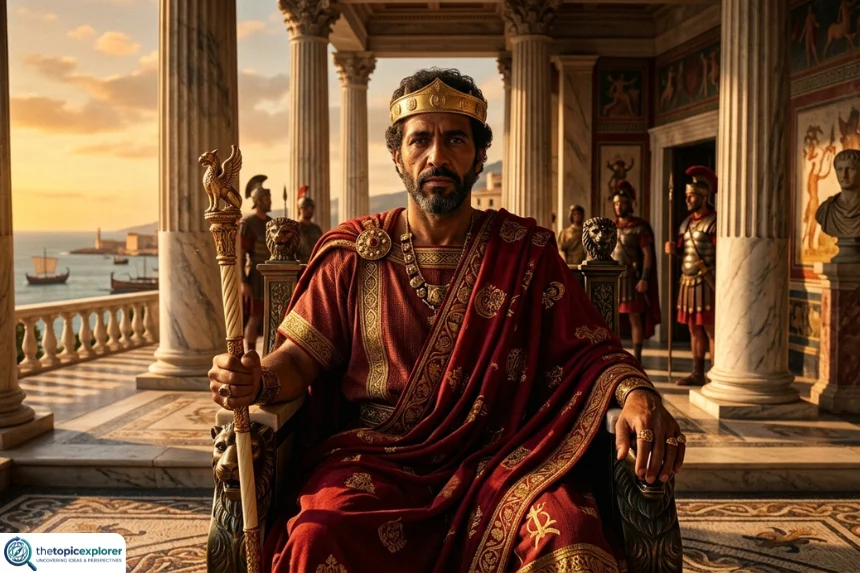
Ptolemy of Mauretania Quick Facts
| Fact | Detail |
|---|---|
| Name | Ptolemy of Mauretania |
| Born | Late 1st century BCE; exact year uncertain |
| Died | 40 CE |
| Position | King of Mauretania |
| Sole reign | About 23–40 CE |
| Father | Juba II |
| Mother | Cleopatra Selene II |
| Maternal grandmother | Cleopatra VII |
| Maternal grandfather | Mark Antony |
| Political position | Roman client king |
| Main royal center | Caesarea, modern Cherchell |
| Important Roman connection | Ally of Rome |
| Major later opponent | None initially; he was ultimately executed by Caligula |
| Successor | No independent royal successor |
British Museum records also identify Ptolemy as a ruler of Mauretania from 23 to 40 CE and as the son of Juba II and Cleopatra Selene.
Was Ptolemy of Mauretania Cleopatra’s Grandson?
Yes.
Ptolemy of Mauretania was a biological grandson of Cleopatra VII, the last active ruler of Ptolemaic Egypt.
His genealogy can be shown simply:
Cleopatra VII + Mark Antony
↓
Cleopatra Selene II
Juba II
+
Cleopatra Selene II
↓
Ptolemy of Mauretania
Oxford’s account of Juba II confirms that Cleopatra Selene was the daughter of Mark Antony and Cleopatra VII and that Ptolemy was Juba’s son by Cleopatra Selene.
Therefore, Ptolemy carried Cleopatra VII’s bloodline into Roman-era North Africa decades after the fall of her Egyptian kingdom.
Why Is Ptolemy’s Connection to Cleopatra Important?
Cleopatra VII and Mark Antony died in 30 BCE after their defeat by Octavian, the future Emperor Augustus.
Egypt then came under Roman control.
Nevertheless, Cleopatra’s surviving family did not disappear immediately.
Her daughter Cleopatra Selene II was brought into the Roman political world and later married Juba II.
Their son, Ptolemy, subsequently inherited the throne of Mauretania.
Therefore, Ptolemy demonstrates that:
the political rule of Ptolemaic Egypt ended in 30 BCE, but Cleopatra VII’s royal family continued through her daughter in North Africa.
That distinction is essential because “the end of Cleopatra” and “the end of Cleopatra’s descendants” were not the same historical event.
Who Were Ptolemy of Mauretania’s Parents?
Ptolemy’s parents were two people whose childhoods had been transformed by Roman conquest:
- Juba II
- Cleopatra Selene II
Both came from defeated royal families.
However, both were later incorporated into Rome’s political order and eventually ruled Mauretania.
Their marriage united a North African royal house with one of the Mediterranean’s most famous Hellenistic dynasties.
Who Was Juba II?
Juba II was Ptolemy’s father.
He was the son of Juba I of Numidia, who had opposed Julius Caesar during the Roman civil wars.
When Juba II was still an infant, he was taken to Rome after his father’s defeat. Oxford’s Classical Dictionary states that the young Juba appeared in Caesar’s triumph in 46 BCE and was subsequently raised in Italy.
Despite that beginning, his future changed dramatically.
Juba received a Roman education and developed close links with the Augustan political system.
Eventually, Augustus gave him the kingdom of Mauretania in 25 BCE.
Therefore, Juba II was not simply a local king outside Roman influence.
He was a monarch whose authority had been deliberately incorporated into Rome’s strategy for ruling North Africa.
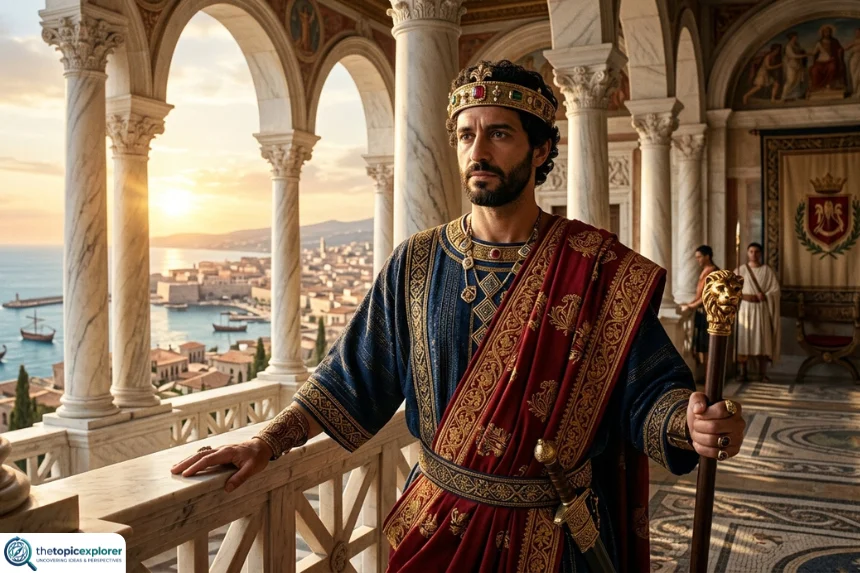
Juba II Was Also a Scholar
Juba II became known for much more than kingship.
Oxford records that he wrote extensively in Greek on subjects including:
- geography;
- history;
- language;
- painting;
- natural history;
- Arabia;
- Libya.
Although those works are largely lost, later ancient authors used them.
Moreover, Juba sponsored exploration and cultural development while transforming his royal centers.
This intellectual environment may have shaped the royal court into which Ptolemy was born.
What Do Coins Tell Us About Juba II and Ptolemy?
Coins provide unusually valuable evidence for Ptolemy’s family and succession.
The British Museum holds a silver coin showing:
- the diademed head of Juba II on one side;
- the diademed and draped bust of Ptolemy on the other.
That is significant because it gives us direct material evidence connecting father and son within Mauretania’s royal imagery.
Rather than depending entirely on later written biographies, historians can study coins produced within the monarchy itself.
Who Was Cleopatra Selene II?
Ptolemy’s mother, Cleopatra Selene II, was the daughter of Cleopatra VII and Mark Antony.
After the collapse of her parents’ regime, she eventually became part of the Roman political world and married Juba II.
Oxford records that Juba married Cleopatra Selene by approximately 20 BCE and that Ptolemy was their son.
Consequently, Cleopatra Selene played an extraordinary historical role.
She began life as a princess of the Ptolemaic royal family.
Later, she became queen of a kingdom in North Africa.
Through Ptolemy, her family line continued into the first century CE.
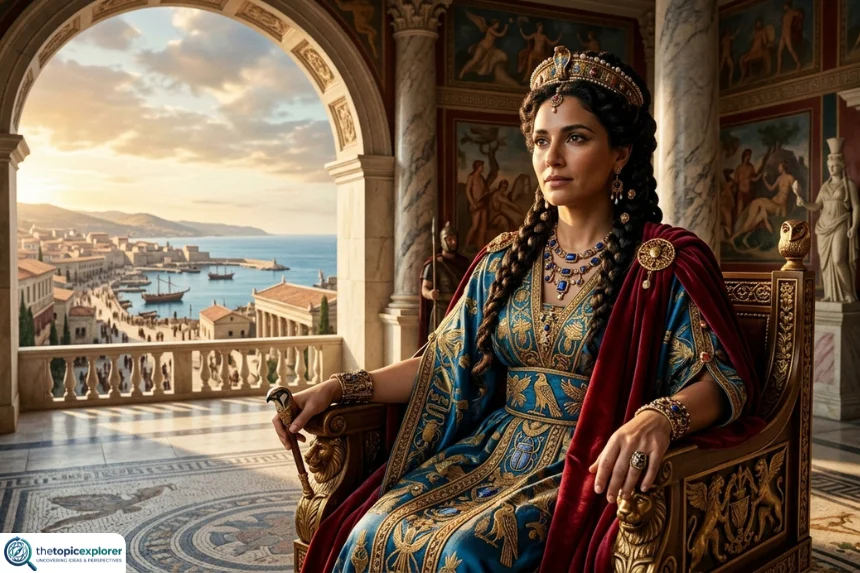
Did Cleopatra Selene Keep Her Egyptian Identity?
Evidence from Mauretanian coinage suggests that Egyptian royal symbolism remained visible.
British Museum coins issued under Juba II and Cleopatra Selene include imagery associated with Isis, one of the most important deities in Egyptian religion. One example combines Juba’s portrait with an Isis symbol and identifies Cleopatra Selene in its royal authority.
Another coin names both Juba II and Cleopatra Selene.
Therefore, Selene’s Ptolemaic-Egyptian heritage was not necessarily erased after she became queen of Mauretania.
Instead, royal imagery could combine:
- North African kingship;
- Hellenistic traditions;
- Egyptian symbolism;
- Roman political relationships.
Ptolemy inherited that complex royal culture.
Was Ptolemy of Mauretania Part of the Ptolemaic Dynasty?
Yes, by descent through his mother.
Cleopatra Selene II belonged to the Ptolemaic royal family because she was Cleopatra VII’s daughter.
Therefore, her son Ptolemy was a descendant of the dynasty that had ruled Egypt for nearly three centuries.
However, that does not mean that he ruled Ptolemaic Egypt.
By the time Ptolemy of Mauretania became king, the independent Ptolemaic kingdom of Egypt had already disappeared.
Rome had controlled Egypt since 30 BCE.
Therefore, the most accurate description is:
Ptolemy of Mauretania was a Ptolemaic descendant who ruled Mauretania, not Egypt.
Was Ptolemy of Mauretania a Pharaoh?
No.
This is an important misconception to correct.
Ptolemy’s name and ancestry can make him sound like another Egyptian Ptolemaic monarch.
However, he was not a pharaoh of Egypt.
He was:
King of Mauretania in North Africa.
The Ptolemaic rulers of Egypt had lost their kingdom decades earlier.
Therefore:
Ptolemy inherited Ptolemaic ancestry, not the Egyptian throne.
His actual royal authority came through the Mauretanian monarchy created around his father Juba II.
Why Was He Named Ptolemy?
The name itself reflected his maternal dynastic heritage.
Numerous kings of Ptolemaic Egypt had been named Ptolemy, beginning with Ptolemy I Soter.
Naming the son of Cleopatra Selene Ptolemy therefore strongly connected him with her ancestral dynasty.
However, his identity should not be reduced to that name.
His father’s ancestry and his North African kingdom were equally important.
Ptolemy represented a fusion of royal traditions rather than a simple continuation of Egyptian kingship.
Was Ptolemy the Last Ptolemaic Ruler?
This question requires careful wording.
Ptolemy was certainly among the last clearly documented royal descendants of Cleopatra VII and was the last king of Mauretania.
However, saying:
“Ptolemy was definitely the last living descendant of Cleopatra”
goes beyond what the evidence can securely prove.
Possible later descendants have been proposed through uncertain genealogies.
Therefore, a safer statement is:
Ptolemy of Mauretania was one of the last securely attested royal descendants of Cleopatra VII and the final king of the Mauretanian dynasty founded under Juba II.
The later bloodline question will be examined more carefully in Part C.
When Was Ptolemy of Mauretania Born?
Ptolemy’s exact birth date is uncertain.
Modern historical reconstructions generally place his birth in the late first century BCE, often around the final decade BCE.
However, ancient sources do not provide a secure modern-style birth record.
Interestingly, the Louvre preserves a sculpted head identified as Ptolemy of Mauretania that has been dated by one scholarly reconstruction to approximately 10–5 BCE. The identification and dating of ancient portraits can themselves be debated, so this does not create an exact birth date.
Therefore, the article should avoid false precision.
Best wording
Ptolemy of Mauretania was probably born in the late first century BCE, but his exact year of birth is uncertain.
That is stronger than presenting a speculative year as unquestioned fact.
Where Did Ptolemy Grow Up?
The surviving evidence does not allow a complete childhood biography.
However, his family’s principal royal center was Caesarea in Mauretania, and his father’s court was deeply influenced by North African, Greek, Egyptian, and Roman culture.
Juba II had transformed the older city of Iol into Caesarea, while Volubilis also served as an important western royal center.
Therefore, Ptolemy grew up as heir to a highly cosmopolitan client kingdom connected closely to Rome and the Mediterranean world.
Where Was Ancient Mauretania?
Ancient Mauretania was a kingdom in northwestern Africa.
Oxford describes it as stretching from the region of the Ampsaga River westward to the Atlantic and including the western Atlas ranges.
In modern geographical terms, the kingdom broadly covered territory associated with:
- northern Algeria;
- Morocco.
Therefore, Ptolemy’s kingdom was a North African Mediterranean state, not a kingdom centered in Egypt.

Is Ancient Mauretania the Same as Modern Mauritania?
No.
This is one of the most important geographical distinctions in the article.
Ancient Mauretania and the modern nation of Mauritania have similar names, but they are not the same territory.
Ancient Mauretania
Was located much farther north.
It covered substantial areas corresponding roughly to parts of modern Morocco and northern Algeria.
Modern Mauritania
Is a present-day country farther southwest, extending along the Atlantic and into the Sahara.
Therefore:
Ptolemy of Mauretania did not rule the modern country of Mauritania.
The similarity in spelling often creates confusion, especially in quick online biographies.
Ancient Mauretania vs. Modern Mauritania
| Ancient Mauretania | Modern Mauritania |
|---|---|
| Ancient North African kingdom | Modern sovereign state |
| Existed during antiquity | Modern country |
| Included territory around Morocco and Algeria | Located farther southwest |
| Mediterranean and Atlantic connections | Atlantic and Saharan geography |
| Ruled by kings including Juba II and Ptolemy | Unrelated modern political system |
This distinction is essential when locating Ptolemy historically.
What Kind of Kingdom Was Mauretania?
Mauretania was not simply a remote Roman province during Ptolemy’s early life.
It was still a kingdom.
Rome exercised enormous influence, but Juba II and later Ptolemy retained royal institutions.
The kingdom had:
- a royal court;
- its own rulers;
- locally issued coinage;
- military forces;
- cities;
- trade;
- agricultural production.
At the same time, the monarchy depended heavily on Rome.
That political arrangement is usually described as a client kingdom.
What Was the Capital of Ptolemy’s Kingdom?
One of the principal capitals was Caesarea, the city known today as Cherchell in Algeria.
The city had earlier been known as Iol.
Juba II refounded and developed it under the name Caesarea. Oxford identifies Caesarea as Juba’s capital and notes Volubilis as another major royal center in the west.
Caesarea became especially important because its archaeology preserves evidence connected with Ptolemy’s dynasty.
Why Was Caesarea Important?
Caesarea functioned as much more than an administrative headquarters.
Under Juba II, the city developed as a cultural and royal center influenced by Mediterranean artistic traditions.
The court collected and commissioned art while participating in the broader Greek and Roman cultural world.
Moreover, portraits identified as Juba II and Ptolemy have been discovered at ancient Caesarea, modern Cherchell.
Therefore, the city gives historians both:
- written historical context;
- archaeological evidence.
What Did Ptolemy of Mauretania Look Like?
We cannot know exactly what Ptolemy looked like in the modern photographic sense.
However, surviving portraits provide important evidence about how he was represented.
The Louvre preserves a marble head identified as Ptolemy of Mauretania that was found at Cherchell, ancient Caesarea.
The museum describes it as a royal portrait showing features including:
- short, wavy hair;
- a royal crown or diadem;
- short facial hair.
The Louvre dates the object broadly within the first half of the first century CE.
Another smaller Louvre portrait, also identified as Ptolemy, was discovered at Cherchell and is dated by scholarly reconstruction to around the late first century BCE.
Do Ptolemy’s Coins Show His Face?
Yes.
British Museum coins from his reign repeatedly depict a diademed and draped bust of Ptolemy.
For example, one silver coin dated to 23–40 CE shows Ptolemy on the obverse and a throne with a crown and sceptre on the reverse.
Another shows his portrait with:
- Capricorn;
- cornucopia;
- rudder imagery.
Other surviving coins use palm-tree imagery.
Therefore, Ptolemy is unusually well represented through royal material culture.
Can We Treat These Portraits as Photographs?
No.
Ancient ruler portraits were not designed merely to record a person’s appearance.
They could communicate:
- legitimacy;
- royal authority;
- ancestry;
- political identity;
- divine or dynastic associations.
Therefore, Ptolemy’s coin portraits tell us how the monarchy wanted him presented as much as they tell us about his physical appearance.
That makes them political evidence, not simply ancient “photos.”
What Does Ptolemy’s Royal Diadem Mean?
The diadem was a recognizable symbol of Hellenistic kingship.
Ptolemy’s appearance wearing one connected him visually with the tradition of Mediterranean monarchs.
That symbolism would have been especially appropriate for someone descended from the Ptolemaic dynasty.
However, he was also using the symbol as King of Mauretania.
Therefore, his portrait blended his dynastic inheritance with his actual North African kingship.
When Did Ptolemy of Mauretania Become King?
Ptolemy became sole ruler after the death of Juba II around 23 CE.
Oxford identifies his reign as 23–40 CE and notes that he had already shared some responsibilities for government during his father’s later years.
This detail explains why different historical summaries can sometimes produce slightly different accession dates.
Co-Rule vs. Sole Rule
Ptolemy appears to have participated in royal government before his father died.
However:
23 CE is the clearest date for the beginning of his sole kingship.
Therefore, an earlier date in some accounts does not necessarily mean one source is completely wrong.
It may reflect the difference between:
- participation in rule;
- independent rule after Juba II’s death.
What Evidence Supports Ptolemy’s Role Before 23 CE?
Coinage provides especially interesting evidence.
The British Museum holds coins portraying Juba II and Ptolemy together, demonstrating that Ptolemy had already been presented publicly alongside his father within the royal system.
That does not automatically prove every detail of formal co-kingship.
However, it strongly supports Ptolemy’s status as recognized heir and participant in the monarchy before becoming sole ruler.
How Long Did Ptolemy of Mauretania Rule?
Using the standard sole-reign dates of 23–40 CE, Ptolemy ruled independently for about 17 years.
His reign therefore lasted long enough to include:
- military cooperation with Rome;
- Roman political recognition;
- substantial royal coinage;
- the continuation of Juba II’s monarchy.
Nevertheless, the reign ended abruptly when Caligula ordered his death.
That dramatic ending can make biographies overlook the years before it.
The next section of the article should correct that imbalance.
Was Ptolemy an Independent King?
Not entirely.
Ptolemy possessed genuine royal authority inside Mauretania.
However, his position existed within a Roman-controlled political order.
Rome had granted the kingdom to his father, and the dynasty depended heavily on imperial approval.
Therefore, describing Ptolemy as either:
“completely independent”
or
“simply a Roman governor”
would both be misleading.
He occupied a position in between.
That system of Roman client kingship becomes essential for understanding why Ptolemy could command his own forces, issue royal coins, and still remain deeply vulnerable to an emperor in Rome.
Why Ptolemy’s Background Matters Before Discussing His Reign
Ptolemy inherited much more than a throne.
From his father came:
- North African royal ancestry;
- Roman political connections;
- an established Mauretanian kingdom;
- a scholarly and culturally ambitious court.
From his mother came:
- descent from Cleopatra VII;
- descent from Mark Antony;
- the prestige of Ptolemaic ancestry;
- visible Egyptian-Hellenistic royal traditions.
Meanwhile, Rome controlled the wider political environment in which the monarchy survived.
Therefore, Ptolemy stood at the intersection of:
Africa + Egypt + Greece + Rome
That mixture explains both the strength and the vulnerability of his position.
What Was a Roman Client King?
To understand Ptolemy of Mauretania, it is essential to understand what a Roman client king actually was.
Ptolemy possessed a genuine royal title. He ruled a kingdom, maintained a court, issued coins, and could command Mauretanian forces.
However, he did not rule completely independently of Rome.
Instead, Mauretania existed within a wider Roman political system.
A client king could govern local territory while accepting Rome’s dominant position and supporting Roman strategic interests.
Therefore, Ptolemy was neither:
an independent emperor equal to Rome
nor:
simply a Roman provincial governor.
He occupied a position between the two.
How Much Power Did Ptolemy of Mauretania Have?
Within Mauretania, Ptolemy possessed substantial royal authority.
His government could:
- maintain local administration;
- issue royal coinage;
- command military forces;
- use traditional symbols of monarchy;
- manage important cities and resources.
However, the dynasty owed much of its political position to Rome.
Rome had installed his father, Juba II, as king, and imperial recognition remained important to the monarchy’s survival.
Therefore, Ptolemy’s royal authority was real, but it existed within limits imposed by Roman power.
That arrangement eventually became crucial because the same imperial system that supported his kingship could also destroy it.
What Was Ptolemy of Mauretania’s Relationship With Rome?
For much of his reign, Ptolemy of Mauretania was a Roman ally rather than an enemy.
This fact is especially important because his eventual execution by Caligula can make his relationship with Rome appear hostile from the beginning.
It was not.
One of the best surviving ancient accounts of Ptolemy comes from the Roman historian Tacitus, who records his participation in Rome’s war against the North African rebel Tacfarinas.
Tacitus describes Roman commander Publius Cornelius Dolabella calling on King Ptolemy and his countrymen during the decisive campaign.
Therefore, Ptolemy’s most clearly documented military action was performed in cooperation with Rome.
Who Was Tacfarinas?
Tacfarinas was a North African rebel leader who fought Roman authority for several years during the reign of Emperor Tiberius.
He had reportedly served previously in Roman auxiliary forces before becoming the leader of a prolonged insurgency.
His movement attracted support from several North African groups and repeatedly challenged Roman armies.
By 24 CE, the conflict had become a serious regional problem.
Tacitus describes Tacfarinas as continuing to raid Roman Africa even after several Roman commanders had already received military honors for supposedly successful campaigns against him.
Therefore, defeating Tacfarinas was not a minor police action.
It brought an end to a long-running rebellion.

Did Tacfarinas Threaten Mauretania?
Yes, the conflict affected the broader North African political environment.
Tacitus states that Tacfarinas had been reinforced by Moorish contingents and that unrest had spread into areas associated with Ptolemy’s kingdom.
Therefore, Ptolemy had a practical reason to cooperate with Rome.
A successful rebel movement could threaten both:
- Roman provincial authority;
- Ptolemy’s own monarchy.
This makes his participation more understandable.
Helping Rome also helped protect his own political position.
Did Ptolemy of Mauretania Fight Tacfarinas?
Yes.
Tacitus records that Roman governor Publius Cornelius Dolabella called on Ptolemy and his Mauretanian forces during the final phase of the conflict.
Dolabella divided the available troops into several columns and used a combination of Roman and Mauretanian forces to pursue Tacfarinas.
The campaign eventually caught the rebel forces near Auzea.
Tacfarinas died during the fighting rather than surrendering.
Tacitus then states that the death of Tacfarinas brought the long war to an end.
Therefore:
Ptolemy of Mauretania played a documented supporting role in the Roman victory over Tacfarinas in 24 CE.
Why Was the Tacfarinas Campaign Important for Ptolemy?
The campaign strengthened Ptolemy’s standing with Rome.
He had only recently become sole king after Juba II’s death.
Therefore, successful cooperation with Roman forces gave him an opportunity to demonstrate:
- loyalty;
- military usefulness;
- regional authority;
- willingness to support Roman security.
Rome responded with an unusually formal honor.
That recognition is one of the clearest pieces of evidence showing how highly Ptolemy was regarded early in his reign.
Why Did Rome Honor Ptolemy of Mauretania?
Tacitus states that Ptolemy’s contribution demonstrated his goodwill toward Rome.
Consequently, the Roman Senate revived an old form of diplomatic honor.
A senator was sent to present Ptolemy with:
- an ivory sceptre;
- an embroidered robe.
He was also formally greeted as:
king, ally, and friend
of the Roman people.
The Oxford Classical Dictionary likewise notes that Ptolemy was recognized as “king, ally, and friend of the Roman people” after assisting against Tacfarinas.
This was more than ceremonial flattery.
It publicly confirmed the political relationship between Ptolemy’s monarchy and Rome.
What Did “King, Ally, and Friend of Rome” Mean?
The title reflected a long Roman diplomatic tradition.
It communicated that Ptolemy was a recognized monarch whose kingdom enjoyed an allied relationship with Rome.
However, the title did not mean the two powers were equal.
Rome remained dominant.
Therefore, the phrase represented both:
prestige
→ Ptolemy was recognized as a legitimate king.
and
dependence
→ his monarchy existed within Rome’s international order.
This balance defined client kingship.
Why Are the Ivory Sceptre and Robe Important?
The gifts were symbols of honor and political legitimacy.
Tacitus specifically records the ivory sceptre and embroidered robe as traditional distinctions sent to Ptolemy.
Moreover, Oxford notes that symbols associated with Rome’s recognition appeared on Ptolemy’s coinage.
Therefore, Ptolemy could use the honor not merely as a personal award but as a public symbol of his relationship with Rome.
This matters because ancient coins functioned partly as political communication.
What Do Ptolemy of Mauretania’s Coins Tell Us?
Ptolemy issued a substantial range of royal coins during his reign.
The surviving examples show that his monarchy continued to present him unmistakably as a king.
A British Museum silver coin dated to 23–40 CE depicts:
- Ptolemy’s diademed and draped portrait;
- a throne;
- a crown;
- a sceptre.
Another silver coin from the same reign shows:
- Ptolemy’s diademed portrait;
- Capricorn;
- a cornucopia;
- a rudder.
These objects provide direct material evidence from the period of his reign.
Why Is Ptolemy Shown Wearing a Diadem?
The royal diadem was strongly associated with Hellenistic monarchy.
Its presence on Ptolemy’s coins communicated his royal status immediately.
That symbolism was particularly meaningful for a ruler whose mother descended from the Ptolemaic dynasty.
However, the diadem did not mean Ptolemy was claiming to be king of Egypt.
Instead, it presented him as a Hellenistic-style monarch ruling Mauretania.
Therefore, his coinage blended:
- inherited royal traditions;
- local Mauretanian kingship;
- Mediterranean political imagery.
What Did the Throne and Sceptre Symbolize?
A throne and sceptre were obvious symbols of authority.
The British Museum coin showing a throne surmounted by a crown and crossed by a sceptre reinforces Ptolemy’s royal position.
These images told anyone handling the coin that the issuer was not simply a local administrator.
He was presenting himself as:
Ptolemy, king of Mauretania.
At the same time, his kingship remained compatible with Roman political supremacy.
That combination is one of the defining features of his reign.
What Does the Capricorn on Ptolemy’s Coin Mean?
Capricorn had important associations in Roman imperial imagery, particularly with Augustus.
Ptolemy’s use of Capricorn, a cornucopia, and a rudder on surviving coinage shows that Mauretanian royal imagery could draw upon symbols familiar within the wider Roman Mediterranean.
The British Museum confirms those three images together on a Ptolemaic Mauretanian silver coin.
However, historians should be cautious about assigning one simple meaning to every ancient symbol.
Coins could communicate several ideas at once, including:
- prosperity;
- legitimacy;
- good fortune;
- political affiliation;
- dynastic continuity.
Why Are Ptolemy’s Coins Important Historical Evidence?
Written ancient sources about Ptolemy are relatively limited.
Coins therefore help fill important gaps.
They can establish or illuminate:
- his royal title;
- his portrait type;
- chronology;
- political imagery;
- links with earlier Mauretanian rulers;
- symbols of authority.
Most importantly, coins were produced during or close to his actual reign.
They are therefore different from a historian writing decades later.
Written sources tell us:
what ancient authors said about Ptolemy.
Coins tell us:
how Ptolemy’s monarchy represented itself.
Both types of evidence are valuable, but they answer different questions.
Was Ptolemy of Mauretania Wealthy?
As king, Ptolemy controlled the resources of an important North African kingdom.
Mauretania benefited from Mediterranean trade, agriculture, livestock, natural resources, and valuable luxury products.
Therefore, Ptolemy was undoubtedly a wealthy monarch by ancient standards.
However, a modern dollar-value “net worth” would be historically meaningless.
There is no responsible formula for converting ancient royal control over:
- land;
- taxes;
- labor;
- trade;
- state resources
into a modern celebrity-style net worth.
Therefore, claims such as:
“Ptolemy of Mauretania had a net worth of $500 million”
should be rejected unless clearly presented as fictional speculation.
Why Might Ptolemy’s Wealth Have Mattered to Caligula?
This question becomes relevant because some ancient and modern explanations connect Ptolemy’s execution with the wealth of his kingdom.
The Oxford Classical Dictionary notes that ancient historian Cassius Dio associated the killing with Ptolemy’s wealth, while modern interpretations have proposed additional political motives.
Therefore, his wealth may have made Mauretania more attractive for direct imperial control.
However:
wealth is one proposed motive, not a proven explanation for his execution.
That distinction will remain important throughout this section.
Was Ptolemy a Successful King Before His Death?
The surviving evidence suggests that his reign was more substantial than the dramatic story of his execution sometimes implies.
He:
- succeeded an established monarchy;
- continued issuing royal coinage;
- cooperated successfully with Rome;
- supplied military forces;
- helped in the final campaign against Tacfarinas;
- received formal Roman honors.
Therefore, his life should not be summarized as:
Cleopatra’s grandson who wore the wrong cloak and got killed.
That version ignores almost his entire reign.
How Was Ptolemy of Mauretania Related to Caligula?
Ptolemy and Emperor Caligula were relatives through Mark Antony.
Ptolemy’s mother, Cleopatra Selene II, was a daughter of Mark Antony and Cleopatra VII.
Caligula descended from Mark Antony through Antonia Minor, Antony’s daughter by Octavia.
Therefore, the two men belonged to the same extended Antonian family.
Because Cleopatra Selene II and Antonia Minor were half-sisters, the exact genealogical relationship is more precisely described as a half first-cousin relationship once removed.
For general readers, however, the clearest wording is:
Ptolemy was a relative and cousin of Caligula through their shared descent from Mark Antony.
Oxford likewise refers to Caligula as Ptolemy’s cousin when discussing the execution.
Why Is Their Family Relationship Important?
Caligula was not killing a completely unrelated foreign king.
Ptolemy belonged to the extended family network surrounding Rome’s Julio-Claudian dynasty.
He also possessed royal ancestry through both parents.
Therefore, Ptolemy represented a potentially impressive figure at the imperial court:
- grandson of Cleopatra VII;
- grandson of Mark Antony;
- son of Juba II;
- king in his own right;
- recognized ally of Rome.
That status may help explain why later stories emphasize Caligula’s jealousy.
However, it does not prove jealousy was the real motive.
Did Caligula Invite Ptolemy to Rome?
Ancient and modern sources agree that Caligula summoned or invited Ptolemy into his presence before having him killed.
The Oxford Classical Dictionary places this event around 39–40 CE, stating that Caligula summoned and executed Ptolemy.
Suetonius likewise says Ptolemy was invited from his kingdom and initially received with great honors before Caligula abruptly ordered his death.
This reversal is one of the central mysteries of Ptolemy’s biography.
A ruler who had long cooperated with Rome was suddenly eliminated by the emperor.
Why Did Caligula Kill Ptolemy of Mauretania?
The most historically responsible answer is:
The exact reason remains uncertain.
Ancient and modern explanations include:
- Caligula’s jealousy over Ptolemy’s spectacular purple clothing;
- desire for Ptolemy’s wealth;
- a wish to bring Mauretania under tighter Roman control;
- possible links to political conspiracies;
- other court or religious rivalries.
Oxford’s Classical Dictionary specifically presents several competing explanations rather than treating one as certain.
Therefore, Phase 3 should distinguish between:
what ancient authors reported
and
what historians can actually prove.
Theory 1 — Did Caligula Kill Ptolemy Because of a Purple Cloak?
This is the most famous story.
According to Suetonius, Caligula had invited Ptolemy from his kingdom and initially treated him with great honor.
Then, during a public spectacle, Ptolemy appeared wearing a magnificent purple robe.
The clothing drew the attention of the crowd.
Suetonius claims that Caligula became jealous of the attention and suddenly had Ptolemy killed.
It is an unforgettable story.
However, it is not necessarily a complete explanation.
Why Would a Purple Robe Matter?
Purple was strongly associated with:
- wealth;
- status;
- royalty;
- high Roman political rank.
Producing high-quality purple dyes was extremely expensive.
Therefore, Ptolemy appearing in spectacular royal purple could visually emphasize his own prestige.
In Suetonius’s narrative, the problem was not simply the color.
The problem was that:
the crowd looked at Ptolemy instead of the emperor.
That fits Suetonius’s wider portrayal of Caligula as jealous of anyone who attracted admiration.
Can We Trust the Purple-Cloak Story Completely?
It should be treated as an ancient literary account, not a modern court record.
Suetonius wrote biographies that often emphasized:
- personality;
- scandal;
- memorable anecdotes;
- imperial cruelty.
Moreover, he wrote decades after Caligula’s death.
Therefore:
Suetonius is evidence that the purple-cloak explanation circulated in antiquity, but he cannot prove that jealousy over clothing was Caligula’s true political motive.
Oxford consequently presents the cloak as only one of several possible explanations.
Did Caligula Really Execute a King Just Because People Admired His Clothes?
Possibly—but we cannot know.
It is entirely possible that Caligula’s personality and jealousy played a role.
However, killing a client monarch also had enormous political consequences.
Therefore, historians naturally ask whether deeper motives existed.
A more complete analysis considers:
- Ptolemy’s wealth;
- Mauretania’s strategic value;
- imperial centralization;
- court politics.
The purple robe may have been:
the immediate trigger,
while broader political concerns provided:
the deeper motive.
Or the cloak story may simply have been an ancient attempt to explain a complicated political killing through Caligula’s personality.
The evidence does not allow certainty.
Theory 2 — Did Caligula Kill Ptolemy for His Wealth?
Another ancient explanation involves money.
Oxford notes that Cassius Dio connected the execution with Ptolemy’s wealth.
Mauretania was a substantial kingdom with valuable resources.
Eliminating its king potentially gave Rome greater access to:
- royal assets;
- revenues;
- territory;
- economic resources.
Therefore, financial incentive is plausible.
However, there is still no surviving document stating:
“Caligula executed Ptolemy specifically to seize his fortune.”
Thus:
wealth should be presented as a theory rather than a settled fact.
Theory 3 — Did Caligula Want Direct Control of Mauretania?
This may provide the strongest political explanation.
A client kingdom was useful when Rome preferred indirect control.
However, emperors could also decide that direct provincial administration offered greater advantages.
Oxford identifies Caligula’s possible desire to bring Mauretania under closer imperial control as perhaps the most plausible explanation among the proposed motives.
If so, Ptolemy’s death was not simply an act of personal jealousy.
It was also part of an imperial power calculation.
The king himself stood between Rome and direct possession of the kingdom.
Remove the king, and the political structure could be changed.
Why Was Mauretania Strategically Valuable?
Mauretania occupied an important position in northwestern Africa.
Its territory connected:
- Mediterranean coastal zones;
- Atlantic routes;
- Roman Africa;
- local tribal networks;
- western North African trade.
It also possessed its own military forces.
Therefore, direct control of the region offered Rome strategic as well as economic advantages.
Ptolemy’s successful cooperation against Tacfarinas had already demonstrated that Mauretanian forces mattered in regional security.
That same importance may have made the kingdom attractive for annexation.
Theory 4 — Was Ptolemy Connected to a Conspiracy Against Caligula?
Some historians have proposed a connection between Ptolemy and the political conspiracy involving Gnaeus Cornelius Lentulus Gaetulicus, a Roman commander accused of plotting against Caligula.
Oxford lists possible complicity with Gaetulicus among the suggested explanations for Ptolemy’s death.
However, this theory requires caution.
There is no surviving evidence that securely proves:
Ptolemy actively participated in a plot to overthrow Caligula.
Therefore, a responsible article should use:
“Some historians have proposed a possible connection.”
It should not use:
“Ptolemy conspired against Caligula.”
Was There Also a Religious Rivalry?
Oxford notes another proposed explanation involving possible friction over primacy within the Isis cult.
This theory is interesting because Ptolemy’s maternal family possessed deep associations with Egyptian royal and religious symbolism.
However, compared with the broad political explanation of imperial control, this remains more speculative.
Therefore, it belongs in a comprehensive overview but should not be presented as the leading established cause.
Which Theory About Ptolemy’s Death Is Most Convincing?
The evidence does not permit a definitive verdict.
However, the theories can be ranked by evidence type.
| Theory | Evidence Status |
|---|---|
| Purple-cloak jealousy | Explicitly reported by Suetonius |
| Desire for Ptolemy’s wealth | Ancient explanation associated with Cassius Dio |
| Direct control of Mauretania | Strong modern political interpretation |
| Gaetulicus conspiracy | Proposed but unproven |
| Isis-cult rivalry | Possible but speculative |
The safest conclusion is:
Caligula ordered Ptolemy’s execution in 40 CE, but the precise motive remains uncertain. Ancient writers emphasized jealousy and wealth, while modern historians also consider strategic and political control of Mauretania.
Why the Purple-Cloak Story Should Not Dominate Ptolemy’s Biography
The cloak story is memorable because it sounds almost unbelievable.
However, allowing it to dominate the article creates a distorted picture of Ptolemy.
Before his death, he had already:
- inherited a major North African monarchy;
- ruled for roughly 17 years;
- maintained relations with Rome;
- helped defeat Tacfarinas;
- received formal honors from the Roman Senate;
- issued significant royal coinage.
Therefore, the proper narrative is:
successful client king → valued Roman ally → sudden imperial victim
rather than simply:
man wore purple → Caligula killed him.
That distinction substantially improves historical accuracy.
Did Ptolemy Rebel Against Rome Before His Execution?
There is no strong evidence that Ptolemy openly rebelled against Rome during his documented reign.
In fact, the best surviving military evidence shows the opposite.
Tacitus records Ptolemy actively supplying forces for a Roman campaign and then receiving official honors for his goodwill.
Therefore:
Ptolemy’s execution should not be described as Rome punishing a proven Mauretanian rebellion.
The political circumstances surrounding his death remain much less clear.
How Dramatic Was Ptolemy’s Fall?
Extremely dramatic.
Around 24 CE, Rome formally honored him as a trusted ally.
Roughly sixteen years later, a Roman emperor ordered him killed.
The Oxford Classical Dictionary dates his reign to 23–40 CE and records both his Roman honors and his eventual execution.
That reversal shows the vulnerability of client kingship.
Ptolemy could possess:
- wealth;
- dynastic prestige;
- military value;
- royal authority;
but he still operated beneath Roman imperial power.
Ultimately, an emperor could decide that the king himself was no longer useful.
When Was Ptolemy of Mauretania Executed?
Ptolemy died in 40 CE.
Oxford dates his execution to approximately 39–40 CE within Caligula’s reign and gives 40 CE as the end of his kingship.
Suetonius directly records Caligula ordering Ptolemy’s death after inviting him from his kingdom.
Because Ptolemy’s exact birth year remains uncertain, his precise age at death cannot be stated confidently.
Therefore, avoid claiming an exact age without labeling it as an estimate.
Where Was Ptolemy of Mauretania Killed?
Suetonius places Ptolemy in Caligula’s presence and describes the fatal decision in the context of public spectacles.
However, surviving ancient accounts do not provide the type of precise execution documentation that would justify a detailed modern reconstruction of his final hours.
Therefore, the article should avoid inventing:
- an exact execution room;
- a specific method of death;
- supposed last words;
- a dramatic final conversation with Caligula.
The secure historical fact is:
Caligula ordered Ptolemy executed in 40 CE.
Did Caligula Personally Kill Ptolemy?
No reliable ancient source says Caligula physically carried out the execution himself.
Therefore, wording matters.
Use:
Caligula ordered Ptolemy’s execution.
Avoid:
Caligula murdered Ptolemy with his own hands.
The first statement reflects the surviving evidence.
Ptolemy’s Relationship With Rome: From Ally to Victim
The transformation can be summarized clearly:
| Stage | Relationship With Rome |
| Early reign | Recognized client king |
| 24 CE | Helps Roman forces against Tacfarinas |
| After campaign | Honored as king, ally, and friend |
| 20s–30s CE | Continues Mauretanian client monarchy |
| c. 39–40 CE | Summoned by Caligula |
| 40 CE | Executed on imperial orders |
This progression helps explain why Ptolemy’s death remains historically fascinating.
Rome did not eliminate a long-standing declared enemy.
It eliminated one of its own recognized client kings.
What Ptolemy’s Reign Reveals About Roman Mauretania
Ptolemy of Mauretania ruled within Rome’s client-king system, meaning he retained meaningful royal power while remaining politically dependent on the Roman Empire.
His strongest documented military achievement came in 24 CE, when Roman commander Publius Cornelius Dolabella called on Ptolemy and Mauretanian forces during the final campaign against Tacfarinas. Tacitus records that the campaign ended with Tacfarinas’s death and that Rome subsequently honored Ptolemy with an ivory sceptre and embroidered robe, recognizing him as king, ally, and friend.
Surviving British Museum coins reinforce his royal status. Examples from 23–40 CE show his diademed portrait alongside imagery including a throne, sceptre, Capricorn, cornucopia, and rudder.
Nevertheless, Ptolemy’s close relationship with Rome did not protect him indefinitely.
Around 39–40 CE, Emperor Caligula summoned the Mauretanian king and ultimately ordered his execution. Suetonius famously blamed Caligula’s jealousy after Ptolemy attracted attention while wearing a splendid purple robe.
However, modern scholarship also considers deeper explanations, including Ptolemy’s wealth, possible political conspiracies, religious rivalry, and—perhaps most significantly—Caligula’s desire to place Mauretania under tighter direct imperial control.
What Happened After Ptolemy of Mauretania Died?
The execution of Ptolemy of Mauretania in 40 CE did not produce a smooth transition to Roman rule.
Instead, his death destabilized the kingdom.
Ptolemy had ruled a functioning Roman client state whose monarchy possessed its own court, troops, cities, and political networks. Therefore, eliminating the king also removed the figure around whom that system had been organized.
Resistance followed.
Oxford’s Classical Dictionary records disturbances after Ptolemy’s killing and states that Roman commanders Suetonius Paulinus and Gnaeus Hosidius Geta subsequently pacified Mauretania during the early 40s CE.
Therefore, Ptolemy’s execution was not merely the end of one man’s reign.
It triggered the collapse of the political arrangement Rome had maintained in Mauretania for decades.
Who Was Aedemon?
A figure named Aedemon became associated with resistance following Ptolemy’s death.
An inscription from Volubilis and later historical reconstruction identify Aedemon as a freedman or former member of Ptolemy’s household who led opposition to Roman control after the king was killed.
His revolt is important because it demonstrates that Ptolemy’s monarchy still inspired loyalty.
Aedemon was not trying to overthrow Ptolemy.
Instead, the revolt occurred because Rome had eliminated him.
Therefore, the sequence was:
Caligula kills Ptolemy
↓
Mauretanian resistance develops
↓
Rome sends forces to suppress the unrest
↓
Direct Roman administration replaces the monarchy
Was Aedemon Trying to Restore Ptolemy?
Ptolemy himself was already dead, so Aedemon could not literally restore him.
However, the revolt appears to have represented resistance to the Roman takeover that followed his execution.
A surviving inscription honoring Marcus Valerius Severus at Volubilis records his role in helping Roman forces against Aedemon. The inscription provides valuable material evidence that the conflict was not simply invented by later historians.
Therefore, Aedemon’s resistance belongs in the political aftermath of Ptolemy’s death rather than as an unrelated tribal rebellion.
Did Rome Immediately Take Control of Mauretania?
Not completely.
Caligula had Ptolemy executed in 40 CE, but disturbances followed.
Consequently, the transition to full Roman provincial government took time.
Oxford records that Mauretania was pacified by Roman commanders around 41–42 CE and that Emperor Claudius constituted two Mauretanian provinces in or around 42 CE.
Some historical reconstructions place the final administrative settlement or annexation slightly later, around 44 CE. Therefore, it is better not to reduce the transition to one instantaneous event.
The clearest wording is:
After Ptolemy’s death in 40 CE, Rome suppressed resistance and transformed Mauretania into directly governed provinces during the early reign of Claudius.
How Did Rome Divide Mauretania?
Under Emperor Claudius, the former kingdom was divided into two principal Roman provinces:
- Mauretania Caesariensis
- Mauretania Tingitana
Oxford states that Claudius established the two provinces in or around 42 CE, with capitals at Caesarea and Tingis.
That political change effectively replaced the kingdom of Juba II and Ptolemy with Roman provincial administration.
What Was Mauretania Caesariensis?
Mauretania Caesariensis covered the eastern portion of the former kingdom.
Its capital was Caesarea, modern Cherchell in Algeria.
This was especially significant because Caesarea had already served as one of the main royal centers under Juba II and Ptolemy.
After the monarchy disappeared, Rome did not abandon the city.
Instead, Caesarea became the capital of the new province and the residence of its Roman procurator.
Therefore, the same city moved from:
royal capital
to:
Roman provincial capital.
What Was Mauretania Tingitana?
Mauretania Tingitana covered the western portion of Roman-controlled Mauretania.
Its principal administrative center was Tingis, modern Tangier in Morocco.
Oxford confirms that Tingis became the capital of Mauretania Tingitana once the territory became a Roman province under Claudius.
The two provinces can be summarized as follows:
| Province | General Area | Capital |
|---|---|---|
| Mauretania Caesariensis | Mainly northern Algeria | Caesarea |
| Mauretania Tingitana | Mainly northern Morocco | Tingis |
This division survived in different forms for centuries.
Did Ptolemy’s Death End the Kingdom of Mauretania?
Yes, in terms of the client monarchy.
No independent Mauretanian king succeeded Ptolemy.
After the resistance was suppressed, Rome replaced the royal system with provincial government.
Therefore, Ptolemy’s death marked:
- the end of his dynasty’s rule;
- the end of the Roman client kingdom created for Juba II;
- the beginning of direct Roman provincial administration.
However, it would be misleading to say:
“Mauretania disappeared.”
The geographical name continued.
Rome simply transformed the former kingdom into provinces bearing the Mauretanian name.
Why Was Ptolemy’s Death So Important Politically?
His execution changed Rome’s method of governing the region.
Before 40 CE:
Rome ruled indirectly through Ptolemy.
After the early 40s CE:
Rome increasingly governed directly through imperial officials.
Therefore, his death illustrates an important feature of Roman imperial expansion.
Client kingdoms could serve Rome for decades.
However, when emperors decided direct rule was preferable, those kingdoms could be absorbed.
Ptolemy’s fate shows both the usefulness and fragility of client monarchy.
Did Ptolemy of Mauretania Have a Wife?
A woman named Julia Urania is often identified as Ptolemy’s wife and queen.
However, this claim requires more caution than many biographies give it.
Julia Urania is known from limited inscriptional evidence connected with Caesarea, and later genealogical reconstructions link her to Ptolemy.
Nevertheless, the surviving evidence for Ptolemy’s marriage is far thinner than the evidence confirming:
- Juba II as his father;
- Cleopatra Selene II as his mother;
- his reign;
- his alliance with Rome;
- his execution.
Therefore, the safest wording is:
Ptolemy is commonly associated with a queen named Julia Urania, but the surviving evidence for the marriage and her background is limited and should not be treated with the same certainty as his parentage or kingship.
Who Was Julia Urania?
Julia Urania appears in an inscription from ancient Caesarea in which she is described with the title of queen.
However, historians know very little securely about her ancestry.
Later theories have attempted to connect her with royal families elsewhere in the eastern Mediterranean.
Those reconstructions are considerably more speculative.
Therefore, claims such as:
“Julia Urania was definitely a Syrian princess”
or
“Julia Urania belonged unquestionably to a specific eastern royal dynasty”
should not be stated as settled fact.
The evidence simply does not justify that level of certainty.
Did Ptolemy of Mauretania Have Children?
This question is even more complicated.
A woman named Drusilla is frequently presented as Ptolemy’s daughter.
Some modern reconstructions place her birth near the end of Ptolemy’s reign and use her to argue that Cleopatra VII’s descendants survived after Ptolemy’s death.
However, the genealogy is not completely secure.
Modern scholarship has made arguments for female descendants continuing Cleopatra Selene’s line, but reviews of that scholarship also emphasize the thin and sometimes inconclusive nature of the evidence.
Therefore:
Ptolemy may have had a daughter named Drusilla, but the relationship should be presented as probable or proposed rather than beyond dispute.
Was Drusilla Definitely Cleopatra VII’s Great-Granddaughter?
Not with the same level of certainty with which Ptolemy can be called Cleopatra’s grandson.
Ptolemy’s maternal descent from Cleopatra VII is securely documented.
The proposed line through Drusilla depends on more complicated reconstruction.
Therefore, there is an important evidence hierarchy:
Secure
Cleopatra VII
↓
Cleopatra Selene II
↓
Ptolemy of Mauretania
More uncertain
Ptolemy of Mauretania
↓
Drusilla
↓
possible later descendants
This distinction prevents genealogical speculation from being presented as established history.
Did Cleopatra’s Bloodline End With Ptolemy of Mauretania?
The most accurate answer is:
Not necessarily.
Ptolemy was one of the last securely documented royal descendants of Cleopatra VII.
However, some scholars have argued that female descendants may have continued the line beyond his death.
A Cambridge review of Jane Draycott’s work on Cleopatra Selene notes that the author makes a cautious case for daughters continuing the lineage while also acknowledging the difficulties of the evidence.
Therefore, the article should avoid saying:
“Cleopatra’s bloodline definitely ended when Ptolemy died.”
It should also avoid the opposite extreme:
“Cleopatra’s descendants are definitely traceable through later royal houses.”
Neither conclusion is secure enough.
Best wording
Ptolemy was among the last securely attested royal descendants of Cleopatra VII, while claims about later descendants remain debated.
Was Ptolemy the Last Ptolemaic King?
This question can be answered more confidently than the bloodline question.
He was not king of Ptolemaic Egypt.
That kingdom had ended in 30 BCE.
However, Ptolemy was a royal descendant of Cleopatra VII who ruled another kingdom in his own right.
Therefore, historians and popular accounts sometimes describe him as the last Ptolemaic ruler.
A more precise formulation is:
Ptolemy of Mauretania was the last king from Cleopatra Selene II’s Mauretanian branch of the Ptolemaic royal family.
That avoids implying that Ptolemaic Egypt somehow survived until 40 CE.
Ptolemy of Mauretania Family Tree
The securely established family relationship looks like this:
Mark Antony + Cleopatra VII
↓
Cleopatra Selene II
Juba I of Numidia
↓
Juba II
Juba II + Cleopatra Selene II
↓
Ptolemy of Mauretania
The proposed later branch is less secure:
Ptolemy of Mauretania
↓
Julia Urania? — commonly identified as wife
↓
Drusilla? — commonly proposed daughter
The question marks are important.
They indicate differences in the quality of surviving evidence rather than ignorance of the popular genealogy.
How Was Ptolemy Connected to Cleopatra VII and Mark Antony?
Through his mother.
Cleopatra Selene II was the daughter of Cleopatra VII and Mark Antony.
Therefore:
- Cleopatra VII was Ptolemy’s maternal grandmother;
- Mark Antony was Ptolemy’s maternal grandfather.
This also connected him indirectly to Rome’s imperial family.
His relationship to Caligula came through the broader family descending from Mark Antony.
Therefore, Ptolemy’s execution involved not merely a foreign ruler but a distant relative within Rome’s extended elite family network.
Ptolemy of Mauretania Timeline
| Date | Event |
| 30 BCE | Cleopatra VII and Mark Antony die |
| 25 BCE | Augustus gives Mauretania to Juba II |
| c. late 1st century BCE | Ptolemy is born |
| c. 20 BCE | Juba II and Cleopatra Selene II are established as royal couple |
| Early 1st century CE | Ptolemy becomes increasingly associated with his father’s monarchy |
| 23 CE | Juba II dies; Ptolemy becomes sole king |
| 24 CE | Ptolemy assists Rome against Tacfarinas |
| 24 CE | Rome honors him as king, ally, and friend |
| 23–40 CE | Ptolemy rules Mauretania |
| c. 39–40 CE | Caligula summons Ptolemy |
| 40 CE | Caligula orders his execution |
| After 40 CE | Aedemon leads resistance associated with Ptolemy’s death |
| 41–42 CE | Roman forces suppress major disturbances |
| c. 42 CE | Claudius organizes Mauretania into two provinces |
| Early Claudian period | Direct Roman provincial government replaces monarchy |
Oxford confirms the post-Ptolemy disturbances, Roman pacification in 41–42 CE, and the establishment of the two provinces around 42 CE.
Ptolemy of Mauretania: From Cleopatra to Roman Annexation
The wider historical sequence is especially striking.
Generation 1
Cleopatra VII and Mark Antony
Their defeat ended independent Ptolemaic Egypt.
Generation 2
Cleopatra Selene II and Juba II
Rome incorporated two children of defeated monarchies into its own political system and allowed them to rule Mauretania.
Generation 3
Ptolemy of Mauretania
Their son inherited the kingdom, cooperated with Rome, and received official Roman honors.
Final stage
Caligula executed Ptolemy.
Shortly afterward, Rome replaced the client kingdom with provincial rule.
Therefore, Ptolemy’s life closes a remarkable political circle:
defeated dynasty → Roman rehabilitation → client kingship → Roman annexation
Common Misconceptions About Ptolemy of Mauretania
Misconception 1: Ptolemy Ruled Egypt
False.
Ptolemy ruled Mauretania in North Africa.
He descended from Egypt’s Ptolemaic dynasty through his mother but did not inherit the Egyptian throne.
Misconception 2: Ptolemy Was a Pharaoh
False.
The independent Ptolemaic kingdom of Egypt had already ended in 30 BCE.
Ptolemy was a Mauretanian king.
Misconception 3: Ancient Mauretania Was Modern Mauritania
False.
Ancient Mauretania lay largely in territory corresponding to northern Algeria and Morocco.
Modern Mauritania lies farther southwest.
Misconception 4: Ptolemy Was Rome’s Enemy
Misleading.
His best-documented military action was actually helping Roman forces defeat Tacfarinas.
Rome then formally honored him.
Misconception 5: Caligula Definitely Killed Ptolemy Because of a Purple Cloak
Not proven.
Suetonius gives the famous cloak story.
However, historians also consider:
- wealth;
- imperial control;
- political conspiracies;
- other court tensions.
Therefore, the precise motive remains uncertain.
Misconception 6: Ptolemy Was Executed for Rebellion
There is no strong evidence that he led an open rebellion against Rome.
Indeed, his earlier record shows substantial cooperation with Roman authorities.
Misconception 7: Caligula Personally Killed Ptolemy
The secure claim is that Caligula ordered his execution.
Ancient sources do not establish that Caligula personally carried out the killing.
Misconception 8: Ptolemy Was Definitely Cleopatra’s Last Descendant
Too absolute.
Ptolemy was among Cleopatra’s last securely documented royal descendants.
Possible later descendants through female lines remain debated.
Misconception 9: Julia Urania and Drusilla Are Completely Certain
Their association with Ptolemy is much less securely documented than his parents or reign.
They should therefore be described with appropriate qualification.
Misconception 10: Rome Took Over Mauretania Instantly in 40 CE
The transition was more complicated.
Resistance followed Ptolemy’s death, Roman forces had to suppress the disturbances, and provincial administration developed under Claudius during the early 40s CE.
Why Is Ptolemy of Mauretania Historically Important?
Ptolemy matters for several reasons.
He Continued Cleopatra VII’s Royal Line
Ptolemy proves that Cleopatra VII’s immediate family remained politically significant after the fall of Egypt.
Her daughter became queen of Mauretania.
Her grandson became king.
Therefore, the story of Cleopatra’s dynasty continued outside Egypt for another generation.
He Connected Two North African Royal Traditions
Through Juba II, Ptolemy inherited the Numidian and Mauretanian royal tradition.
Through Cleopatra Selene II, he inherited Ptolemaic ancestry.
Therefore, his monarchy combined:
- indigenous North African kingship;
- Hellenistic royal imagery;
- Egyptian dynastic heritage;
- Roman political patronage.
Few ancient rulers embodied so many political traditions simultaneously.
He Demonstrates How Roman Client Kingship Worked
Ptolemy enjoyed genuine authority.
He had:
- royal titles;
- a court;
- forces;
- coinage;
- prestige.
However, Rome still controlled the larger political environment.
Therefore, his reign shows that a Roman client king could appear powerful locally while remaining vulnerable to imperial decisions.
He Was a Documented Roman Military Ally
Ptolemy helped Rome defeat Tacfarinas in 24 CE.
Tacitus records his participation and the honors Rome subsequently granted him.
Therefore, his execution cannot easily be explained as punishment for a long-established anti-Roman policy.
The sudden change makes his death even more historically interesting.
His Death Changed the Political Map of North Africa
After his execution, resistance broke out.
Rome suppressed it and eventually replaced the kingdom with:
- Mauretania Caesariensis;
- Mauretania Tingitana.
Oxford dates the establishment of these provinces to around 42 CE.
Therefore, Ptolemy’s death marks a clear transition from client kingship to Roman provincial rule.
What Is Ptolemy of Mauretania Best Remembered For?
Today, Ptolemy is usually remembered for three reasons:
- being Cleopatra VII’s grandson;
- being the last king of Mauretania;
- being executed on Caligula’s orders.
However, those facts should be supplemented by another:
He was also a functioning North African monarch who cooperated militarily with Rome and ruled for roughly 17 years before his sudden fall.
That broader view prevents his entire life from being reduced to Cleopatra and Caligula.
Frequently Asked Questions About Ptolemy of Mauretania
Who was Ptolemy of Mauretania?
Ptolemy of Mauretania was a North African client king who ruled Mauretania from about 23 to 40 CE.
He was the son of Juba II and Cleopatra Selene II and therefore the grandson of Cleopatra VII and Mark Antony.
Was Ptolemy of Mauretania Cleopatra’s grandson?
Yes.
His mother, Cleopatra Selene II, was the daughter of Cleopatra VII and Mark Antony.
Who was Ptolemy’s father?
His father was Juba II, king of Mauretania and son of Juba I of Numidia.
Who was Ptolemy’s mother?
His mother was Cleopatra Selene II, daughter of Cleopatra VII and Mark Antony.
Was Ptolemy part of the Ptolemaic dynasty?
Yes, through his mother.
However, he ruled Mauretania rather than Egypt.
Was Ptolemy of Mauretania a pharaoh?
No.
Ptolemaic Egypt had fallen to Rome decades before his reign.
Ptolemy was a king of Mauretania.
Where was ancient Mauretania?
Ancient Mauretania occupied northwestern Africa, broadly including parts of modern Morocco and northern Algeria.
Is Mauretania the same as modern Mauritania?
No.
The ancient kingdom was located substantially farther north than the modern country of Mauritania.
What was the capital of Ptolemy’s kingdom?
One of the principal royal capitals was Caesarea, modern Cherchell in Algeria.
It later became the capital of the Roman province Mauretania Caesariensis.
When did Ptolemy become king?
He became sole ruler around 23 CE, following the death of Juba II.
How long did Ptolemy rule?
Using the standard dates of 23–40 CE, he ruled as sole king for approximately 17 years.
What was a Roman client king?
A Roman client king governed a local kingdom while remaining politically subordinate to Rome and generally supporting Roman interests.
Ptolemy therefore possessed genuine royal power without being fully independent of the Roman Empire.
Did Ptolemy fight Tacfarinas?
Yes.
Ptolemy supplied Mauretanian forces during Rome’s final campaign against Tacfarinas in 24 CE.
Rome subsequently honored him as king, ally, and friend.
Why did Rome honor Ptolemy?
His military cooperation against Tacfarinas demonstrated his value as a Roman ally.
Tacitus records that Rome sent him an ivory sceptre and embroidered robe.
How was Ptolemy related to Caligula?
The two were related through Mark Antony.
For general readers, they can be described as members of the same extended Antonian family.
Why did Caligula kill Ptolemy of Mauretania?
The exact reason is unknown.
Suetonius blamed Caligula’s jealousy after Ptolemy attracted attention in a magnificent purple robe.
Other explanations involve Ptolemy’s wealth, political concerns, possible conspiracy links, and Rome’s desire for greater control over Mauretania.
Did Caligula really kill Ptolemy because of a purple cloak?
Suetonius tells that story.
However, historians cannot confirm that the cloak was the true or sole reason for Ptolemy’s execution.
Was Ptolemy involved in a plot against Caligula?
A conspiracy connection has been proposed, but surviving evidence does not securely prove Ptolemy participated.
Therefore, it should be treated as a theory.
When did Ptolemy of Mauretania die?
Ptolemy died in 40 CE after Caligula ordered his execution.
What happened after Ptolemy died?
Resistance developed in Mauretania, including a revolt associated with Aedemon.
Roman forces suppressed the disturbances, and Claudius reorganized the former kingdom into Roman provinces.
What were Mauretania Caesariensis and Mauretania Tingitana?
They were the two Roman provinces created from the former Mauretanian kingdom.
Mauretania Caesariensis covered the eastern region, while Mauretania Tingitana occupied the western region.
Did Ptolemy have a wife?
He is commonly associated with a queen named Julia Urania.
However, evidence concerning the marriage and her identity is limited, so the relationship should be described cautiously.
Did Ptolemy have children?
A woman named Drusilla is frequently proposed as his daughter.
However, the surviving genealogy is not completely secure.
Did Cleopatra’s bloodline end with Ptolemy?
Not necessarily.
Ptolemy was among Cleopatra VII’s last securely documented royal descendants, but scholars have proposed possible later descendants through female lines. Those reconstructions remain debated.
Was Ptolemy the last king of Mauretania?
Yes.
No independent Mauretanian monarch succeeded him.
Rome subsequently replaced the monarchy with direct provincial administration.
Conclusion: Why Ptolemy of Mauretania Matters
Ptolemy of Mauretania was much more than Cleopatra VII’s grandson.
He was the heir to two displaced royal traditions, the son of Juba II and Cleopatra Selene II, and ruler of a prosperous North African client kingdom operating inside the Roman imperial system.
His ancestry connected:
Cleopatra VII
Mark Antony
Juba II
Numidia
Ptolemaic Egypt
Imperial Rome
Yet his own reign was historically significant as well.
Ptolemy helped Rome fight Tacfarinas, and Rome rewarded him by formally recognizing him as a king, ally, and friend.
For roughly 17 years, he continued the monarchy established by his parents.
Then the relationship changed dramatically.
Caligula summoned Ptolemy and ordered his execution in 40 CE.
Suetonius famously attributed the killing to jealousy caused by Ptolemy’s spectacular purple clothing. However, broader political explanations—including wealth, court politics, and Rome’s desire for direct control of Mauretania—mean the true motive remains uncertain.
Ptolemy’s death produced consequences far beyond the imperial court.
Resistance followed, Roman armies intervened, and under Claudius the former kingdom was reorganized into Mauretania Caesariensis and Mauretania Tingitana.
Therefore, Ptolemy’s story ends with a major transformation:
a kingdom ruled by Cleopatra’s grandson became territory administered directly by Rome.
His biography consequently connects the fall of Ptolemaic Egypt with the expansion of Roman imperial government in North Africa.
That is why Ptolemy of Mauretania deserves to be remembered not simply as the relative Caligula killed, but as the final king of a remarkable North African monarchy positioned between Cleopatra’s dynasty and the Roman Empire.
