

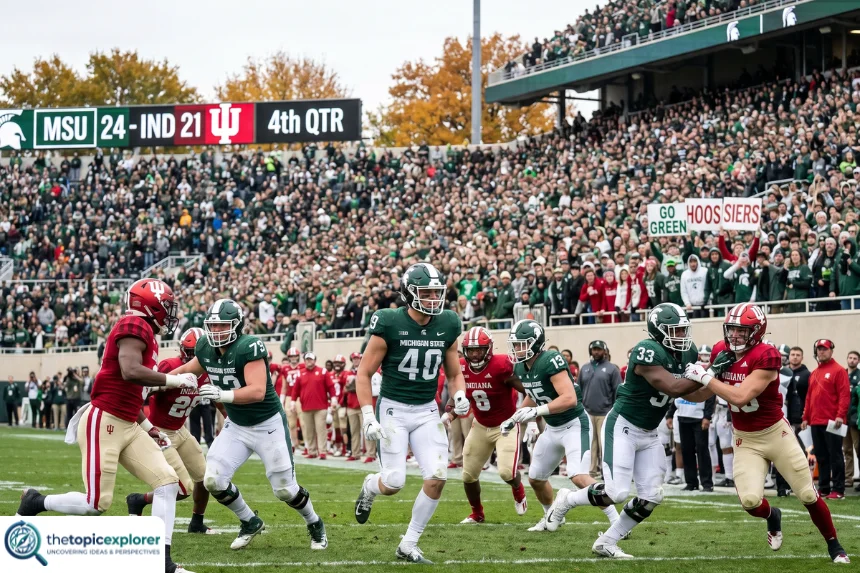

The Michigan State Spartans football vs Indiana Hoosiers football match player stats show a commanding 38-13 Indiana victory on October 18, 2025. Quarterback Fernando Mendoza led the No. 3 Hoosiers by completing 24 of 28 passes for 332 yards, four touchdowns and no interceptions.
Michigan State quarterback Aidan Chiles completed 27 of 33 passes for 243 yards and one touchdown. In addition, he led the Spartans with 48 net rushing yards. However, Indiana scored touchdowns on its first five possessions, averaged 8.3 yards per play and never punted.
Michigan State vs Indiana Quick Answer
| Question | Answer |
|---|---|
| Who won? | Indiana defeated Michigan State |
| What was the final score? | Indiana 38, Michigan State 13 |
| When was the game? | October 18, 2025 |
| Where was it played? | Memorial Stadium in Bloomington, Indiana |
| Who led all passers? | Fernando Mendoza with 332 yards |
| Who led all rushers? | Kaelon Black with 64 yards |
| Who led all receivers? | Omar Cooper Jr. with 115 yards |
| How many touchdowns did Mendoza throw? | Four |
| Did either team commit a turnover? | No |
| What trophy did Indiana retain? | The Old Brass Spittoon |
Game Information
| Game detail | Information |
|---|---|
| Matchup | Michigan State Spartans at Indiana Hoosiers |
| Date | October 18, 2025 |
| Final score | Indiana 38, Michigan State 13 |
| Halftime score | Indiana 21, Michigan State 10 |
| Venue | Memorial Stadium |
| City | Bloomington, Indiana |
| Attendance | 55,165 |
| Kickoff | 3:36 p.m. ET |
| Duration | 3 hours, 22 minutes |
| Indiana record after game | 7-0 overall, 4-0 Big Ten |
| Michigan State record after game | 3-4 overall, 0-4 Big Ten |
| Rivalry trophy | Old Brass Spittoon |
Readers can check the official Indiana box score for the complete play-by-play, drive chart and participation report.
Final Score by Quarter
| Team | First | Second | Third | Fourth | Final |
|---|---|---|---|---|---|
| Michigan State | 3 | 7 | 0 | 3 | 13 |
| Indiana | 7 | 14 | 14 | 3 | 38 |
Michigan State opened the scoring with a field goal. Later, the Spartans took a 10-7 lead on Aidan Chiles’ touchdown pass to Nick Marsh.
However, Indiana answered with 31 consecutive points. The Hoosiers led 21-10 at halftime, added two third-quarter touchdowns and eventually moved ahead 38-10.
Michigan State scored the final points on a 34-yard field goal with 33 seconds remaining. Therefore, the 38-13 final accurately reflects Indiana’s control after the middle of the second quarter.
Michigan State vs Indiana Passing Stats
| Player | Team | Completions-Attempts | Yards | TD | INT | Long | Sacks |
|---|---|---|---|---|---|---|---|
| Fernando Mendoza | Indiana | 24-28 | 332 | 4 | 0 | 48 | 0 |
| Aidan Chiles | Michigan State | 27-33 | 243 | 1 | 0 | 23 | 3 |
| Alessio Milivojevic | Michigan State | 3-5 | 50 | 0 | 0 | 22 | 1 |
Fernando Mendoza’s Performance
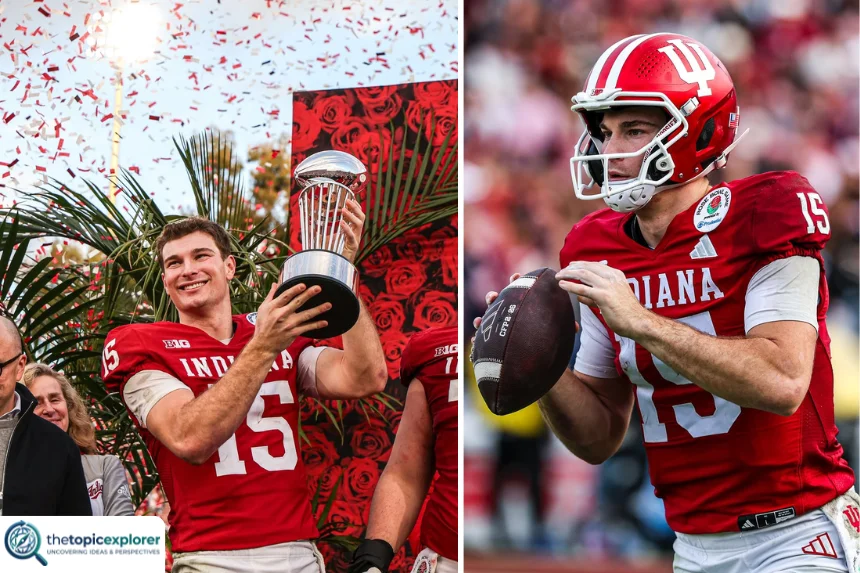
Mendoza delivered the game’s best individual performance. He completed 85.7% of his passes and averaged 11.9 yards per attempt.
Moreover, each of his four touchdown passes went to one of three receivers. He connected with E.J. Williams Jr. from 13 yards, Elijah Sarratt from 24 and 27 yards, and Omar Cooper Jr. from 48 yards.
Mendoza did not throw an interception or take a sack. Consequently, Indiana consistently stayed ahead of the chains and generated 15 passing first downs.
His 332 yards marked his first 300-yard passing game for Indiana. According to Indiana’s postgame notes, the 85.7% completion rate tied a program single-game record among qualifying performances with at least 20 attempts.
Aidan Chiles’ Performance
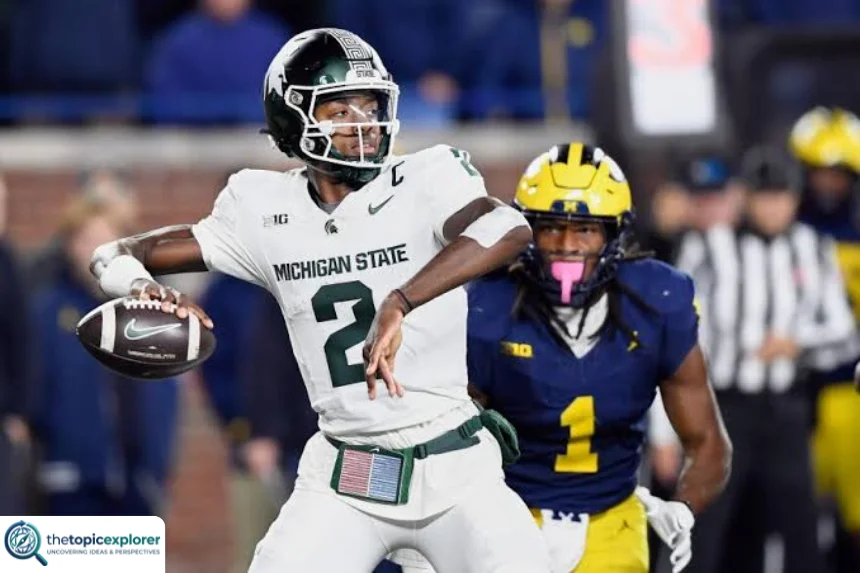
Chiles also completed passes efficiently. His 27-of-33 line produced an 81.8% completion rate, 243 yards, one touchdown and no interceptions.
At one point, he completed 20 consecutive passes. Michigan State’s official game recap identifies that run as a school record and the second-longest completion streak in a Big Ten game at the time.
Nevertheless, the short passing game did not create enough explosive gains. Chiles’ longest completion covered 23 yards, while Mendoza completed passes of 48 and 39 yards.
Indiana also sacked Chiles three times. Backup quarterback Alessio Milivojevic took another sack while completing three passes for 50 yards.
Michigan State Rushing Stats
| Player | Carries | Net yards | TD | Long | Average |
|---|---|---|---|---|---|
| Aidan Chiles | 8 | 48 | 0 | 64 | 6.0 |
| Elijah Tau-Tolliver | 5 | 13 | 0 | 9 | 2.6 |
| Alessio Milivojevic | 2 | 9 | 0 | 11 | 4.5 |
| Brandon Tullis | 2 | 3 | 0 | 5 | 1.5 |
| Makhi Frazier | 7 | 1 | 0 | 3 | 0.1 |
| Team total | 24 | 74 | 0 | 64 | 3.1 |
Chiles led Michigan State with 48 net yards, largely because of a career-long 64-yard run in the fourth quarter. However, college football statistics subtract sack yardage from rushing totals.
Therefore, his 64-yard gain and 48 net yards can both be correct. He gained 78 yards on rushing plays before 30 lost yards reduced his official net total.
Michigan State’s running backs struggled to create room. In particular, Frazier finished with one net yard on seven carries. As a result, the Spartans could not balance their efficient short passing with a dependable conventional rushing attack.
Indiana Rushing Stats
| Player | Carries | Net yards | TD | Long | Average |
|---|---|---|---|---|---|
| Kaelon Black | 10 | 64 | 1 | 29 | 6.4 |
| Khobie Martin | 6 | 40 | 0 | 22 | 6.7 |
| Fernando Mendoza | 5 | 18 | 0 | 8 | 3.6 |
| Roman Hemby | 6 | 11 | 0 | 9 | 1.8 |
| Team | 1 | -1 | 0 | 0 | -1.0 |
| Team total | 28 | 132 | 1 | 29 | 4.7 |
Black led all rushers with 64 yards on 10 carries. Most importantly, his 29-yard touchdown gave Indiana a 21-10 lead with 59 seconds left before halftime.
Meanwhile, Martin gained 40 yards at 6.7 per attempt. The Hoosiers did not rely on one high-volume runner, but they produced enough rushing efficiency to complement Mendoza’s passing.
Indiana also avoided sacks, so its rushing total did not suffer the same quarterback-loss deductions as Michigan State’s figure.
Michigan State Receiving Stats
| Player | Receptions | Yards | TD | Long |
|---|---|---|---|---|
| Nick Marsh | 7 | 64 | 1 | 16 |
| Omari Kelly | 3 | 59 | 0 | 23 |
| Chrishon McCray | 4 | 42 | 0 | 13 |
| Evan Boyd | 2 | 40 | 0 | 22 |
| Elijah Tau-Tolliver | 3 | 30 | 0 | 18 |
| Makhi Frazier | 4 | 16 | 0 | 9 |
| Jack Velling | 4 | 16 | 0 | 9 |
| Brandon Tullis | 1 | 10 | 0 | 10 |
| Bryson Williams | 1 | 8 | 0 | 8 |
| Michael Masunas | 1 | 8 | 0 | 8 |
Marsh led Michigan State with seven catches and 64 yards. In addition, he caught a 15-yard slant from Chiles for the Spartans’ only touchdown.
Kelly nearly matched Marsh’s yardage on only three receptions. However, no Michigan State player reached 65 receiving yards, and the team recorded only one passing play longer than 22 yards.
The Spartans spread 30 completions among 10 receivers. Nevertheless, the distribution did not produce the same scoring threat as Indiana’s more explosive passing game.
Indiana Receiving Stats
| Player | Receptions | Yards | TD | Long |
|---|---|---|---|---|
| Omar Cooper Jr. | 8 | 115 | 1 | 48 |
| Elijah Sarratt | 4 | 70 | 2 | 27 |
| E.J. Williams Jr. | 5 | 59 | 1 | 19 |
| Riley Nowakowski | 3 | 54 | 0 | 39 |
| Roman Hemby | 2 | 19 | 0 | 21 |
| Jonathan Brady | 2 | 15 | 0 | 16 |
Cooper led all receivers with eight catches for 115 yards. His 48-yard touchdown opened the second half and stretched Indiana’s advantage to 28-10.
Sarratt delivered the most scoring value. Specifically, he caught touchdown passes of 24 and 27 yards while finishing with 70 receiving yards.
Williams scored Indiana’s first touchdown and added 59 yards. Meanwhile, Nowakowski produced 54 yards on three receptions, including a 39-yard gain.
As a result, Indiana had four players with at least 54 receiving yards. Michigan State could not concentrate its coverage on one target without exposing another matchup.
Defensive Player Stats
Indiana Defensive Leaders
| Player | Solo | Assists | Total tackles | TFL | Sacks |
|---|---|---|---|---|---|
| Louis Moore | 6 | 5 | 11 | 0.5 | 0 |
| Aiden Fisher | 3 | 6 | 9 | 1.5 | 0 |
| D’Angelo Ponds | 5 | 4 | 9 | 0.5 | 0 |
| Rolijah Hardy | 5 | 3 | 8 | 2.5 | 2.0 |
| Stephen Daley | 3 | 0 | 3 | 2.0 | 2.0 |
Moore led the game with 11 total tackles. Fisher and Ponds followed with nine each.
However, Hardy and Daley made the biggest backfield impact. Each defender recorded two sacks, while Hardy added 2.5 tackles for loss.
Overall, Indiana finished with nine tackles for loss and four sacks. Therefore, Michigan State frequently lost the benefit of its high completion percentage through negative plays.
Michigan State Defensive Leaders
| Player | Solo | Assists | Total tackles | TFL | Sacks |
|---|---|---|---|---|---|
| Malcolm Bell | 5 | 2 | 7 | 0 | 0 |
| Jordan Hall | 1 | 5 | 6 | 0 | 0 |
| Armorion Smith | 5 | 1 | 6 | 1.0 | 0 |
| Alex VanSumeren | 1 | 5 | 6 | 0 | 0 |
| Wayne Matthews III | 0 | 5 | 5 | 0 | 0 |
Bell led the Spartans with seven tackles. Smith contributed one of Michigan State’s three tackles for loss.
Still, the Spartans did not sack Mendoza. That clean pocket allowed Indiana’s quarterback to wait for downfield routes and average nearly 14 yards per completion.
Neither defense forced a turnover. Consequently, the difference came from down-to-down execution rather than takeaways.
Kicking and Punting Stats
| Player | Team | Field goals | Extra points | Long field goal |
|---|---|---|---|---|
| Martin Connington | Michigan State | 2-3 | 1-1 | 38 |
| Nicolas Radicic | Indiana | 1-1 | 5-5 | 31 |
Connington made field goals from 38 and 34 yards. However, he missed a 50-yard attempt in difficult conditions during the third quarter.
Radicic converted all five extra points and made a 31-yard field goal. Therefore, Indiana did not leave any available kicking points on the field.
Michigan State punted twice for 90 yards. Ryan Eckley produced a 50-yard punt, while Chiles added a 40-yard punt. Indiana, by contrast, did not punt once.
Complete Team Stats Comparison
| Category | Michigan State | Indiana |
|---|---|---|
| First downs | 19 | 24 |
| Rushing first downs | 6 | 8 |
| Passing first downs | 13 | 15 |
| Total offense | 367 yards | 464 yards |
| Offensive plays | 62 | 56 |
| Yards per play | 5.9 | 8.3 |
| Rushing | 24-74 | 28-132 |
| Yards per rush | 3.1 | 4.7 |
| Passing | 30-38 | 24-28 |
| Passing yards | 293 | 332 |
| Passing touchdowns | 1 | 4 |
| Interceptions thrown | 0 | 0 |
| Sacks allowed | 4 | 0 |
| Third downs | 5-14 | 5-8 |
| Fourth downs | 3-4 | 1-2 |
| Penalties | 6-46 | 1-5 |
| Punts | 2 | 0 |
| Turnovers | 0 | 0 |
| Time of possession | 31:14 | 28:46 |
The official Big Ten final statistics show that Michigan State ran six more plays and possessed the ball for 2:28 longer. Nevertheless, Indiana gained 97 more total yards.
The key number was yards per play. Indiana averaged 8.3, while Michigan State averaged 5.9. Therefore, the Hoosiers needed fewer snaps to create scoring opportunities.
Indiana also converted five of eight third downs, a 62.5% success rate. Michigan State converted five of 14, or 35.7%.
Full Scoring Summary
| Quarter | Time | Scoring play | Score afterward |
|---|---|---|---|
| First | 8:07 | Martin Connington 38-yard field goal | MSU 3-0 |
| First | 2:40 | E.J. Williams Jr. 13-yard TD catch from Fernando Mendoza | Indiana 7-3 |
| Second | 9:22 | Nick Marsh 15-yard TD catch from Aidan Chiles | MSU 10-7 |
| Second | 6:47 | Elijah Sarratt 24-yard TD catch from Mendoza | Indiana 14-10 |
| Second | 0:59 | Kaelon Black 29-yard TD run | Indiana 21-10 |
| Third | 13:09 | Omar Cooper Jr. 48-yard TD catch from Mendoza | Indiana 28-10 |
| Third | 3:55 | Sarratt 27-yard TD catch from Mendoza | Indiana 35-10 |
| Fourth | 1:56 | Nicolas Radicic 31-yard field goal | Indiana 38-10 |
| Fourth | 0:33 | Connington 34-yard field goal | Indiana 38-13 |
The NCAA scoring summary also records all nine scoring plays.
How the Game Changed
Michigan State’s opening two drives lasted 6:53 and 8:18. As a result, the Spartans controlled the clock and led 10-7 early in the second quarter.
Indiana responded immediately. Mendoza moved the offense 75 yards in five plays and found Sarratt for a touchdown. Later, Black’s 29-yard run completed an 80-yard drive and produced a 21-10 halftime advantage.
A 30-minute severe-weather delay extended halftime. Nevertheless, Indiana remained sharp when play resumed.
The Hoosiers covered 75 yards in four plays on their first second-half possession. Mendoza’s 48-yard touchdown pass to Cooper took only 1:51 off the clock.
Michigan State then missed a 50-yard field goal. Indiana answered with another touchdown drive, pushing the score to 35-10. At that point, the Spartans needed four scores and could no longer rely on their time-consuming offensive approach.
Why Indiana Won 38-13
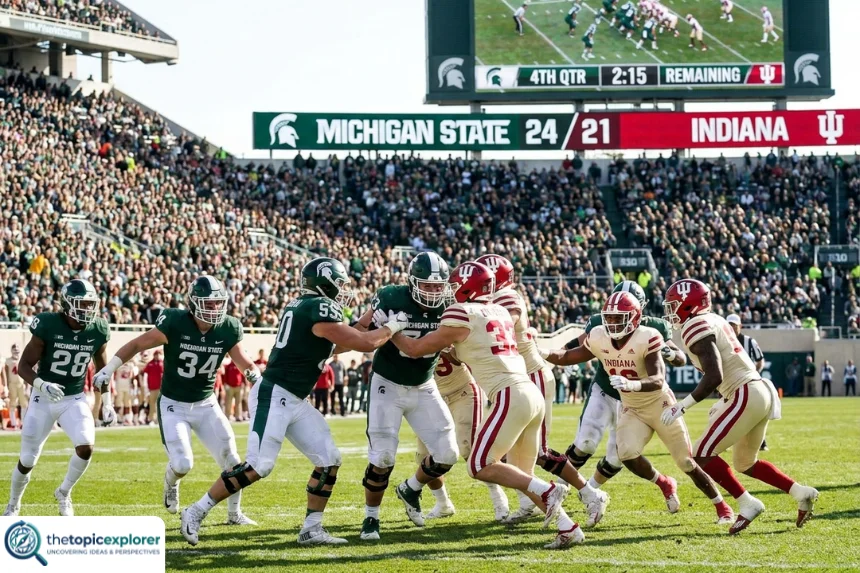
Indiana won because it combined accuracy, explosive plays and disciplined football.
First, Mendoza completed 24 of 28 attempts without a sack or interception. Second, Indiana produced six offensive gains of at least 22 yards. Third, the Hoosiers scored touchdowns on their first five possessions.
Furthermore, Indiana committed only one penalty for five yards. The defense added four sacks and nine tackles for loss.
Michigan State did several things well. Chiles completed more than 80% of his passes, the offense did not commit a turnover and the Spartans converted three fourth downs.
However, those positives produced only one touchdown. Michigan State averaged 3.1 yards per rush, allowed four sacks and scored three points after taking its 10-7 lead.
Ultimately, Indiana turned 56 plays into 464 yards and five touchdowns. Michigan State needed 62 plays to gain 367 yards and scored only once in the end zone.
Old Brass Spittoon Rivalry Context
The teams play for the Old Brass Spittoon, one of the Big Ten’s traditional rivalry trophies.
Michigan State and Indiana first met in 1922. However, the trophy tradition began in 1950.
Indiana’s victory allowed the Hoosiers to retain the Spittoon after also winning the 2024 matchup. Moreover, it gave Indiana consecutive victories in the rivalry for the first time since its three-game run from 1967 through 1969.
After the 2025 result, Indiana’s official notes listed the Hoosiers at 20-50-2 in the series. Michigan State still held the historical advantage, but Indiana had won four of the six meetings from 2020 through 2025.
Best Players in the Match
Fernando Mendoza, Indiana
Mendoza was the clear player of the game. His 332 yards, four touchdowns, 85.7% completion rate and zero turnovers drove Indiana’s 38-point performance.
Omar Cooper Jr., Indiana
Cooper led all receivers with 115 yards. In addition, his 48-yard touchdown immediately restored Indiana’s momentum after halftime.
Elijah Sarratt, Indiana
Sarratt caught four passes for 70 yards and two touchdowns. Therefore, half of Mendoza’s touchdown passes went to him.
Rolijah Hardy and Stephen Daley, Indiana
Hardy and Daley recorded two sacks each. Their pressure helped limit Michigan State to 13 points despite Chiles’ accuracy.
Aidan Chiles, Michigan State
Chiles produced 243 passing yards, 48 net rushing yards and one touchdown. Moreover, his 20 consecutive completions set a school record, even though the Spartans could not convert enough drives into points.
Nick Marsh, Michigan State
Marsh led the Spartans with seven catches and 64 yards. He also scored their only touchdown.
Frequently Asked Questions
1. Who won the Michigan State vs Indiana football game?
Indiana won 38-13 on October 18, 2025. Consequently, the Hoosiers improved to 7-0 overall and 4-0 in Big Ten play.
2. What were Fernando Mendoza’s stats against Michigan State?
Mendoza completed 24 of 28 passes for 332 yards and four touchdowns. Moreover, he threw no interceptions and took no sacks.
3. What were Aidan Chiles’ stats against Indiana?
Chiles completed 27 of 33 passes for 243 yards, one touchdown and no interceptions. In addition, he led Michigan State with 48 net rushing yards.
4. Who was the leading rusher in the game?
Indiana’s Kaelon Black led all players with 64 rushing yards on 10 carries. Furthermore, he scored on a 29-yard run before halftime.
5. Who had the most receiving yards?
Omar Cooper Jr. led the game with eight receptions for 115 yards. His performance also included a 48-yard touchdown.
6. Which player scored the most touchdowns?
Fernando Mendoza accounted for four passing touchdowns. Among receivers, Elijah Sarratt led the game with two touchdown catches.
7. Did Michigan State or Indiana commit a turnover?
No. Neither team threw an interception or lost a fumble. Therefore, turnovers did not determine the result.
8. How many total yards did each team gain?
Indiana gained 464 total yards, while Michigan State recorded 367. However, Indiana ran six fewer offensive plays.
9. What is the Old Brass Spittoon?
The Old Brass Spittoon is the rivalry trophy awarded to the winner of the Michigan State-Indiana football game. Indiana retained it with the 2025 victory.
10. Where was the 2025 Michigan State vs Indiana game played?
The game took place at Memorial Stadium in Bloomington, Indiana. In addition, the announced attendance was 55,165.
Conclusion
The Michigan State Spartans football vs Indiana Hoosiers football match player stats reveal why Indiana won 38-13. Fernando Mendoza completed 24 of 28 passes for 332 yards and four touchdowns, while Omar Cooper Jr. led all receivers with 115 yards.
Michigan State received an accurate performance from Aidan Chiles, who threw for 243 yards and completed a school-record 20 consecutive passes. However, the Spartans produced only one touchdown and allowed four sacks.
Meanwhile, Indiana scored touchdowns on its first five possessions, averaged 8.3 yards per play and never punted. Therefore, the Hoosiers overcame Michigan State’s possession advantage through superior efficiency and explosive plays.
